
Porch Group Advances Integrated Home Services Model with Reciprocal Insurance Management
Porch Group’s Q2 2026 results show progress in its insurance reciprocal operation and data-driven home services platform.
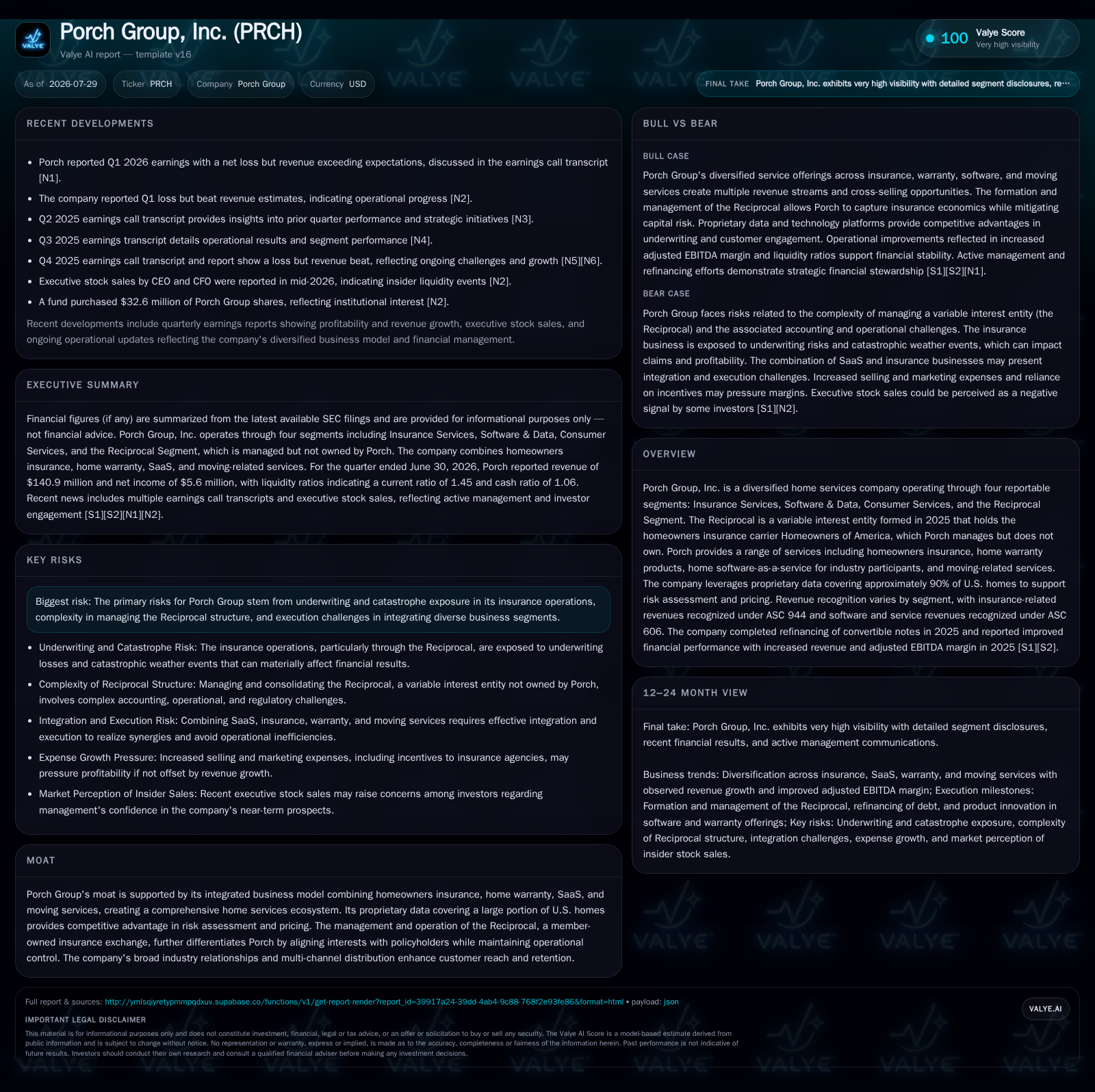
Porch Group reported continued integration of its multi-segment home services business, anchored by the management of a newly formed reciprocal insurance exchange launched in 2025. The company leverages proprietary home data across its Insurance Services, Software & Data, and Consumer Services segments to enhance risk assessment, pricing, and customer engagement. While the innovative reciprocal insurance model aligns interests with policyholders, underwriting risks and capital intensity remain key considerations. Liquidity and refinancing efforts have stabilized the balance sheet, supporting growth investments in SaaS and home-related consumer products.
Recent Operating Update
Porch Group’s second quarter ended June 30, 2026 filing marked significant progress in consolidating its integrated home services platform centered on the management of a reciprocal insurance exchange launched at the start of 2025 [S2],[S3]. This Reciprocal Segment is a variable interest entity that Porch operates as primary beneficiary but does not own outright; it holds the homeowners insurance carrier Homeowners of America (HOA) [S1]. Management fees derived from homeowner policies written through this model contributed meaningfully to quarterly revenue streams.
The Q2 filing emphasized an increase in gross written premium (GWP) under the Reciprocal, supported by enhanced risk assessment capabilities using proprietary data covering about 90% of U.S. residential properties [S1]. Revenue recognition varies by segment—insurance-related fees follow ASC 944 guidance whereas Software & Data subscription income is recognized under ASC 606—reflecting distinct monetization mechanics within Porch’s hybrid model
Business Model Overview
Porch Group operates an integrated business model combining four reportable segments: Insurance Services (focused on homeowners insurance), Software & Data (home industry SaaS), Consumer Services (warranty and moving services), and the Reciprocal Segment (insurance carrier managed via VIE structure) [S1].
Revenue drivers differ markedly across these areas:
Insurance Services earns management fees linked to policy volumes produced by the Reciprocal plus commissions from lead generation for third-party agencies, policy fees charged directly to homeowners, reinsurance ceding commissions enhancing capital efficiency, and interest income from surplus notes extended to the Reciprocal [S11]. This creates a multifaceted revenue stream influenced by gross written premium growth, policy retention rates, claims experience affecting loss ratios, and reinsurance cost structures.
Software & Data generates mostly subscription-based revenues from SaaS offerings used by real estate agents, contractors, and other home industry participants. The segment benefits from recurring revenues weighted by average revenue per user (ARPU) expansions while controlling customer acquisition costs through focused marketing [S17]. Operational efficiency gains have improved Adjusted EBITDA margins to about 20% on annual basis
Consumer Services includes home warranty products with extended coverage durations (impacting revenue recognition timing) and moving-related ancillary services targeting homeowners during transition phases [S17]. Profitability lifted due to fewer warranty claims alongside a strategic emphasis on higher-margin moving services despite softening revenue trends
Reciprocal Segment, formed in early 2025 as a member-owned but managed entity via Porch’s operational control under VIE accounting rules, introduces structural alignment of incentives between policyholders and management. The Reciprocal pays claims directly while Porch receives fees for operations management without ownership equity exposure. This reduces direct underwriting risk but requires sophisticated coordination of reinsurance programs—excess-of-loss catastrophe coverage begins at $25 million per event up to $410 million—as well as regulatory compliance oversight typical for insurance carriers [S1],[S8].
This business model blends traditional insurance underwriting economics—gross written premiums less claims/loss adjustment expenses—with technology-driven recurring revenues from SaaS subscriptions and fee-for-service revenues in consumer home services. The broad ecosystem approach aims to cross-sell products effectively while leveraging proprietary data assets for superior risk segmentation.
Industry Structure and Competitive Position
Porch sits at the confluence of homeowners insurance underwriting, technology-enabled SaaS solutions for real estate professionals, home warranty providers, and consumer moving service marketplaces—an uncommon cross-industry profile blending multiple value chain roles. Key peer categories include tech-forward insurers like Lemonade or Hippo that focus purely on homeowner policies; traditional warranty providers such as American Home Shield; SaaS-centric platforms resembling Zillow or Next Insurance; and specialized reinsurance firms managing catastrophe exposure.
Porch’s moat derives largely from three pillars: its extensive proprietary data set spanning roughly 90% of U.S. homes which enhances predictive risk analytics; its novel reciprocal insurance structure that aligns policyholder interests with operational control; and its multi-channel distribution including direct-to-consumer offers combined with partnerships tapping industry participants via SaaS channels [S1]. This integrated approach differentiates Porch from narrowly focused pure-play insurtechs or standalone software firms.
Remaining challenges include maintaining attractive underwriting economics given inherent catastrophe risk exposure common in homeowners insurance markets—where weather-driven losses can be volatile—and ensuring effective platform adoption alongside sustained customer retention across diverse product lines.
Growth Drivers
Several vectors underpin Porch’s growth prospects:
- Expansion of Gross Written Premiums through scaling the Reciprocal’s policy base is critical since it fuels correlated revenue lines including policy fees and management commissions.
- Increasing SaaS adoption among home service industry actors broadens recurring revenue inflows with scalable unit economics benefiting from low marginal delivery costs.
- Cross-selling synergies allow Porch to bundle home warranty products or moving services with homeowner insurance offerings tapping existing relationships.
- Improved Risk Modeling powered by proprietary data allows more precise pricing yielding better loss ratios over time which supports margin expansion.
- Regulatory Tailwinds may favor alternative models like reciprocals which align stakeholders compared to traditional carriers.
- Geographic market penetration remains an opportunity given concentration in certain states such as Texas accounting for over half consolidated revenues currently [S23]
KPIs to monitor include renewal/retention rates for both policies and software subscriptions, claims frequency/severity influencing loss ratios within the Reciprocal book, average revenue per user growth in SaaS offerings, customer acquisition cost trends reflecting marketing effectiveness, and surplus contributions helping capital adequacy.
Risks and Constraints
Key risks encompass:
- Underwriting Risk: Catastrophe events can cause sharp spikes in claim severity leading to unfavorable loss ratios impacting profitability despite reinsurance programs.
- Operational Complexity: Managing a variable interest entity like the Reciprocal introduces governance challenges plus potential regulatory scrutiny unique to mutual or reciprocal insurers.
- Capital Intensity: Maintaining sufficient surplus levels per regulatory requirements requires ongoing capital access amid elevated outstanding convertible notes totaling about $475 million as of mid-2026 [F1], imposing leverage constraints.
- Integration Challenges: Cohesively running diverse segments ranging from tech platforms through moving services demands nimble execution capabilities.
- Market Competition: Pressure from both established insurers adopting tech innovations as well as emerging insurtech startups could constrain pricing power.
- Customer Churn: Subscription services require stable retention mechanics; any deterioration may necessitate increased spending on customer acquisition raising CAC.
- Regulatory Restrictions: Dividend distribution limitations applicable to regulated subsidiaries may restrict funds flow within corporate structures affecting liquidity flexibility [S1],[S5].
Monitoring claims loss ratios especially post-catastrophe seasons alongside reinsurance cost trends will provide early indicators whether underwriting discipline is holding firm. Similarly tracking net promoter scores or churn rates across SaaS clients serves as bellwethers for sustainable demand.
What To Watch Next
Investors should observe upcoming quarterly reports for:
- Increases or pressures in gross written premium volumes within the Reciprocal Segment signaling market penetration momentum;
- Adjusted EBITDA margins performance particularly within Insurance Services where fee-based profitability levers exist;
- Customer retention statistics including renewal rates both for homeowners insurance policies and SaaS subscribers revealing demand durability;
- Progress on ancillary Consumer Services products where higher-margin warranties or moving offerings could offset slower revenue growth;
- Capital raising activities or debt repurchases given ongoing convertible note maturities scheduled through 2030 impacting financial flexibility;
- Potential early adoption effects or impact of new accounting standards relating to VIE consolidation expected post-Q1 2027 [S18];
- Regulatory developments affecting mutual/reciprocal insurer frameworks which could influence strategic options.
Financial Profile Discussion
As of June 30, 2026, Porch held approximately $64 million in cash and equivalents against total debt close to $475 million yielding net debt near $411 million with a current ratio standing at about 1.45 indicating reasonable near-term liquidity coverage albeit under moderate leverage pressure typical for an expanding insurer-tech hybrid [F1]
The company undertook significant refinancing actions during 2025 replacing near-term convertible maturities due in September with longer-dated debt bearing higher coupons but easing imminent repayment risk—a move aimed at supporting sustained investment into growth initiatives across software development and consumer service expansion [S8],[S14],[S25].
Reported operating income was positive at nearly $37 million for full-year 2025 after prior losses reflecting structural benefits from the shift away from direct carrier underwriting towards fee-based management income linked to the Reciprocal’s premiums plus improved cost control initiatives especially within Software & Data segment driving margin enhancement [F1],[S11],[S12],[S17].
While net losses attributable to Porch remain due primarily to earnings swings at the consolidated level partially offset by net income generated inside the Reciprocal entity itself—signaling a complex accounting interplay—the company is trending toward enhanced cash flow conversion through disciplined spending balanced against targeted organic growth investment.
Overall financial strategy appears focused on balancing capital intensity typical for regulated insurance businesses with scaled technology platform economics offering higher margin potential over time—a blend demanding vigilant cash flow management but offering diversification benefits versus pure-play insurtech peers.
This analysis is based solely on publicly available filings dated through July 29, 2026. It seeks to provide an informed perspective on Porch Group’s integrated home services operating model incorporating distinctive reciprocal insurance management amid growing SaaS adoption while highlighting key drivers and risks without offering investment advice.
Disclaimer: This is research-only, informational analysis and not investment advice. It may include AI-generated interpretation and general industry context. Always verify important details using primary sources.

Comments