
Subscription Resilience and Retail Expansion Define Bark, Inc.'s Strategic Reset
Bark, Inc. focuses on managing supply chain challenges and enhancing customer loyalty through innovation while balancing direct subscriptions and retail partnerships amidst profitability pressures.
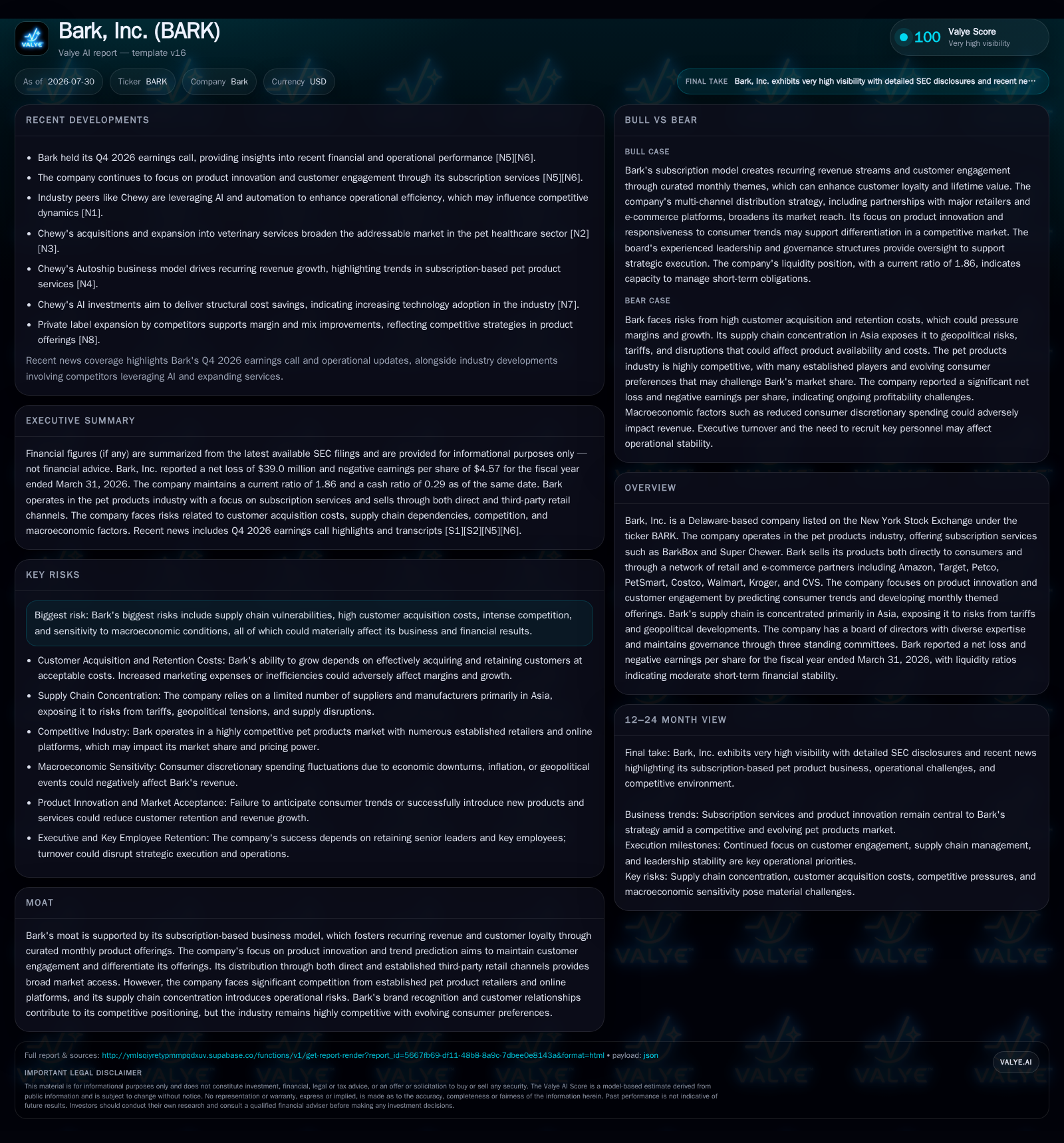
In its latest filings, Bark, Inc. reported persistent operating losses but maintains moderate liquidity and a current ratio near 1.9, amid strategic initiatives to deepen customer engagement and expand retail distribution. The company’s dual revenue streams—subscription boxes directly sold to consumers and retail channel sales—create a complex margin profile influenced by fulfillment costs and tariff exposure concentrated in Asia. Product innovation remains central to driving subscription retention and reducing churn against a competitive landscape including omnichannel retailers and e-commerce giants. Recent leadership changes and a $40 million authorized share repurchase program underscore management’s intent to stabilize the financial profile and support growth.
Latest Quarterly Results Highlight Persistent Margin and Cash Flow Challenges
The continuing net losses underscore the structural difficulties of scaling a subscription-based pet products business amid rising fulfillment costs and supply chain complexities common in this sector.
Dual Revenue Stream Dynamics: Subscription Boxes Versus Retail Partnership Performance
Bark's monetization model centers on a curated subscription offering—primarily BarkBox and Super Chewer—that delivers themed monthly selections of toys, treats, and accessories directly to consumers on a recurring basis [S1]. This subscription model creates monthly recurring revenue (MRR) streams where customer acquisition cost (CAC), churn rate, and lifetime value (LTV) are critical KPIs affecting profitability.
Complementing DTC sales, Bark has developed expansive retail partnerships with major omni-players such as Amazon, Target, Petco, PetSmart, Costco, Walmart, Kroger, and CVS [S1], broadening product accessibility beyond the subscription segment. However, these retail channels generally feature lower margin profiles due to wholesale pricing structures and higher fulfillment complexities.
This dual-channel approach allows Bark to scale brand reach significantly while balancing an average order value (AOV) that varies across segments. Peer companies like Chewy emphasize integrated e-commerce with embedded subscription options for premium margin capture; Bark's more balanced reliance on retail partners introduces operational complexity but supports diversified volume growth [N1][N4]
Supply Chain Vulnerabilities Under Tariff Pressures Affect Fulfillment Economics
A notable operational risk arises from Bark’s product sourcing heavily concentrated in Asia where tariffs impose incremental costs elevating fulfillment expenses [S2][S6]. The company disclosed ongoing exposure to trade barriers linked to geopolitical uncertainties that may adversely impact gross margins if additional duties or logistical constraints arise.
Supply chain disruptions or cost escalations driven by tariffs are exacerbated by labor shortages in shipping lanes or port operations—a widespread sector-wide issue affecting many import-dependent retailers in consumer goods verticals. Bark's maintaining affordable pricing while absorbing or passing through these costs will be pivotal for preserving both subscription renewal rates and retail sales competitiveness.
Contingency initiatives such as tariff refunds under emergency powers legislation indicate active management response but further operational risks remain contingent on evolving global trade policies [S6].
Product Innovation Fuels Customer Engagement but Requires Careful CAC Management
Bark leverages product innovation as a cornerstone of its moat by continuously curating monthly themed boxes designed to reflect emerging consumer trends in pet ownership preferences [S1]. This innovation strategy serves dual purposes: retaining existing customers through engaging fresh content thus lowering subscription churn rates; and enhancing brand differentiation in an otherwise commoditized market segment.
However, the company acknowledges high CAC remains a significant challenge alongside efforts to improve retention metrics [S2][S1]. Balancing promotional spending against sustainable LTV economics is critical; inefficient CAC can erode margin potential irrespective of sales growth velocity
Maintaining low churn justifies ongoing investment in content personalization and product diversity — both essential underpinnings for longer-term subscription revenue durability.
Competitive Landscape Frames Customer Retention Imperative
Bark operates within an intensely competitive pet products ecosystem populated by established omnichannel players such as Petco and PetSmart who benefit from physical store presence augmented by growing e-commerce capabilities [N3][S1]. Further intensifying competition is Amazon’s dominant position as an online marketplace offering extensive pet product assortments at competitive prices.
This environment imposes pressure on Bark’s pricing power and heightens the importance of building strong brand loyalty among consumers to retain subscriptions over time.
The subscription model hinges significantly on minimizing churn since replacement subscriber acquisition entails disproportionate marketing spends relative to incremental revenue generated. Hence Bark’s focus on product innovation to maintain engagement is critical not only for customer satisfaction but also for offsetting competitor advances.
Growth Prospects in Pet Humanization and Channel Expansion
The company benefits from well-established secular tailwinds driven by rising pet ownership rates alongside trends reflecting increased humanization of pets—including demand for premium toys, treats, novelty items combined into convenient subscription experiences that cater to emotional bonding preferences [S1].
Channel expansion via strategic partnerships with major retailers provides access to broader customer segments who prefer omnichannel purchasing patterns beyond direct online subscriptions. Furthermore, evolving offerings surrounding consumables like pet nutrition or wellness services represent adjacent opportunities for product line extensions that could leverage existing brand recognition [N4].
These growth drivers provide a foundation for sustainable top-line expansion provided supply chain resilience is maintained.
Key Risks Elevate Vigilance on Macroeconomic Sensitivity and Supply Stability
Bark explicitly flags macroeconomic variables including inflationary pressures raising input costs; reduced consumer discretionary spending impacting pet product purchases; technology platform uptime risks; along with supplier retention concerns potentially constraining inventory availability [S2]
Tariff volatility remains a pronounced uncertainty given sourcing concentration impacts cost structures directly influencing pricing decisions.
Inventory management must be vigilantly executed to avoid excess stock that burdens working capital or shortages that undermine sales commitments.
Elevated CAC relative to LTV ratios could further stress profitability if retention improvements stall.
What to Monitor Next: Churn Metrics, Retail Channel Penetration, New CFO Impact
Stakeholders should closely watch upcoming quarterly disclosures detailing subscription churn trends as primary moderators of MRR sustainability post-innovation investments.
Tracking expansion depth into key retail partners will clarify progress toward broadening brand footprint beyond core subscribers—this mix shift affects gross margin across channels given differing cost-to-serve economics.
The appointment of Anya Hamill as CFO starting September 8 signals an inflection point in financial stewardship aimed at optimizing capital allocation amid continued losses [S3][S27]. Observing how the company manages balance sheet efficiency alongside executing the authorized stock repurchase program will offer insight into evolving financial discipline.
Financial Profile Discussion: Cash Liquidity Supports Strategic Flexibility Amid Losses
At fiscal Q3 end (March 31, 2026), Bark possessed roughly $19.3 million in cash & equivalents against current liabilities around $65.4 million yielding a current ratio near 1.86—enough liquidity cushion for ongoing operations though tight relative to scale of net losses posted ($39 million) [F1][S2]
While exact updated debt levels post prior note repurchases are not specified herein, earlier convertible note settlements suggest some reduction in leverage risk though total debt was estimated at $79.2 million at fiscal year-end 2022 indicating legacy obligations may persist requiring monitoring [F1]
Continued negative operating income reflects structural cost investments including marketing outlays driving high CAC plus fulfillment expenses elevated by supply chain tariffs.
This analysis synthesizes recent SEC filings alongside industry knowledge without making investment research views or incorporating unsupported projections regarding subscriber metrics or market share. It focuses on understanding Bark’s business model dynamics within prevailing sector challenges concerning supply chains, competition, customer retention economics, and financial positioning.
Disclaimer: This is research-only, informational analysis and not investment advice. It may include AI-generated interpretation and general industry context. Always verify important details using primary sources.

Comments