
Borealis Foods Faces Capital and Dilution Pressures Amid E-Commerce Growth Challenges
Borealis Foods reports modest e-commerce traction alongside significant equity financing hurdles and related-party debt conversions threatening shareholder dilution.
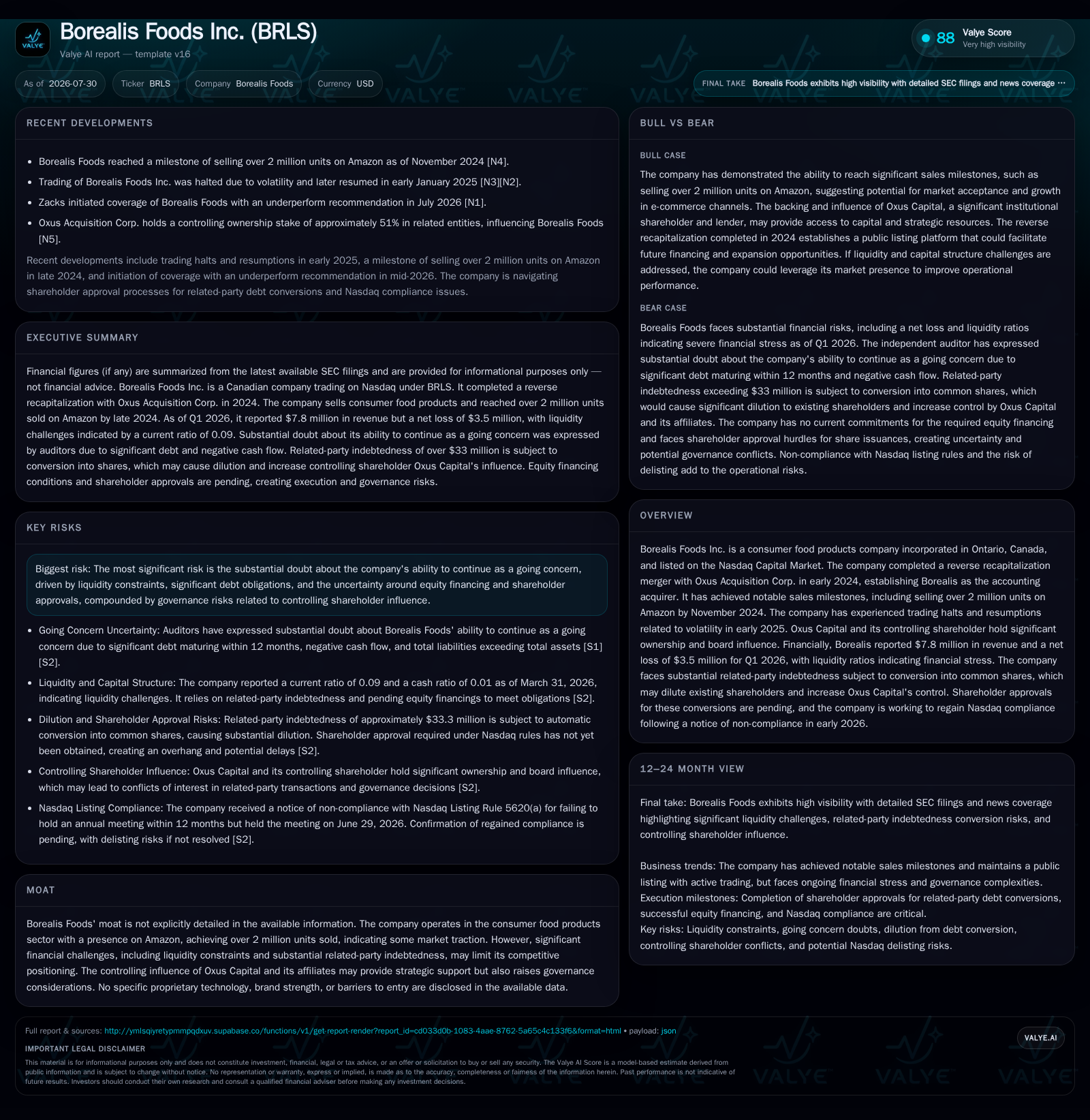
Borealis Foods Inc., an Ontario-based consumer packaged goods company, has demonstrated early sales momentum with over 2 million units sold via Amazon by late 2024, signaling some market acceptance in e-commerce channels. However, its recent quarterly filings reveal escalating liquidity pressures and an imminent automatic conversion of substantial related-party debt into common shares, likely causing significant dilution and increased control by Oxus Capital and affiliates. The company’s financial stress compounds governance concerns and cloud near-term operational scalability, despite operating in a high-potential sector characterized by multi-channel distribution and consumer demand for innovative food products.
Recent Operating Update
Borealis Foods’ latest quarterly filing for Q1 2026 reported $7.8 million in revenue with a corresponding net loss of $3.5 million [S2]. This snapshot underscores the company’s early-stage status where top-line growth is emerging but profitability remains elusive amidst investment in growth initiatives. Notably, the firm has reported selling over 2 million units on Amazon by late 2024, affirming some initial success within the direct-to-consumer (DTC) e-commerce channel—a critical growth vector in the consumer packaged goods (CPG) food sector dominated increasingly by digital sales platforms. This accomplishment suggests that Borealis’s branded food products have gained measurable retail traction online.
Business Model Overview
Borealis Foods operates as a manufacturer and marketer of branded packaged food products primarily targeting consumers through digital platforms such as Amazon alongside plans for expanding retail presence. Revenue generation depends on unit sales volumes driven by consumer demand within its portfolio of SKUs (stock keeping units), pricing strategies calibrated against competitive private labels and established brands, as well as successful channel penetration.
The strategic focus on e-commerce aligns with broader industry trends where convenience-driven consumers increasingly shop online for specialty foods. Effective execution here involves optimizing product listings for discoverability, managing inventory turnover efficiently to reduce holding costs, and investing in targeted promotional spend to grow brand equity and repeat purchase rates.
Margins at this stage remain compressed due to scale inefficiencies inherent in early commercialization phases and the necessity of absorbing supply chain costs during raw material price volatility—common challenges in CPG food manufacturing. While Borealis sources its raw materials either directly or via contract manufacturers, tight control of supply chain management will be critical to support margin improvement as volume scales.
Industry Structure and Competitive Position
The CPG food products industry is densely populated with incumbent multinational corporations such as General Mills and Kraft Heinz representing large branded peers that benefit from extensive retail shelf space and powerful distribution networks. Mid-size companies like B&G Foods or Hostess Brands similarly exert influence over niche or specialty segments.
Borealis sits at the smaller end of this spectrum, competing primarily via product differentiation intended to resonate with contemporary consumer preferences including health-and-wellness trends often dominant among online shoppers. However, absent evidence of proprietary formulations or strong brand recognition suggests limited moat protection against private label entrants or established legacy producers capable of leveraging economies of scale.
Growth within this industry depends significantly on expanding distribution reach—not only enhancing presence on e-commerce platforms but also securing retail grocery accounts which carry higher barriers to entry due to slotting fees and retailer relationships. Borealis’s ability to transition from online success toward brick-and-mortar adoption would materially affect durability of revenue streams and gross margins.
Growth Drivers
Key levers for Borealis moving forward include:
- Expansion of E-commerce Sales: Leveraging Amazon’s platform dominance while possibly diversifying to other online marketplaces can help increase unit sales volume—critical given that e-commerce accounted for its milestone sales achievement over 2 million units sold. Tracking average selling price per unit alongside promotional spend effectiveness will further clarify revenue quality.
- New Product Introduction: Continuous innovation aligned with health trends or premiumization strategies could improve product mix favorably affecting average selling prices and customer retention.
- Geographic Market Expansion: Beyond domestic Canadian markets (assumed from incorporation details), penetration into U.S. retail chains would unlock large incremental demand if successful.
- Supply Chain Optimization: Achieving cost efficiencies through supplier negotiations or contract manufacturing scale could improve gross margin percentage critical for moving toward profitability.
- Brand Building: Investing in marketing campaigns to strengthen brand equity can enhance customer acquisition while mitigating returns or churn rates in competitive environments.
Executing these drivers will require strengthening financial capacity and governance alignment to attract strategic partners or institutional investors supportive of longer development timelines common in CPG sectors.
Risks and Constraints
What to Watch Next
Investors should monitor:
- Progress toward fulfilling or renegotiating equity financing commitments—specifically if new capital inflows materialize above the $9 per share price point which might stave off dilution triggered by debt conversion agreements.
- Shareholder votes anticipated concerning approval mandates required under Nasdaq listing rules prior to executing any large-scale shares issuance from debt conversion plans [S2].
- Quarterly unit sales updates on key e-commerce platforms measuring penetration gains outside Amazon or frontline pricing resilience amid competitive discounting dynamics.
- Gross margin trends indicating success in sourcing efficiencies or product mix improvements necessary before positive operating income emerges.
- Any announcements regarding partnerships securing retail channel access or new product launches aligned with evolving consumer demands could validate growth strategy robustness.
Financial Profile Discussion
Moreover, convertible related-party loans totaling roughly $33 million fatally increase shareholder dilution prospects since conversion is contractually triggered barring equity financing success prior to July 1, 2026 [S2]. Such dilution not only depresses per-share economics but also consolidates control under Oxus Capital insiders already holding significant board influence –an arrangement that may deter external investors wary about governance transparency or minority rights protection.
From an operating standpoint, absence of positive operating income confirms ongoing investment phase without clear margin break-even visibility; achieving sustainable EBITDA margins typical among mid-tier CPG peers remains a distant prospect dependent on scaling unit volumes coupled with cost discipline initiatives typically enacted over multiyear horizons among peers like B&G Foods or TreeHouse Foods.
The analysis above synthesizes current public filings with standard industry framing relevant to small public consumer packaged goods companies facing near-term financing crossroads. It explicitly avoids unsupported claims about exact market positioning beyond verified data points while highlighting prevalent sector challenges around operational scalability amid liquidity constraints.
Disclaimer: This is research-only, informational analysis and not investment advice. It may include AI-generated interpretation and general industry context. Always verify important details using primary sources.

Comments