
Microsoft’s Cloud and AI Investment Drive Margin Shifts in FY26
Microsoft’s fiscal year 2026 results highlight the tension between scalable cloud revenue growth and rising AI infrastructure costs impacting margins.
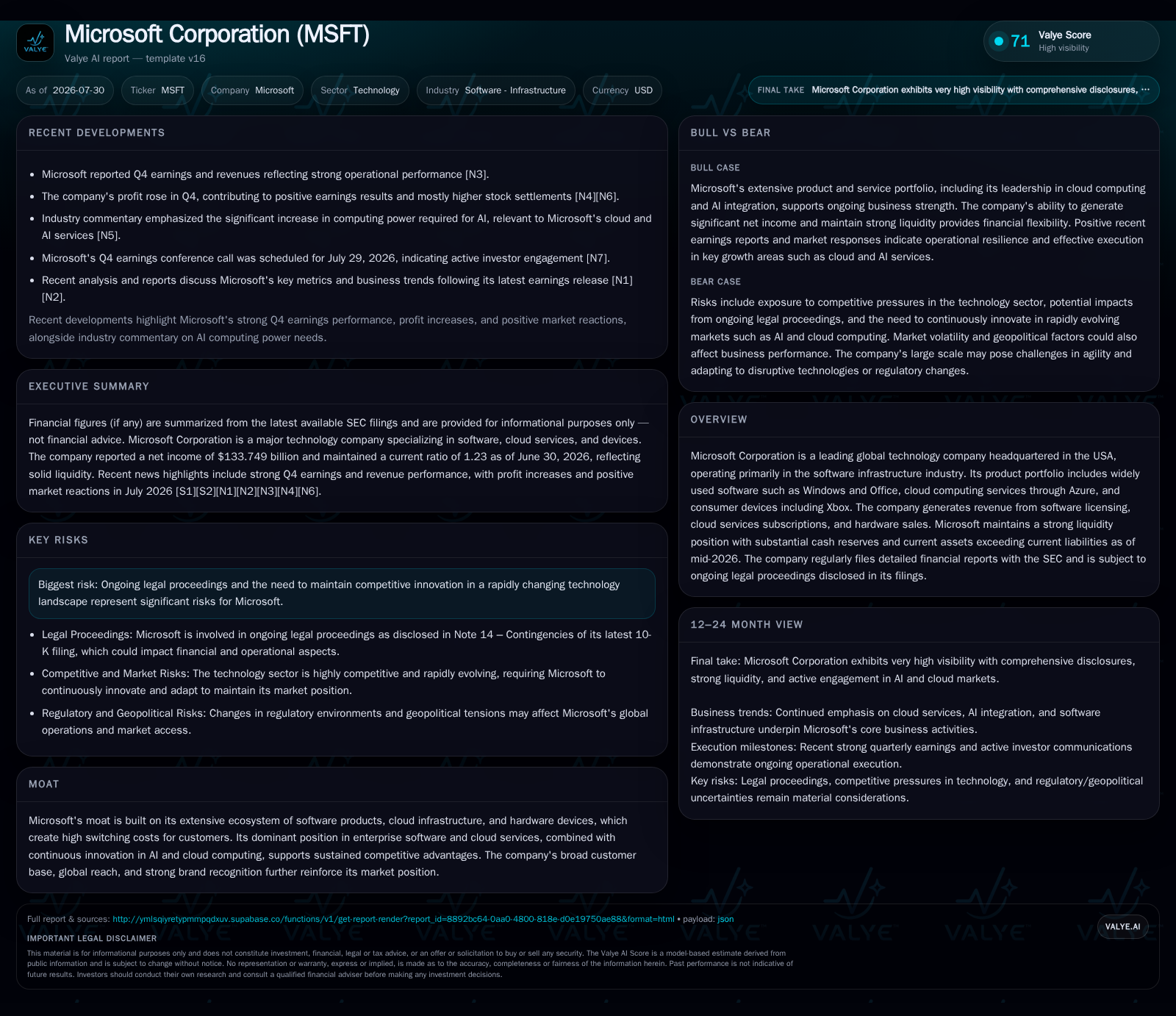
Microsoft Corporation reported strong cloud revenue growth alongside increased expenditures on AI infrastructure in its fiscal year 2026. While Azure and Microsoft 365 showed robust expansion fueling recurring revenue streams, these gains came with compressed gross margins due to capital-intensive AI compute investments. The company’s diverse revenue mix, including licensing and hardware, supports its ecosystem moat, though elevated R&D and legal risks require monitoring. Microsoft’s solid liquidity and controlled leverage position it well to sustain investments in cloud scale and AI innovation amid intensifying competition.
Q4 FY26 Operating Results Signal Margin Pressure From AI Infrastructure Investments
Microsoft's fiscal fourth quarter ending June 30, 2026 reflected a clear inflection point where rapidly expanding AI infrastructure costs exerted visible pressure on margins. The company disclosed that investments in compute capacity and AI talent resulted in operating expense increases of approximately 5% in the quarter, with significant R&D outlays focused on scaling cloud-related AI services [S3], [S4], [S5]. Cloud gross margin percentages declined slightly to around 67%, illustrating the tradeoff between expanded AI product usage — which is compute-intensive — and ongoing efficiency improvements in Azure and Microsoft 365 Commercial cloud services [S5], [S6], [S7].
These developments constitute a strategic pivot that challenges Microsoft’s historical operating leverage model. As AI workloads demand exponentially more processing power, data center capex escalates materially. This dynamic depresses near-term incremental margins but buttresses sustainable annual recurring revenue (ARR) growth by enabling differentiated AI capabilities embedded across the portfolio. Confirming this thesis requires monitoring whether future quarters see margin stabilization or further compression linked directly to AI adoption metrics.
Understanding Microsoft’s Mixed Revenue Streams: Licensing, Cloud, and Devices Integration
Microsoft operates a multi-faceted software infrastructure business model combining traditional software licensing revenues with subscription-based cloud services and hardware sales integrating tightly into its ecosystem. Licensing revenues stem largely from Windows OS and Office suites sold globally to both enterprise customers and consumers, providing stable base cash flows underpinning valuation moats [S1]. Cloud services through Azure (IaaS/PaaS) and Microsoft 365 (SaaS) deliver recurring subscription revenues tied to usage volumes and service breadth, which have been growing robustly.
In fiscal 2026, Intelligent Cloud segment revenue grew substantially with server products and cloud services up approximately 31%, including a 39% climb in Azure-related revenue fueled by hybrid cloud adoption and digital transformation initiatives across enterprises worldwide [S11], [S13]. Meanwhile, hardware sales via Xbox consoles faced declines due to lower unit volumes; however, subscription content offerings like Xbox Game Pass saw user engagement gains offsetting partial losses in first-party content sales [S18]. This diversity enables cross-selling opportunities that reinforce customer lifetime value (LTV) through integrated billing models.
The subscription billing practices supporting Microsoft’s SaaS products allow for high net retention rates given effective ecosystem lock-in — customers increasingly embed Microsoft tools deeply into workflows spanning communication, productivity, data analytics, and application development environments. These factors tend to reduce churn risks despite competitive pressures.
Competitive Dynamics in Software Infrastructure: Benchmarking Cloud Growth and Ecosystem Strengths
Within the software infrastructure sector, Microsoft's Azure competes fiercely against Amazon Web Services (AWS) and Google Cloud Platform for enterprise cloud share. Microsoft's substantial recent growth trajectory positions it closely behind AWS while surpassing many other peers in ARR expansion rates. Its ecosystem integration is differentiated by tight bundling of productivity tools (Office/Microsoft Teams), identity/security frameworks (Azure Active Directory), developer platforms (GitHub), and CRM/ERP applications under Dynamics.
This integrated offering strategy raises switching costs materially compared with standalone SaaS vendors or pure-cloud providers like Salesforce or Oracle. However, intensifying competition drives pricing pressures that can compress margins if cloud providers aggressively discount or invest heavily ahead of demand. Therefore, quarterly benchmarking of ARR growth rates alongside net retention metrics will provide insight into Microsoft's competitive corridor sustainability.
Innovation around hybrid multi-cloud deployments and specialized AI infrastructure further bolsters defensibility versus peers highlighting differential technology leadership. Sustained R&D investment focusing on both platform capability enhancements and market-responsive features remains critical amid this environment.
Emerging Growth Vectors: AI Adoption, Subscription Expansion, and Enterprise Digital Transformation
Fiscal year 2026 marked an acceleration in Microsoft's deployment of AI-enabled enterprise solutions embedded within its cloud platform offerings. These solutions address compute-heavy workloads such as large language models, machine learning pipelines, and real-time analytics that command premium pricing structures reflecting higher service complexity.
Subscription expansion continues as enterprises adopt consumption-based billing models that align costs with actual usage patterns rather than fixed licenses alone. This evolution supports durable ARR uplifts offsetting some margin pressures inherent in heavy compute consumption sectors. Additionally, growth driven by remote work trends fuels demand for collaboration tools integrated into Microsoft 365.
Artificial intelligence also unlocks new cross-selling pathways into security/compliance verticals critical for regulated industries — another sustained growth vector supported by global expansion efforts into emerging markets where digital transformations gain momentum.
Risks to Monitor: Legal Proceedings, Competitive Intensity, and Capital Deployment Efficiency
Microsoft remains exposed to ongoing legal proceedings detailed in its annual report disclosures related to antitrust investigations globally alongside intellectual property matters that could potentially impact financial outflows or operational flexibility [S1]. Although these have not materially disrupted current results they add uncertainty warranting attention especially given shifting regulatory environments tightening controls over dominant tech platforms worldwide.
Competitive intensity continues to escalate particularly among hyperscale cloud operators investing aggressively into next-generation infrastructure; this requires Microsoft to balance increased R&D spend against operating leverage goals carefully.
Operational execution risks around integrating acquired technologies or transitions toward more consumption-oriented pricing are watchpoints given potential impacts on customer satisfaction metrics or sales cycle lengths.
What to Watch Next: Guiding Indicators From ARR Trajectory to AI Product Penetration Metrics
Upcoming milestones include quarterly disclosures of commercial net retention rates reflecting ability to maintain or deepen wallet share per customer amid competitive pressures. Sales cycle lengths will also indicate macroeconomic sensitivity given global uncertainties affecting IT budgets.
Additionally, early indicators of stabilized or improved gross margins post-AI investment phase would validate successful cost management strategies without sacrificing growth momentum. Commentary from management during earnings calls regarding pipeline strength for new AI-infused offerings or large enterprise wins might signal future durable uplifts in recurring revenue bases beyond existing contracts.[N3],[S3]
Investors should also track the evolution of average revenue per user (ARPU) for Azure subscriptions aligned with increased adoption of premium services leveraging cutting-edge AI capabilities — a key signal for both market acceptance and pricing power preservation.
Financial Profile Discussion: Liquidity Resilience Amid Increased Capital Intensity
As of June 30, 2026, Microsoft held cash and equivalents near $20.9 billion against total debt approximating $46.1 billion resulting in a net debt position around $25.2 billion while maintaining a healthy current ratio of approximately 1.23 indicating sound near-term liquidity coverage capacity under prevailing asset-liability structures [F1]
Capital expenditures have trended upward reflective of strategic commitments toward data center expansions necessary for sustaining Azure’s competitive capacity particularly around specialized AI training clusters [S9]
This analysis synthesizes Microsoft's latest fiscal Q4 FY26 SEC disclosures emphasizing evolving margin profiles driven by directed investments in artificial intelligence infrastructure balanced against strong revenue growth from core cloud services supported by diversified monetization avenues including licensing and hardware sales. Strategic competitive positioning benefits substantially from broad ecosystem integration providing high customer retention amidst intense industry competition; however ongoing legal/regulatory risks plus capital intensity constraints are material contingencies shaping valuation implications over medium term horizons.
Readers should consider that forward-looking assessments depend on sustained execution quality surrounding technology innovation cycles plus evolving macroeconomic conditions affecting enterprise spending patterns globally.
Disclaimer: This report is for informational purposes only without investment research view intent.
Disclaimer: This is research-only, informational analysis and not investment advice. It may include AI-generated interpretation and general industry context. Always verify important details using primary sources.

Comments