
NeoGenomics Expands Molecular Oncology Testing Amid Capacity and Regulatory Challenges
Q2 2026 results reveal growth in advanced molecular oncology services while highlighting operational and regulatory headwinds shaping NeoGenomics’ competitive dynamics.
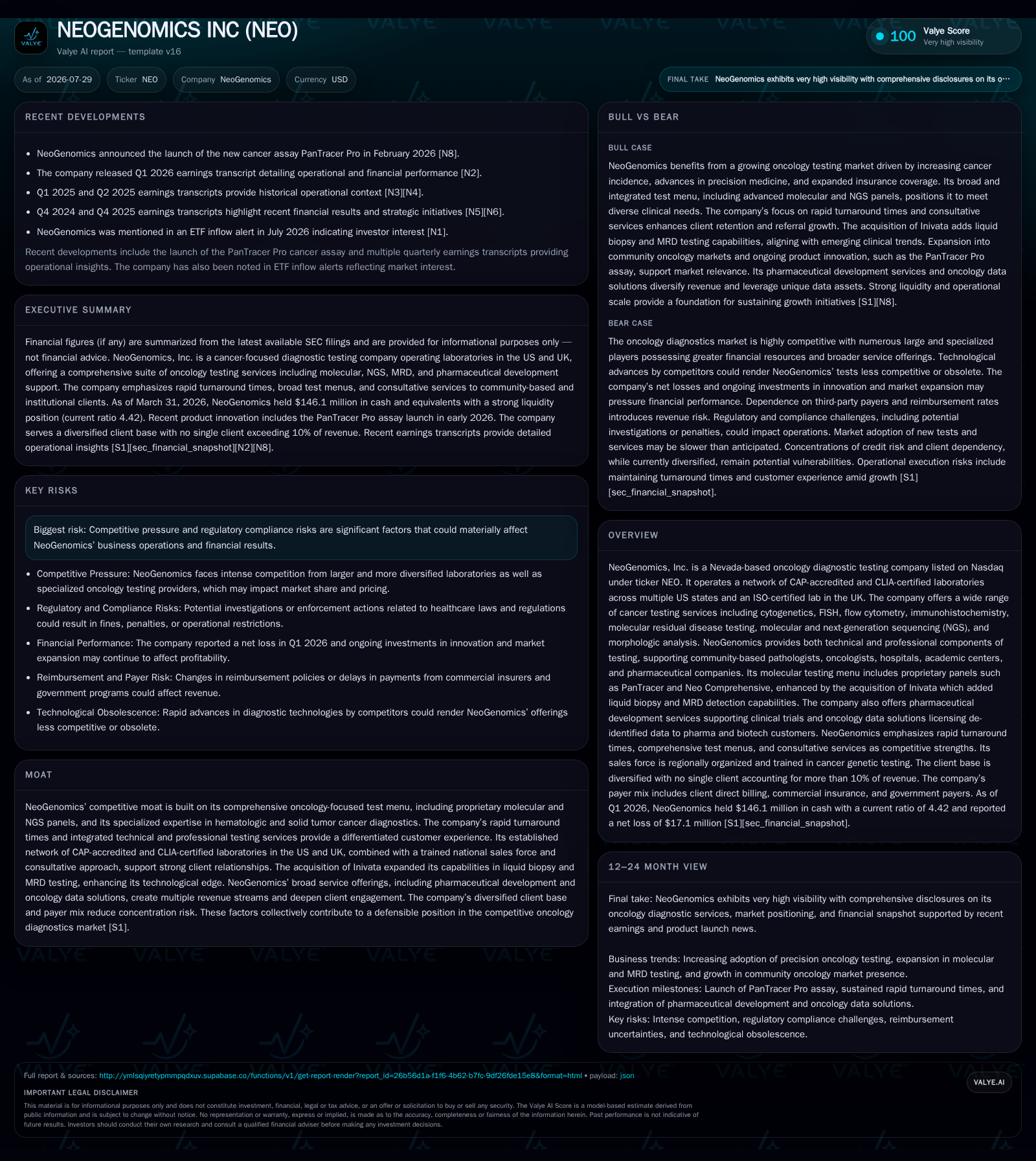
NeoGenomics reported Q2 2026 progress marked by increased volumes in next-generation sequencing (NGS) and liquid biopsy testing, driven in part by integrating acquisitions such as Inivata and Pathline. The company sustains its broad oncology-focused test menu enabled by proprietary panels like PanTracer, reinforcing its role as a comprehensive cancer diagnostics provider. However, capacity constraints and ongoing federal investigations into compliance issues pose risks to scaling tests and margin expansion. Pharmaceutical contract growth provides diversification beyond traditional payer reimbursement cycles and enhances revenue stability. NeoGenomics maintains strong lab accreditations and emphasizes rapid turnaround times to support client retention in a competitive landscape dominated by peers like Exact Sciences and Guardant Health. Liquidity remains healthy with over $146 million cash supporting continued R&D and operational investments.
Second Quarter Momentum Highlights Expansion in Molecular Oncology Testing
NeoGenomics' second quarter of 2026 demonstrated tangible increases in test volume for advanced molecular oncology assays, notably next-generation sequencing (NGS) panels and liquid biopsy offerings. The integration of Inivata’s liquid biopsy platform contributed materially to expanded test capabilities, including sensitive molecular residual disease (MRD) detection services now available through proprietary panels such as PanTracer [S2], [S3]. This higher mix of molecular testing aligns with broader industry trends where personalized cancer therapeutics increasingly require genomic profiling for treatment stratification. Despite these volume gains, management continues to acknowledge constraints on laboratory capacity utilization causing some bottlenecks in fulfilling demand promptly [S2]. Turnaround time (TAT), a critical competitive differentiator within oncology diagnostics that affects clinician satisfaction and referral retention, remains a focal metric for operational efficiency improvements.
Proprietary Test Panels and Acquisition Strategy Driving Service Breadth
NeoGenomics' product portfolio depth is significantly bolstered by strategic acquisitions completed over the prior year. The acquisition of Inivata has endowed NeoGenomics with a leadership position in liquid biopsy-based MRD diagnostics—a minimally invasive technique garnering strong clinical uptake due to improved patient tolerability compared to tissue biopsies [S1], [S7]. Simultaneously, the acquisition of Pathline LLC expanded geographic reach particularly in the Northeastern U.S., a high-density oncology market segment supporting higher sample volumes regionally [S7]. These acquisitions integrate smoothly into NeoGenomics’ existing CAP-accredited and CLIA-certified laboratory network spanning multiple U.S. states plus an ISO-certified UK facility, offering cross-border service consistency for multinational pharmaceutical clients [S1]. Proprietary panels such as Neo Comprehensive complement these platforms by providing comprehensive genomic profiling tailored to hematologic as well as solid tumor malignancies.
Competitive Differentiation Via Certification, Turnaround Times, and Pharma Collaborations
In an industry where regulatory certification constitutes both a baseline entry requirement and a quality standard signaling reliability to referral sources, NeoGenomics’ operating suite of CAP-accredited, CLIA-certified labs plus ISO certification in the UK sets it apart from many competitors lacking multi-jurisdictional validations [S1], [S2]. These accreditations facilitate partnerships with institutions demanding stringent quality controls while enabling billing access across diverse payer groups. Rapid turnaround times—often measured in days rather than weeks—further establish switching costs by embedding NeoGenomics deeply within oncologists' diagnostic workflows. Additionally, the company has solidified its foothold in pharmaceutical clinical trial testing through a growing contractual portfolio that enhances margins compared to standard payer reimbursements [S2], effectively diversifying revenue streams beyond patient-driven volumes. This consultative model supported via a trained national sales force sustains robust client retention rates amid stiff competition from molecular testing peers such as Exact Sciences or liquid biopsy specialists Guardant Health.
Industry Headwinds: Capacity Constraints and Regulatory Compliance Risks
Despite progress on growing molecular offerings, NeoGenomics contends with capacity constraints limiting its ability to scale test volumes linearly with rising demand. These bottlenecks stem from specialized equipment throughput limits and personnel skill shortages intrinsic to complex molecular assays requiring precise handling [S1]. Margin expansion is vulnerable if incremental volumes cannot be accommodated without significant incremental investment or operational inefficiencies.
Regulatory compliance poses another substantive risk vector. The company continues navigating an ongoing federal healthcare investigation centered on certain consulting agreements potentially implicating anti-kickback statutes (AKS) risk exposure. A reserve of $11.2 million has been accrued representing minimum probable loss; however, the eventual outcome could result in material fines or operational restrictions impacting Medicare/Medicaid participation—yet another complexity typical among clinical laboratories contending with aggressive federal oversight [S4], [S5]. These regulatory entanglements demand sustained compliance investments alongside enhanced internal controls.
Pharmaceutical Partnering as a Diversification & Growth Lever
Pharmaceutical clinical trial support constitutes an increasingly important element of NeoGenomics’ business model, insulating the company partially from reimbursement variability common among traditional payers [S1], [S2]. Contracts with biopharma clients leverage specialized companion diagnostic tests tied directly to new drug approvals or trial enrollment schedules—revenue sources characterized by higher pricing power due to their critical role in drug development pipelines. Expanding this contract base enhances predictability relative to fluctuating patient volumes driven by deductible resets or seasonality. Monitoring pharmaceutical contract counts serves as a key indicator of this revenue diversification's health.
Growth Outlook Supported by Rising Cancer Incidence and Technological Adoption
Underlying secular growth drivers remain intact for NeoGenomics’ core oncology diagnostics segment. With roughly one in two men and one in three women expected to develop cancer in their lifetimes, rising cancer prevalence alongside enhanced screening adoption fuels increasing demand for sensitive diagnostic modalities including genomic profiling and liquid biopsies [S1]. Parallel advancements in personalized medicine underscore the need for companion diagnostics integral to matching patients with targeted therapies. Technologies initially positioned at academic centers are reaching broader community settings where NeoGenomics maintains entrenched presence, further broadening addressable markets. Although visibility on specific pipeline product launches is less granular publicly, continued R&D investment signals commitment to expanding molecular test menus consistent with these trends.
This analysis is based exclusively on currently available SEC filings dated through July 28, 2026 ([S1]-[S29]) supplemented by financial data ([F1]) and considers general industry knowledge relevant to oncology diagnostic testing providers with no investment research views intended.
Disclaimer: This is research-only, informational analysis and not investment advice. It may include AI-generated interpretation and general industry context. Always verify important details using primary sources.

Comments