
Abbott Laboratories Integrates Exact Sciences Acquisition While Expanding Diagnostics and Device Innovation
Abbott's mid-2026 update highlights strategic M&A integration, sustained innovation across diversified healthcare segments, and navigating regulatory cost pressures.
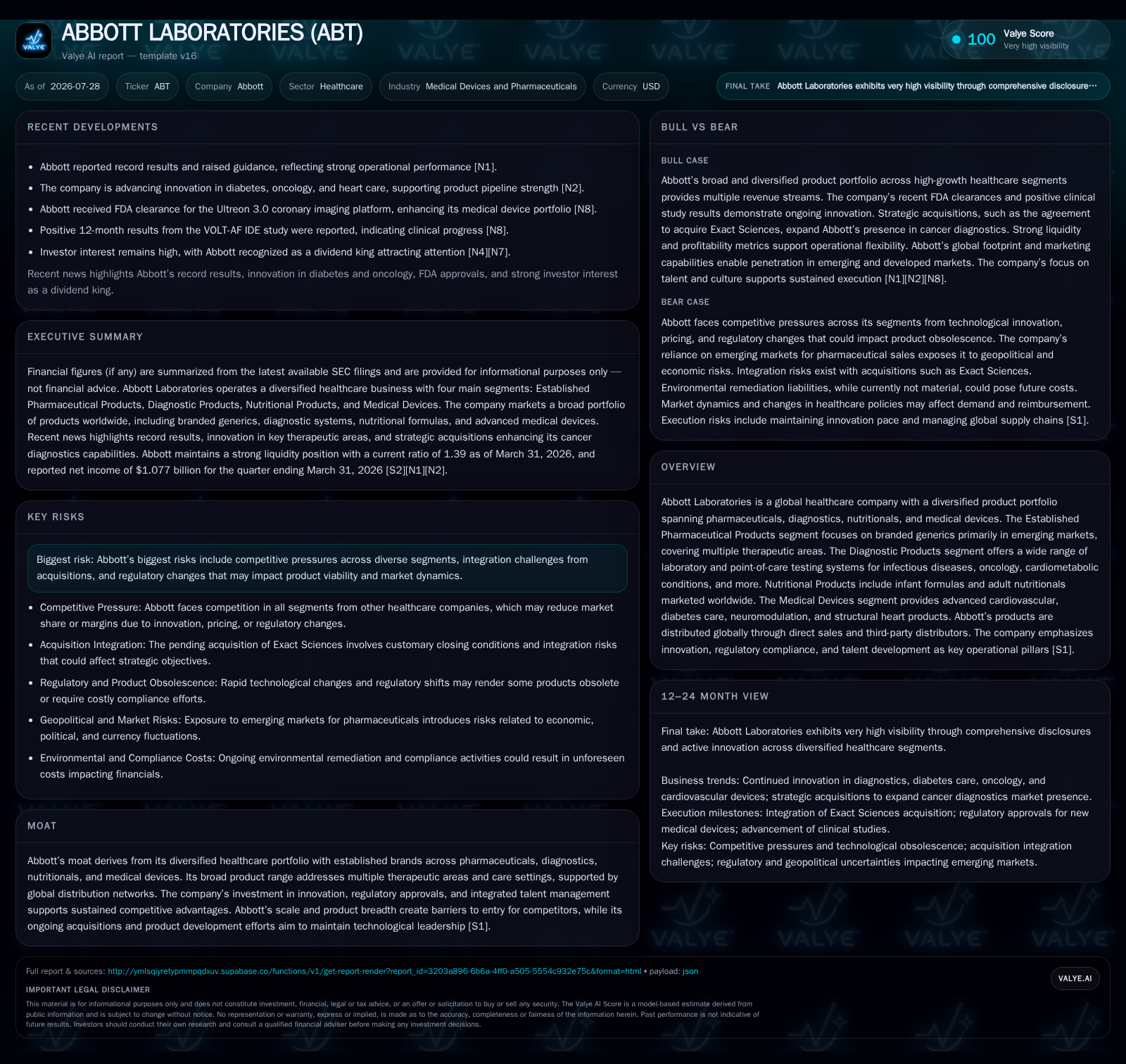
In its latest quarterly disclosure dated July 28, 2026, Abbott Laboratories finalized the preliminary allocation of its $20.6 billion acquisition of Exact Sciences, positioning the company to enter the cancer diagnostics market [S2]. Abbott’s business model remains diversified across pharmaceuticals, diagnostics, nutritionals, and medical devices, with growth driven by R&D investments and geographic expansion into emerging markets [S1]. Capital structure remains investment grade with manageable leverage and strong liquidity [S2][F1]. Key risks include regulatory scrutiny on product pricing and ongoing legal proceedings related to infant formula products [S1][S6]. The successful integration of acquisitions alongside continued innovation in diagnostics and neuromodulation products will be critical execution points to monitor in upcoming quarters.
Recent Operating Developments
Abbott Laboratories’ most consequential event this quarter was the formal accounting update regarding its acquisition of Exact Sciences Corporation announced in late 2025. The preliminary purchase price allocation assigns $12.8 billion to acquired intangible assets and $11.4 billion to goodwill—both non-deductible—while net tangible assets account for only $0.4 billion. Deferred income taxes and net debt reduce the total enterprise value which stands at approximately $20.6 billion [S2]. This acquisition marks Abbott’s strategic entry into the oncology diagnostics market, expanding its Diagnostic Products segment beyond established infectious diseases and cardiometabolic testing systems.
The balance sheet snapshot as of June 30, 2026 shows a cash position of $5.1 billion with total current assets near $24.5 billion versus current liabilities of approximately $18 billion, reflecting solid working capital management despite the acquisition-related funding activities [S2][F1]. Trade receivables increased moderately to $8.6 billion while inventories rose to $7.3 billion as the company manages supply chain demands amid growth initiatives
Additionally, Abbott reported remaining performance obligations worth $6.2 billion primarily within Diagnostics, with Medical Devices ($455 million) and Established Pharmaceuticals ($243 million) holding lesser portions [S2]. These backlog figures illustrate mid-term contracted revenue visibility underpinning organic growth prospects across higher-margin product lines
Business Model Overview
Abbott operates a diversified business model spanning four reportable segments: Established Pharmaceutical Products (branded generics mainly sold in emerging markets), Diagnostic Products (laboratory and point-of-care testing systems), Nutritional Products (infant formulas and adult nutritionals worldwide), and Medical Devices (cardiovascular intervention tools, diabetes care technologies including continuous glucose monitors, neuromodulation systems for chronic pain treatment) [S1].
Revenue generation flows mostly from direct sales to hospitals, clinics, laboratories, distributors, government agencies, pharmacies, and retailers globally. Pricing dynamics vary considerably among segments; branded generics face competitive pricing pressure but benefit from penetration in emerging markets where brand recognition matters; Diagnostics leverage proprietary platforms with unit-based consumables fostering recurring revenue; Medical Devices emphasize innovative high-value products like implantable pulse generators creating differentiation; Nutritionals combine volume-driven sales with strong consumer branding.
Innovation through allocated R&D budgets around $2.9 billion annually supports new product introductions and lifecycle management essential in an industry characterized by rapid technological change and stringent regulatory requirements [S1]. Abbott’s emphasis on regulatory compliance dovetails with its talent development priorities to reinforce competitive moat derived from integrated capabilities across multiple therapeutic vectors.
Industry Structure and Competitive Positioning
Operating within the diversified healthcare products industry positions Abbott against giants such as Johnson & Johnson (multi-segment healthcare), Roche Diagnostics (diagnostics focus), Medtronic (devices specialization), Nestlé Health Science (nutritionals), Pfizer (pharmaceuticals), and Boston Scientific (devices). All compete on innovation cycles tied tightly to regulatory approvals that influence market access timing.
Abbott’s scale enables broad distribution reach and complex global supply chain operations—key hurdles for new entrants given regulatory hurdles that govern manufacturing quality standards, clinical trial requirements for approvals, post-market surveillance obligations, pricing controls by payors or governments especially outside the U.S., and reimbursement uncertainties.
Its expansive portfolio diversifies revenue concentration risks seen often in single-segment peers reliant solely on pharmaceuticals or devices. Brand recognition combined with integrated direct sales organizations enhances customer retention rates despite intensifying competition.
However, structural challenges persist given ongoing healthcare cost containment efforts worldwide driven by governments and private insurers seeking lower product utilization or aggressive pricing negotiations [S1]. Abbott explicitly anticipates continuing pressure on price realization and reimbursement coverage limitations that require balancing innovation investments against margin sustainability
Growth Drivers
Key stimuli underpinning Abbott’s growth include:
- Innovation Pipeline: Continued R&D investment fosters new diagnostic platforms especially cancer-related tests stemming from Exact Sciences capabilities; advanced neuromodulation devices targeting chronic pain expand therapeutic reach; next-gen diabetes care techs enhance patient management solutions.
- Emerging Markets Penetration: Established Pharmaceutical Products capitalize on increasing demand for affordable branded generics where healthcare infrastructure is expanding; Nutritionals grow as infant health awareness rises.
- Aging Population & Chronic Diseases: Cardiovascular diseases, diabetes prevalence fuel sustained needs for device interventions and diagnostic monitoring enhancing volume throughput.
- Point-of-Care Testing Adoption: Increasing clinical preference for rapid reliable bedside assays benefits Diagnostics segment revenue expansion.
- Capacity Expansion & Operational Efficiency: Restructuring plans implemented over prior years aim at reducing costs across segments improving gross margins amidst pricing headwinds [S1].
- Strategic Acquisitions: Besides Exact Sciences’ oncology diagnostics franchise addition in 2025 cited above, prior acquisitions like Cardiovascular Systems Inc. (CSI) integrate complementary vascular technologies boosting device portfolio breadth with targeted synergies realized over time [S4].
- Regulatory Milestones: Timely clearances enabling launch or approval of new products directly influence near-term sales ramp potential.
Risks and Constraints
Abbott faces sizable risks common to diversified healthcare firms:
- Regulatory Complexity & Approval Delays: Protracted review cycles or negative outcomes can defer launches impacting pipeline valuation.
- Litigation Exposure: A substantial number (~1,760) of lawsuits relating to certain infant formula products alleging health issues pose reputational threats despite current favorable rulings; outcomes remain uncertain impacting contingent liabilities estimation [S6][S19].
- Pricing Pressure & Healthcare Cost Containment: Disciplined payors globally drive reimbursement caps limiting upside pricing flexibility particularly outside premium U.S. markets.
- Integration Risks: Assimilating large acquisitions such as Exact Sciences requires managing cultural fit and operational overlap without disrupting core business performance.
- Supply Chain Disruptions: Global manufacturing dependencies render vulnerability to material shortages or logistic delays affecting inventory turnover ratios.
- Foreign Exchange Volatility: Significant international exposure means currency fluctuations can materially adjust reported results absent hedging.
What to Watch Next
Key upcoming indicators that will shed light on Abbott’s trajectory include:
- Completion of final purchase price allocation adjustments for Exact Sciences alongside initial integration cost disclosures.
- Regulatory approval successes or setbacks especially involving oncology diagnostics introduced via acquisition pipeline updates.
- Performance trends disclosed for Diagnostics reflecting backlog conversion rates tied to remaining performance obligations exceeding $6 billion.
- Margin evolution vis-à-vis restructuring savings versus inflationary input cost pressures impacting gross profit margins.
- Resolution progress regarding infant formula litigation to mitigate contingent risk uncertainty.
- Updates on neuromodulation device rollouts featuring advanced directional leads supporting chronic pain treatment efficacy claims.
- Emerging market revenue growth rates within branded generics serving as proxy for market penetration success under demographic shifts.
Financial Profile Discussion
As of June 30, 2026, Abbott maintains a robust liquidity position with cash and cash equivalents around $5.1 billion complemented by manageable short-term investments totaling approximately $500 million [S2]. The company carries about $13 billion in total debt based on end-of-year 2025 filings resulting in net debt near $6.1 billion after subtracting cash balances—reflecting moderate leverage consistent with an investment-grade rating maintained by S&P AA- standard [F1][S11][S16]. Working capital exceeds $6 billion affirming short-term solvency standing at a healthy current ratio of roughly 1.39 [F1].
Capital expenditures remain focused on facility upgrades concentrated around manufacturing capacity enhancements supporting long-term innovation pipelines along with IT infrastructure investments instrumental in digitalized device offerings [S1][F1]. Free cash flow generation sustains funding flexibility necessary for both organic R&D outlays (~$2.9 billion spent in 2025) as well as disciplined M&A activities underpinning strategic expansion ambitions
Overall operating income benefited from margin improvement initiatives offsetting tariff headwinds experienced recently while SG&A expenses increased modestly due to intensified marketing efforts targeting higher-growth therapy areas indicating balanced reinvestment approach versus cost containment measures already underway via streamlining programs reflected in restructuring charges recorded across multiple years since 2023 [S1][F1]
Disclaimer: This analysis is based solely on information publicly available through Abbott Laboratories’ SEC filings dated up to July 28, 2026 () and validated numeric datasets ([F1]), supplemented by industry knowledge frameworks without speculative assumptions or unconfirmed data points.
Disclaimer: This is research-only, informational analysis and not investment advice. It may include AI-generated interpretation and general industry context. Always verify important details using primary sources.

Comments