
Equity LifeStyle Properties Strengthens Growth via High Occupancy and Strategic Expansion
ELS reports solid Q2 2026 operational momentum, leveraging demographic tailwinds and supply constraints in manufactured home and RV communities.
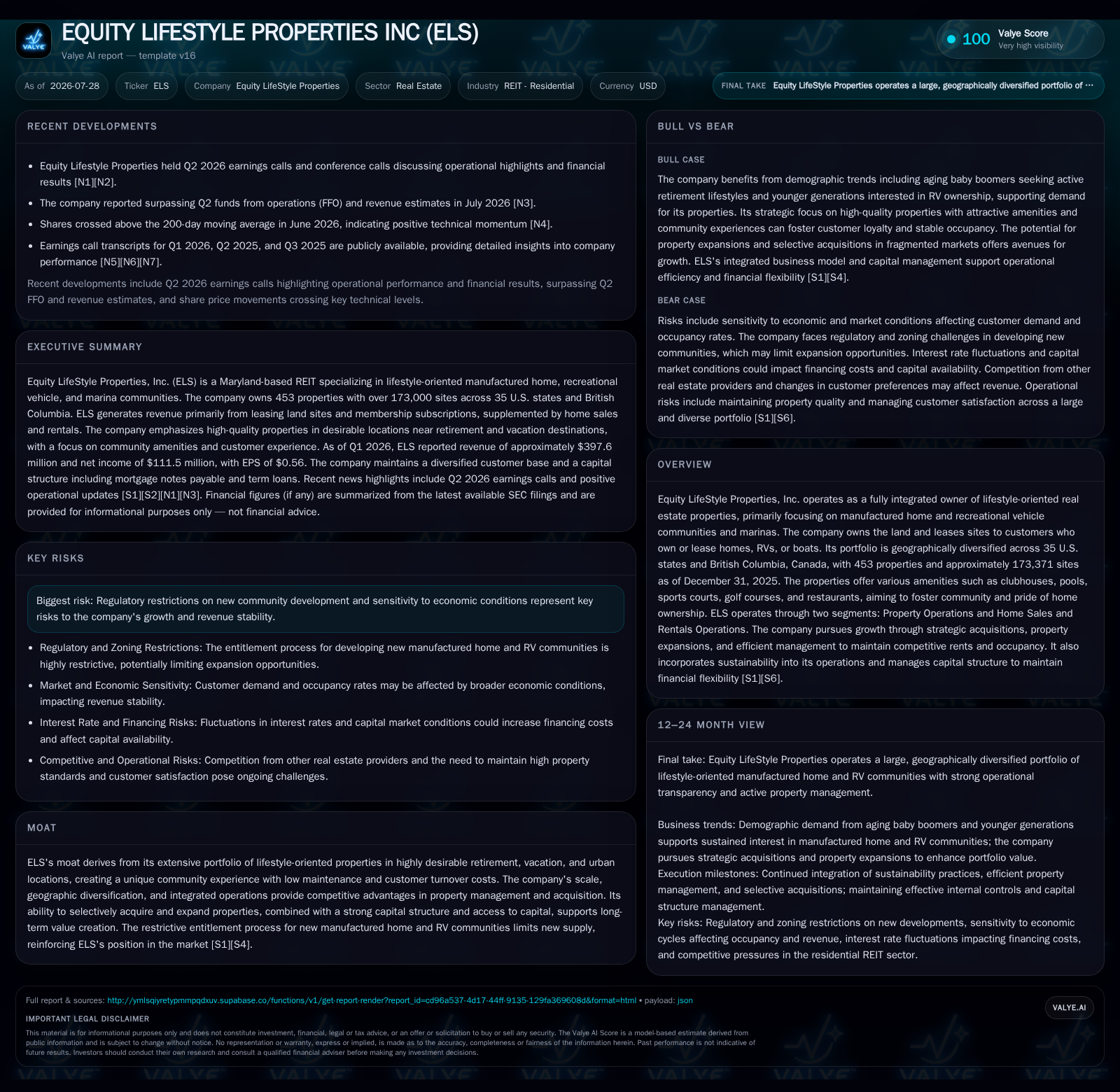
Equity LifeStyle Properties, Inc. (ELS) demonstrated continued strength in the second quarter of 2026, building on a well-diversified portfolio of lifestyle-oriented manufactured home, RV community, and marina properties. The company’s growth is supported by a low-maintenance asset base, attractive rent growth, and constrained supply due to regulatory entitlements. Facing a favorable demographic environment driven by retiring baby boomers and increasing interest among Millennials and Gen Z, ELS sustains rental income growth and expansion through site additions and acquisition pipeline. Key risks remain regulatory limitations on new developments and sensitivity to economic cycles. The company’s capital structure remains sound, supporting further value creation backed by stable funds from operations (FFO) and consistent dividends.
Recent Operating Update
Equity LifeStyle Properties (ELS) reported continued operational progress in its Q2 2026 filing dated July 28, highlighting persistent demand across its portfolio of manufactured home (MH), recreational vehicle (RV), and marina communities [S2][S4]. The company maintains a portfolio of 453 properties totaling approximately 173,371 developed sites spread across prime U.S. retirement, vacation, and urban markets as of year-end 2025 [S1]. These assets enjoy high occupancy rates sustained by long-term lease agreements for land sites occupied by tenants who own residences such as manufactured homes or RVs.
In the most recent announcements coinciding with Q2 results, the board declared a quarterly dividend that reflects an annualized payout of $2.17 per share, underpinning consistent capital return discipline aligned with stable Funds From Operations (FFO) generation [S3]. Operationally, the release reaffirmed strong income growth from property operations driven by rent increases and successful expansion initiatives including the addition of hundreds of new developed sites in the past year [S4].
Business Model
ELS functions as a self-managed REIT specializing in lifestyle-centric real estate assets that include MH communities, RV parks, and marinas — all positioned as affordable alternative housing options offering community amenities to retirees, vacationers, second homeowners, and first-time buyers [S1]. The company owns the land underlying all sites in its portfolio and monetizes this through leasing arrangements typically on an annual basis or via right-to-use contracts granting limited stay memberships.
This dual-segment business includes Property Operations—collecting rental income from sites plus ancillary service fees—and Home Sales & Rentals Operations supplying dwellings or cottages either sold or leased to residents. This integrated approach strengthens control over property economics while creating value through expanded services.
Key revenue drivers are occupancy rate stability owing to limited customer turnover costs characteristic of single-family lot leasing models coupled with moderate but steady average rent increases supported by market demand fundamentals. The stability inherent in long-term leases combined with incremental expansion opportunities—such as developing additional lots within existing properties—and disciplined acquisitions form the backbone for organic growth.
Competitive strength derives from geographic diversification across sought-after retirement/vacation locales where lifestyle-based amenities heighten tenant satisfaction and retention potential—factors that mitigate volatility versus traditional apartment or multi-family REITs.
Industry Structure & Competitive Position
The residential REIT sector focused on manufactured housing benefits from substantial barriers to entry primarily rooted in protracted zoning restrictions and rigorous entitlement processes that curtail new community development nationwide. ELS leverages this supply rigidity which fosters landlord pricing power amid growing demand from aging baby boomers seeking downsized yet active living environments as well as younger generations increasingly valuing affordable flexible housing alternatives.
Comparable public peers include Sun Communities Inc., which similarly operates MH/RV parks but on a smaller geographical footprint scale relative to ELS’s sizable presence extending into Canada. Apartment REITs offer contrast with higher tenant turnover risks though larger absolute market size while single-family rental REITs exhibit differing dynamics tied closely to urban rental markets rather than lifestyle resort-style settings.
ELS’s wide distribution network across multiple states diversifies regional economic risk exposure while specialized amenities—clubhouses, pools, sports facilities—provide competitive differentiation enhancing resident loyalty beyond mere shelter needs. This community-centric positioning is central both tactically for retention metrics such as lease renewal rates and strategically for branding.
Growth Drivers
Multiple structural tailwinds underpin the company’s medium- to long-term growth outlook:
- Demographic shifts: Approximately 10,000 Americans turn age 65 daily; as Baby Boomers retire they drive demand for affordable retirement lifestyles outside traditional housing markets [S1].
- Millennial/Gen Z adoption: Emerging generations demonstrate rising interest in RV ownership and manufactured homes as cost-effective second-home solutions aligned with flexible living preferences [S1].
- Supply Constraints: The entitlement process severely limits new MH/RV community construction reinforcing scarcity value of existing developed sites under ELS’s control [S1].
- Portfolio Expansion: Continued organic site additions (362 new developed sites added during calendar year 2025) alongside selective strategic acquisitions broaden capacity while optimizing portfolio mix [S1].
- Pricing Power: Incremental rent increases averaged ~5% for MH site rentals year-over-year reflecting sustained market strength despite general inflationary pressures [S1].
- Operational Efficiencies: Expense containment strategies kept property operating costs excluding management overhead up just 1% year-over-year in 2025 despite inflation trends, supporting margin preservation [S1].
Collectively these factors feed into positive same-property net operating income growth trends exceeding historical averages for the sector, reaffirming resilience even amid cyclical macroeconomic challenges.
Risks & Watchpoints
While ELS demonstrates durable fundamentals there are several key risk considerations critical for ongoing evaluation:
- Regulatory Environment: Local zoning hurdles remain formidable; any relaxation could alter competitive dynamics but so far materially restricts new development capacity imposing long-term supply risk that caps industry expansion speed [S1][S17].
- Economic Cyclicality: Recessions or reduced discretionary spending could dampen consumer willingness to pay modest rent premiums or invest in second-home purchases; impact would manifest through lower occupancy or slower home sales volumes.
- Interest Rate Sensitivity: Rising rates increase borrowing costs directly affecting net yields on leverage employed; also potentially compress cap rates negatively influencing asset valuations across REIT portfolios including ELS’s sizable debt stack exceeding $3 billion at end-2025 [F1][S6][S12].
- Customer Turnover: Although generally low compared to conventional apartments due to longer lease terms, unexpected spikes could impact rental income stability.
- Supply Chain & Labor Constraints: Potential delays or cost escalations affect capacity expansions or refurbishments reducing speed/cost efficiency gains noted historically.
- Geographic Concentration: While diversified broadly nationwide there is still material exposure to particular states sensitive to environmental regulations or economic shifts which could lead to localized occupancy fluctuations.
Monitoring lease renewal rates, incremental rent realizations per site, acquisition pipeline conversions into completed expansions, FFO margins relative to interest obligations, alongside macroeconomic indicators will be vital balancing metrics.
What to Watch Next
Investors should track these near-term milestones:
- Quarterly updates on occupancy trends especially within newly added lots indicate market absorption capacity under current pricing regimes.
- Management commentary around acquisition progress or disposition plans signaling balance sheet optimization or strategic pivoting.
- Updates on lease renewals or yield management initiatives particularly within short-term resort/marina segments which may have more volatile demand patterns.
- Any changes announced related to dividend policy reflecting confidence in cash flow sustainability amid rising operational or financing costs.
- Earnings guidance revisions pointing toward any material shifts in expected normalized FFO per share growth considering ongoing inflationary or regulatory contexts.
Financial Profile Discussion
At December 31, 2025 ELS held total debt approximating $3.35 billion against no significant material change noted through mid-2026 filings; net leverage appears consistent post issuance of unsecured term loans maturing through the early next decade permitting manageable refinancing windows given current covenant compliance status [F1][S6][S12][S2]
The balance sheet benefits from a revolving line of credit facility providing liquidity flexibility complementing term debt instruments carrying fixed/effective rates near mid-to-high fours percent [S3][F1]. Interest coverage ratios remain adequate given stable NOI streams prioritizing funds flow available for dividends which currently stand at an annualized $2.17 per common share declared midyear—reflecting measured payout ratios supportive of investment-grade credit profiles
Disclaimer: This is research-only, informational analysis and not investment advice. It may include AI-generated interpretation and general industry context. Always verify important details using primary sources.

Comments