
Reliance, Inc. Extends Industry Lead Through Scale and Value-Added Metal Processing
Reliance’s Q2 2026 results show record shipments and pricing strength, reinforcing its moat built on broad product mix, processing capabilities, and strong liquidity.
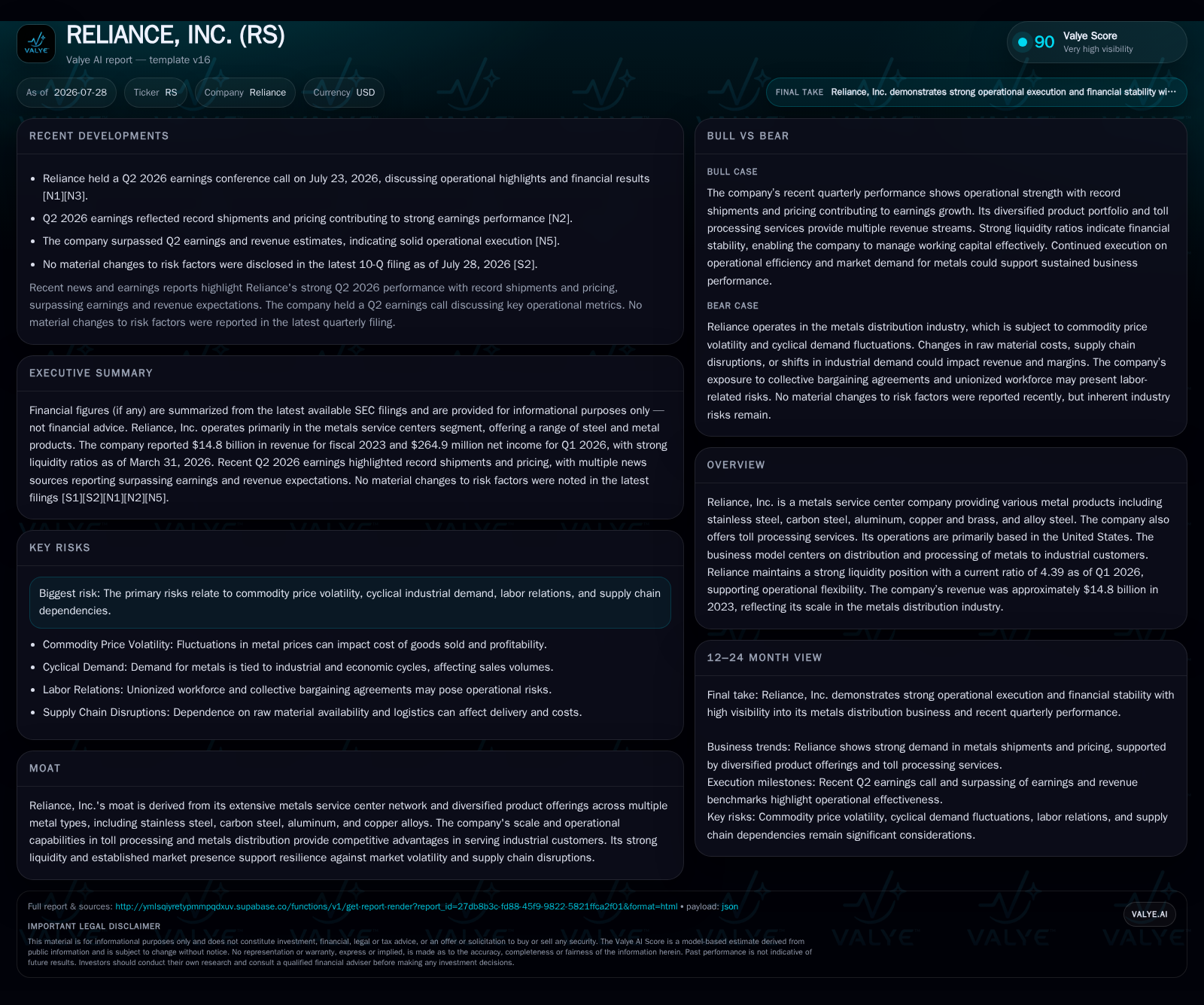
In the latest quarter ended June 30, 2026, Reliance, Inc. reported record shipment volumes and maintained pricing discipline, signaling ongoing strength in industrial metals demand and operational execution [S2][S3]. Its business model as a broad-based metals service center emphasizes small orders, just-in-time delivery, and value-added toll processing services that differentiate it from smaller peers [S1]. Reliance’s competitive moat is supported by its scale in North America, diversified product offerings including stainless steel, carbon steel, aluminum, copper and alloy steels, and deep supplier relationships that help manage inventory costs amid commodity price volatility [S1]. Despite cyclical risks in end markets and commodity prices, Reliance's robust liquidity with a current ratio of 4.39 as of Q1 2026 supports operational flexibility [F1]. The company’s capacity to quickly adjust selling prices to mill cost fluctuations and its low customer concentration underpin resilience in an otherwise fragmented services industry [S1][S6].
Recent Operating Update
Reliance, Inc. reported record shipment volumes and maintained pricing discipline in the second quarter ended June 30, 2026, demonstrating operational strength amid ongoing industrial sector headwinds [S2][N2]. The company’s decentralized operating model enables rapid responsiveness to small order sizes, a critical feature in metals distribution where just-in-time delivery supports customer working capital efficiency [S3][N2]. These results highlight Reliance’s ability to leverage its broad metals portfolio and value-added processing capabilities to sustain profitability despite commodity price volatility and cyclical demand fluctuations.
Business Model: Scale-Driven Metals Service Center
Reliance operates as a leading metals service center, distributing a wide range of metals including stainless steel, carbon steel, aluminum, copper and brass alloys, alloy steels, and specialty metals. It maintains inventory of over 100,000 SKUs sourced primarily from major domestic mills, serving more than 125,000 customers across 41 U.S. states and select international markets [S1][S8]
The company’s customer base mainly consists of small job shops and fabricators that require customized metal quantities with frequent deliveries rather than large block orders typical of integrated mills or manufacturers [S1][S15]. Reliance differentiates itself by offering extensive value-added toll processing services such as cutting, sawing, machining, and electropolishing, which reduce customers’ lead times and capital expenditures on processing equipment. These services are increasingly important as many manufacturers outsource specialized metal processing to service centers rather than invest internally [S1][S15].
Revenue is primarily generated through spot-market pricing rather than long-term contracts, allowing Reliance to adjust selling prices quickly in response to fluctuations in mill costs. This pricing discipline helps mitigate margin compression during commodity price volatility but also exposes the company to inventory valuation risks if metal prices decline abruptly [S10][S23]. The average order size is approximately $3,120, with about 40% of orders fulfilled within 24 hours, underscoring the company’s emphasis on small, rapid-turnaround orders [S1].
Reliance’s broad product mix and extensive supplier relationships enable efficient inventory management and purchasing at competitive prices, which is critical given the capital-intensive nature of metals distribution and the volatility of commodity markets [S6][S10]. The company’s low customer concentration—with the largest customer accounting for only 0.6% of net sales—supports stable recurring demand primarily driven by purchase orders rather than fixed contracts [S6][S10].
Industry Structure and Competitive Position
The North American metals distribution industry is highly fragmented, with thousands of dealers ranging from single-location operators to national service center networks. Reliance is the largest player by sales volume in this fragmented market, reportedly accounting for approximately 17% of U.S. metal tonnage sold in 2025, up from about 15% in prior years [S20]
Competitors include regional metals service centers and integrated mills, but few match Reliance’s scale, geographic coverage, product breadth, and processing capabilities. The company’s competitive advantages stem from:
- Large-scale procurement leveraging long-term supplier mill relationships, enabling pricing power and preferred allocation during supply disruptions.
- A decentralized network of over 310 locations across 41 states and multiple countries, facilitating superior customer service responsiveness and just-in-time delivery.
- Diversified product offerings across multiple metal types and industries, reducing exposure to any single market downturn.
- Growing value-added processing services that generate higher-margin revenue streams and mitigate raw material price volatility.
These factors create a significant moat that smaller distributors find difficult to replicate due to the capital intensity of processing equipment and the complexity of managing a broad geographic footprint [S1][S6][S10].
Growth Drivers
Several structural trends support Reliance’s growth prospects:
- Expansion in industrial production across sectors such as automotive, aerospace, heavy machinery, and energy infrastructure increases baseline metals consumption.
- Outsourcing of specialized metal processing by manufacturers continues to grow, benefiting service centers with advanced toll processing capabilities.
- Strategic acquisitions aimed at expanding geographic reach and product offerings enhance market penetration.
- Investments in advanced automated processing technology improve throughput and gross margins by increasing value-added service capacity.
- Infrastructure spending driven by government stimulus programs fuels demand for metals used in construction and energy projects.
- Supply chain optimization trends favor just-in-time inventory management, increasing reliance on local metals service centers.
These drivers translate into key operating KPIs such as rising shipment tonnage volumes (evidenced by Q2 2026 records), higher utilization rates of processing equipment, and improvements in average selling price per ton through expanded product mix and value-added services [S2][S10][S15]
Risks and Watchpoints
Reliance faces several risks typical of the metals distribution sector:
- Commodity price volatility can cause inventory valuation challenges and margin pressure, especially when metal prices decline rapidly [S23].
- Cyclical demand fluctuations tied to industrial manufacturing and construction sectors may impact order volumes seasonally or during economic downturns, although diversification across industries and geographies helps mitigate this risk [S6][S23].
- Skilled labor shortages and labor relations issues can affect processing operations where downtime is costly.
- Supply chain disruptions may delay raw material procurement, impacting delivery schedules critical to small-order customers.
- Customer credit risk, while currently low due to minimal concentration, remains a potential concern during economic slowdowns.
- Regulatory changes, including tariffs and trade policies, could affect raw material costs and availability unexpectedly.
Monitoring metrics such as days sales outstanding can provide early indications of credit risk, while inventory turnover rates reflect the company’s effectiveness in managing commodity price cycles without excessive stock accumulation [S6][S23]
What To Watch Next
Key indicators to monitor include quarterly shipment volumes following the Q2 record, pricing realization relative to mill cost changes to assess margin sustainability, and progress on investments in toll processing technologies that may shift revenue mix toward higher-margin services. Customer retention rates, historically above 90%, will also signal competitive positioning effectiveness. Any changes in sales contract structure, such as moving toward longer-term agreements, would be significant given the current spot-market pricing reliance.
Additionally, strategic acquisition activity expanding geographic footprint or specialty product lines remains a key growth catalyst to watch [S10][S15].
Financial Profile Discussion
Overall, the financial profile supports Reliance’s capacity to navigate the capital-intensive metals distribution industry and invest in growth initiatives while managing cyclical risks.
Disclaimer: This analysis is for informational purposes only and does not constitute investment advice. It is based on information disclosed through SEC filings and public statements as of July 28, 2026, combined with industry knowledge relevant to metals distribution dynamics.
Disclaimer: This is research-only, informational analysis and not investment advice. It may include AI-generated interpretation and general industry context. Always verify important details using primary sources.

Comments