
Incyte Corp Advances Revenue Growth Ahead of JAKAFI Patent Expiration in 2028
Robust commercial performance supported by expanded indications and partnerships contrasts with looming patent cliff risks and regulatory pressures.
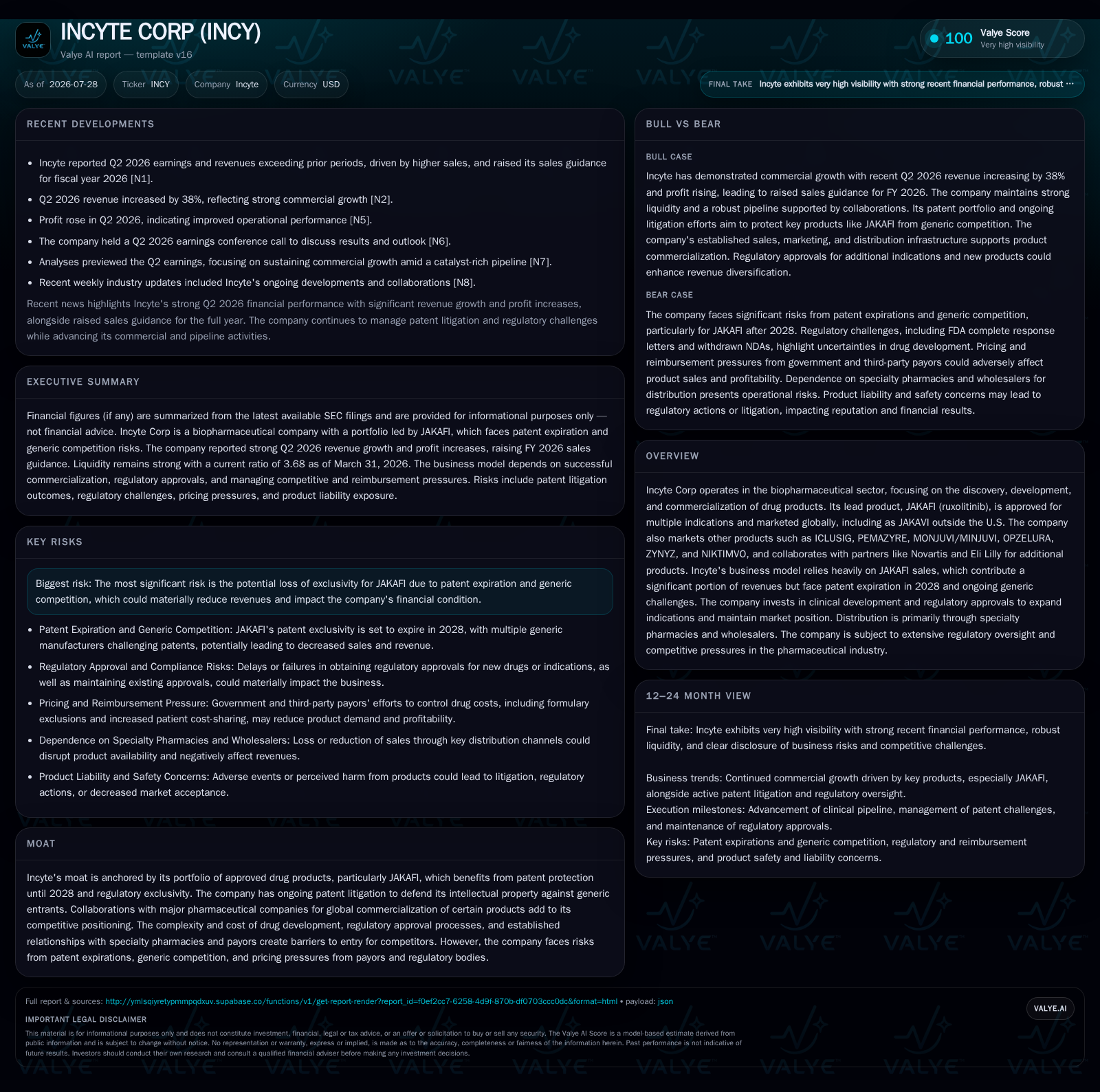
Incyte Corp reported a strong Q2 2026 performance with revenue growth led by its flagship JAKAFI franchise, which remains the core revenue driver despite its anticipated patent expiration in 2028. The company’s business model leverages specialty pharmacy distribution, extensive R&D investment focused on lifecycle management, and strategic collaborations with Novartis and Eli Lilly to extend global product reach. Industry headwinds include increasing generic filings challenging JAKAFI’s exclusivity, pricing pressures from payors, and regulatory scrutiny typical of the biopharmaceutical sector. Ongoing pipeline advancement and commercial expansion into new indications serve as critical growth levers to offset the patent cliff risk. Financially, Incyte maintains healthy liquidity but operates with elevated net debt reflecting past acquisitions and R&D commitments.
Recent Operating Update
Incyte Corporation reported a robust Q2 2026 performance, with revenues increasing 38% year-over-year, driven primarily by strong sales of its flagship product JAKAFI (ruxolitinib) and increased contributions from partnered products under collaboration agreements with Novartis and Eli Lilly [S2][N1][N2][N3]. JAKAFI continues to be the core revenue driver, despite the looming patent expiration scheduled between June and December 2028. The quarter’s earnings surpassed analyst estimates, supported by disciplined cost management, high gross margins, and sustained demand across approved indications [S2][N3].
Management highlighted that JAKAFI’s patent exclusivity is under threat due to multiple Abbreviated New Drug Application (ANDA) filings and a 505(b)(2) New Drug Application (NDA) with paragraph IV certifications challenging key patents. Generic manufacturers such as Apotex, Hikma Pharmaceuticals, and others have initiated litigation, with some settlements reached but several cases still pending [S1][S2]. These developments underscore the critical importance of lifecycle management strategies, including pursuing new indications and combination therapies, to sustain market share and delay revenue erosion.
Business Model Overview
Incyte operates as a specialty biopharmaceutical company focused on the discovery, development, regulatory approval, and commercialization of proprietary pharmaceutical products [S1][S2]. The company’s revenue model is anchored on direct product sales of patented drugs like JAKAFI, distributed primarily through specialty pharmacy networks and third-party wholesalers. These channels facilitate patient access while navigating complex reimbursement landscapes governed by government programs, managed care organizations, and pharmacy benefit managers, which significantly influence pricing and utilization rates [S1][S2].
Incyte also generates royalties from licensing agreements, notably with Novartis for ex-U.S. commercialization of JAKAVI (the international brand of JAKAFI) and TABRECTA, and with Eli Lilly for OLUMIANT, which diversifies revenue streams beyond direct sales [S1]. The company invests heavily in research and development (R&D), focusing on lifecycle management of existing products through new indication approvals and combination regimens, as well as advancing novel pipeline candidates. Due to limited internal clinical trial capacity, Incyte relies extensively on contract research organizations (CROs) to conduct preclinical and clinical studies, which introduces operational dependencies and potential timing risks [S1].
Margins benefit from the high-value niche indications targeted by Incyte’s therapies, but pricing pressures from payors and the impending patent cliff for JAKAFI pose challenges to margin sustainability [S6][S8]. The company must also maintain rigorous manufacturing quality controls, often through outsourced partners, and ensure compliance with evolving regulatory requirements related to drug safety, labeling, and marketing practices
Industry Structure and Competitive Position
Incyte operates within a highly regulated biopharmaceutical industry where patent exclusivity and regulatory approvals are critical to commercial success. The industry’s value chain encompasses drug discovery, clinical development, regulatory submission, manufacturing, and commercialization, with companies like Incyte often partnering with larger pharmaceutical firms or outsourcing key functions such as manufacturing and clinical trials [S1].
Competition for JAKAFI and other products arises from large integrated pharmaceutical companies with broader portfolios and specialty biopharmaceutical firms innovating targeted therapies. The Hatch-Waxman Act facilitates generic competition post-patent expiry through abbreviated approval pathways, intensifying revenue erosion risks once exclusivity lapses [S1]. Generic manufacturers such as Teva and others represent significant competitive threats in the post-patent landscape.
Peers in the specialty biopharmaceutical space, including firms like Gilead Sciences and Regeneron Pharmaceuticals, face similar dynamics balancing reliance on blockbuster products with the imperative to replenish pipelines and extend product lifecycles.
Growth Drivers
To mitigate the anticipated revenue decline from JAKAFI’s patent expiration in 2028, Incyte is actively pursuing expansion of approved indications, including exploring combination therapies that may enhance efficacy and broaden patient populations [S2]. Regulatory approvals for supplemental indications and label expansions are key catalysts to sustaining product sales and market share.
Strategic collaborations with Novartis and Eli Lilly facilitate global market penetration and provide diversified royalty income, leveraging partners’ established commercial infrastructures [S1]. Additionally, initiatives to improve patient convenience and adherence, such as developing subcutaneous formulations through partnerships like the one with Halozyme using ENHANZE technology, support lifecycle management and competitive positioning [N14].
Pipeline advancement remains a critical growth lever, with successful clinical trial outcomes and regulatory milestones essential to offsetting the patent cliff. Increased patient diagnosis rates and favorable reimbursement negotiations also underpin volume growth potential.
Risks and Watchpoints
The primary risk centers on the expiration of JAKAFI’s patent exclusivity in 2028, which exposes the product to generic competition and potential rapid revenue decline [S1][S2]. The ongoing patent litigation and multiple ANDA challenges highlight the uncertainty around the timing and extent of generic entry
Pricing pressures from managed care organizations, government healthcare programs, and potential legislative actions such as most favored nation pricing threaten margin sustainability [S9][S17]. Regulatory compliance risks include potential penalties related to off-label promotion, marketing practices, and product safety surveillance, which require stringent internal controls [S6][S8][S21].
Dependence on CROs for clinical development introduces risks of delays or failures that could materially impact pipeline progression and future revenue streams [S1]. Product liability exposures, despite insurance coverage and self-insurance mechanisms, remain a potential financial and reputational risk [S7]. Cybersecurity threats to clinical data and vendor systems are actively managed through comprehensive programs overseen by senior management and the board, but remain an operational vulnerability [S1].
Market acceptance risks include payer reimbursement adequacy and formulary positioning, which directly affect physician prescribing behavior and patient access [S17]. Counterfeit product infiltration poses additional brand integrity risks, necessitating vigilant supply chain monitoring [S20].
What To Watch Next
Key near-term indicators include FDA decisions on supplemental indications for JAKAFI, which could extend its commercial lifecycle. Clinical trial readouts demonstrating improved efficacy or safety in combination regimens would serve as positive catalysts. Monitoring quarterly sales trends will provide early signals of demand shifts, particularly as patent expiry approaches.
Outcomes of ongoing patent litigation and potential settlement agreements with generic challengers will influence the timing and severity of revenue erosion. Changes in payer coverage policies, including government program updates and private insurer formulary adjustments, will critically affect pricing and utilization.
Updates on strategic collaborations, including expansions or new licensing deals, will impact royalty income and geographic reach. Progress in manufacturing scale-up or delivery technology enhancements will reflect operational readiness and competitive differentiation.
Financial Profile Discussion
Incyte’s financial position supports its strategic initiatives, but managing leverage and maintaining cash flow generation will be critical to funding R&D and lifecycle management activities amid evolving market and regulatory pressures.
Disclaimer: This analysis is for informational purposes only and does not constitute investment advice. All financial and operational data are sourced from publicly filed documents and company disclosures.
Disclaimer: This is research-only, informational analysis and not investment advice. It may include AI-generated interpretation and general industry context. Always verify important details using primary sources.

Comments