
Nautilus Biotechnology Advances Proteomics Platform Toward Commercial Launch Amid Early Access Program Progress
Nautilus reports incremental maturation of its integrated single-molecule proteomics platform with expanding early access adoption, underpinning its phased commercialization strategy despite persistent development and financial challenges.
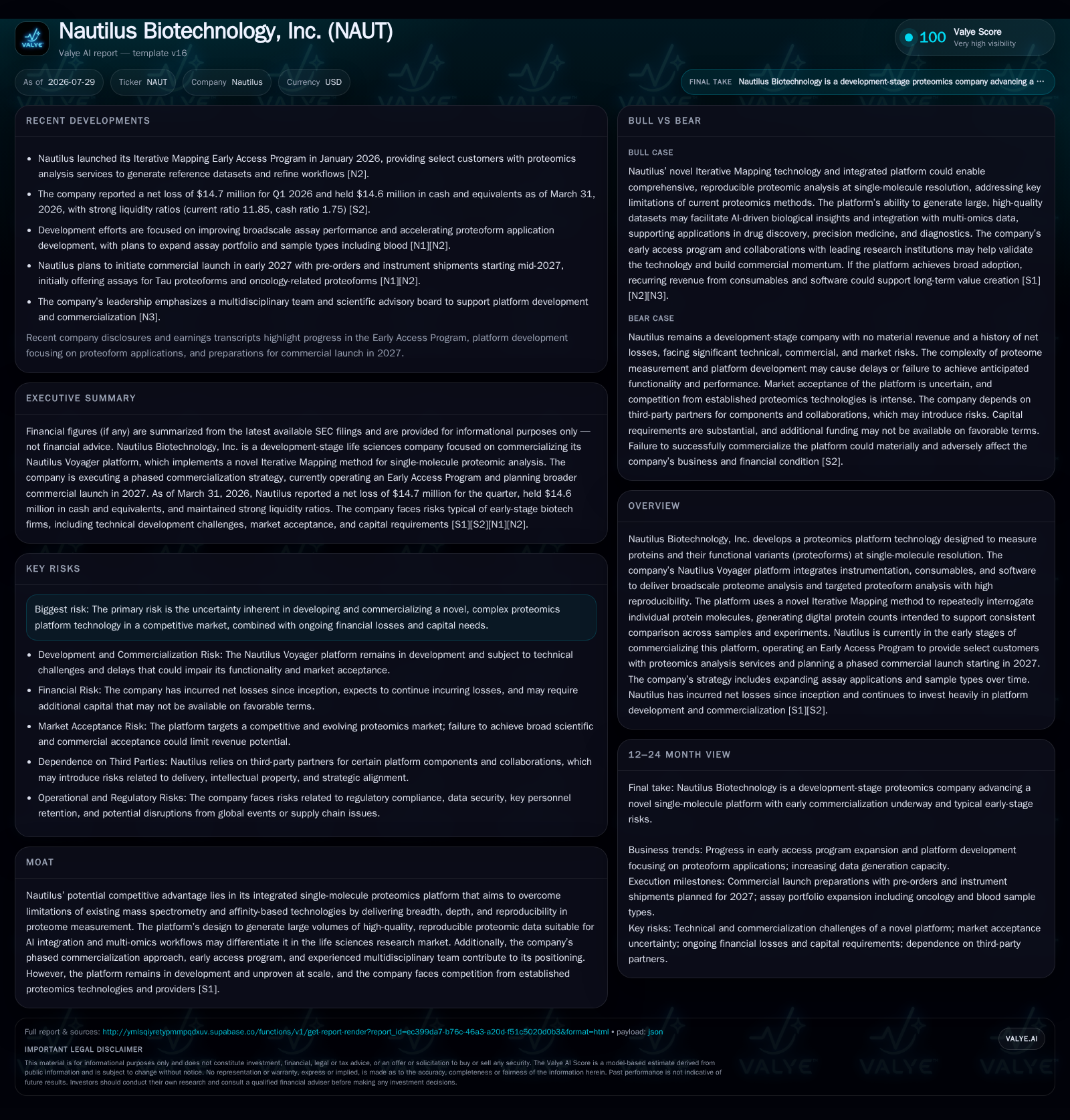
In its Q2 2026 filing, Nautilus Biotechnology highlighted progress in its Early Access Program for the Nautilus Voyager platform, aimed at delivering high-throughput, reproducible single-molecule proteomics analysis. While no commercial revenue has yet been recognized, the scaling early access user base and technical enhancements support an evolving platform readiness. The company’s integrated instrumentation, consumables, and software offering faces a competitive environment dominated by established proteomics incumbents and emerging multi-omics players. Growth hinges on broadening assay applications, expanding customer adoption, and navigating manufacturing scale-up complexities. Significant financial investment continues with limited near-term revenue visibility, emphasizing capital sufficiency as a key constraint alongside execution risks.
Q2 2026 Operating Update Highlights Early Access Program Expansion Amid Ongoing Development Challenges
In its Q2 2026 Form 10-Q filing dated July 28, Nautilus Biotechnology reiterated progress in advancing its Nautilus Voyager platform through an Early Access Program (EAP) that grants select pharmaceutical, academic, and research customers access to pre-commercial versions of its integrated proteomics solution [S2]. This platform combines nanofabricated protein arrays, a broad panel of approximately 300 unique multi-affinity reagent consumables, precision instrumentation, and machine learning–enabled software analytics designed to deliver high-throughput, reproducible single-molecule protein quantification via the proprietary Iterative Mapping method [S1][S2]. The company reported an expanding user base within the EAP, reflecting incremental validation of platform reproducibility and assay performance across diverse applications [S3]. However, consistent with prior disclosures, Nautilus has not yet recognized commercial revenue, underscoring the early stage of its market entry and phased commercialization strategy [S2].
The EAP serves as a critical mechanism for generating real-world data on key operating metrics such as throughput capacity (samples per run), assay reproducibility, and consumables usage volume, while fostering collaborative relationships with leading biopharmaceutical and academic institutions. These collaborations underpin Nautilus’ land-and-expand commercialization approach, which aims to broaden assay breadth from targeted proteoform analysis toward comprehensive broadscale proteomics over time, thereby driving consumables consumption and software license uptake [S1]. Despite these advances, management highlighted ongoing technical and manufacturing scale-up challenges that could delay broader commercial launch and impact customer adoption timing, reflecting the inherent complexity of pioneering single-molecule proteomics technology [S2].
Integrated Platform Model: Combining Instrumentation, Consumables, and Software
Nautilus’ business model revolves around the Nautilus Voyager platform, an end-to-end proteomics solution integrating capital instrumentation sales with recurring consumable revenue from affinity reagent kits and subscription-based software analytics. The platform’s core innovation lies in Iterative Mapping, which digitally counts intact protein molecules by repeatedly interrogating billions of individual proteins immobilized on nanofabricated arrays using a large panel of multi-affinity reagents [S1]. This approach aims to overcome limitations of conventional mass spectrometry and affinity-array methods, which often suffer from poor reproducibility due to aggregate peptide measurements or limited multiplexing capability.
The integrated offering bundles precision hardware—incorporating advanced optics and fluidics—with consumables comprising approximately 300 unique affinity reagents and antibodies, alongside proprietary machine learning–driven bioinformatics software designed to transform raw protein counts into actionable biological insights [S1]. This model aligns with industry trends emphasizing workflow integration and multi-omics data fusion, positioning Nautilus to address critical needs in biomarker discovery and drug target identification.
However, the complexity of manufacturing such a multi-component platform presents significant operational challenges. Producing high-precision instrumentation and scaling consumable reagent manufacturing with consistent quality and yield requires substantial capital investment and supply chain coordination [S1]. The ability to expand assay applications by adding new affinity reagents is essential to increasing the addressable market and driving consumables volume growth, a key revenue lever post-commercialization.
Competitive Landscape: Navigating a Complex Proteomics Ecosystem
Nautilus operates in a competitive life sciences tools market where established mass spectrometry vendors such as Thermo Fisher Scientific dominate proteomics instrumentation, and specialized proteomics companies like SomaLogic offer alternative affinity-based platforms [S1]. Nautilus differentiates itself through its single-molecule digital counting technology, which targets improved breadth and reproducibility relative to incumbent peptide-centric mass spectrometry workflows and limited multiplex affinity arrays.
Additionally, the broader trend toward multi-omics integration, exemplified by genomics platform leaders like Illumina, underscores the importance of seamless workflow integration and advanced analytics capabilities. Nautilus’ machine learning–enabled software aims to facilitate this integration, supporting complex biomarker discovery workflows that combine proteomic data with genomic and metabolomic layers [S1].
Intellectual property protection remains a critical competitive factor. While no new patent litigation or material intellectual property disputes were reported recently, safeguarding proprietary technology against emerging single-molecule counting methods or enhanced affinity reagents is essential to maintaining a competitive moat [S13].
Customer adoption challenges persist due to entrenched mass spectrometry infrastructure and workflows within pharmaceutical research. Overcoming this inertia will depend on demonstrating compelling reproducibility and throughput advantages through EAP data and successfully scaling manufacturing to deliver cost-effective solutions [S2].
Growth Drivers: Multi-Omics and AI-Enabled Biomarker Discovery
Key growth catalysts for Nautilus include expanding the platform’s assay portfolio to cover diverse sample types beyond standard cellular lysates, such as clinical specimens, thereby broadening applicability across research and translational medicine contexts [S1]. This expansion is expected to drive increased consumables consumption—the primary recurring revenue source—and deepen customer engagement through subscription-based bioinformatics services.
The integration of machine learning analytics within the software suite is designed to convert high-resolution protein counts into actionable insights, accelerating biomarker discovery and drug development workflows. This capability aligns with industry demand for multi-omics data fusion and AI-driven biological data interpretation, positioning Nautilus to capture emerging opportunities in precision medicine research [S1].
Sustained investment in R&D supports assay development pipelines and manufacturing process improvements aimed at enhancing yield and cost efficiency, critical for future margin expansion as commercial volumes grow [S1]
Risks and Challenges: Technical, Commercial, and Financial Considerations
Nautilus faces significant risks typical of early-stage life sciences tools companies developing complex, novel platforms. Technical challenges include potential delays in platform maturation, assay validation, and manufacturing scale-up involving precision instrumentation and complex consumable reagent production [S1]. Supply chain dependencies for specialty antibodies and reagents add further operational risk.
Commercial risks center on market acceptance uncertainties, as pharmaceutical and academic researchers may be slow to adopt new proteomics methodologies that challenge established mass spectrometry workflows. Intellectual property risks persist despite a broad patent portfolio, with potential infringement claims or insufficient patent breadth posing threats to competitive advantage [S13]. Regulatory compliance complexities related to research-use-only versus clinical diagnostic applications may also impact marketing and product deployment strategies [S13].
Key Milestones and Monitoring Points
Upcoming operational milestones critical to assessing Nautilus’ commercialization trajectory include:
- Growth in active users within the Early Access Program adopting multiple assays, serving as a proxy for increasing market validation and customer engagement [S2][S3].
- Launch and validation of new assays across diverse sample types that demonstrate reproducibility and applicability in pharmaceutical biomarker discovery settings.
- Manufacturing scale-up progress for both instrumentation assembly and consumable reagent production, impacting capacity, yield, and cost structure.
- Transition from pilot instrument shipments to broader commercial deliveries, signaling readiness for volume sales.
- Development of strategic partnerships or collaborations that facilitate distribution scaling and scientific validation.
- Trends in R&D expenditure aligned with assay development and manufacturing improvements, reflecting resource allocation efficiency amid capital constraints.
Financial Summary: Cash Position and Capital Needs
Operating losses continue as the company invests heavily in product development and commercial infrastructure buildout without generating product sales revenue [S2]. The company’s financial sustainability depends on successful execution of its commercialization strategy, milestone achievement, and access to capital markets or alternative funding sources.
This analysis integrates Nautilus Biotechnology’s recent regulatory disclosures with sector-specific context to provide a comprehensive view of its proteomics platform development and commercialization status. The company’s innovative single-molecule counting technology and integrated platform approach position it to address critical gaps in proteomics research, yet substantial technical, operational, and financial challenges remain. Monitoring early access program adoption, assay validation progress, manufacturing scale-up, and capital adequacy will be essential to evaluating Nautilus’ advancement toward commercial viability within the competitive life sciences tools ecosystem.
Disclaimer: This analysis is for informational purposes only and does not constitute investment advice. It incorporates AI-assisted interpretation and industry context. Readers should verify details from primary sources.
Disclaimer: This is research-only, informational analysis and not investment advice. It may include AI-generated interpretation and general industry context. Always verify important details using primary sources.

Comments