
Qorvo Strengthens Market Position as Merger Countdown Progresses
Qorvo's Q1 FY2027 report reveals steady segment momentum and operational resilience amid ongoing merger integration and market headwinds.
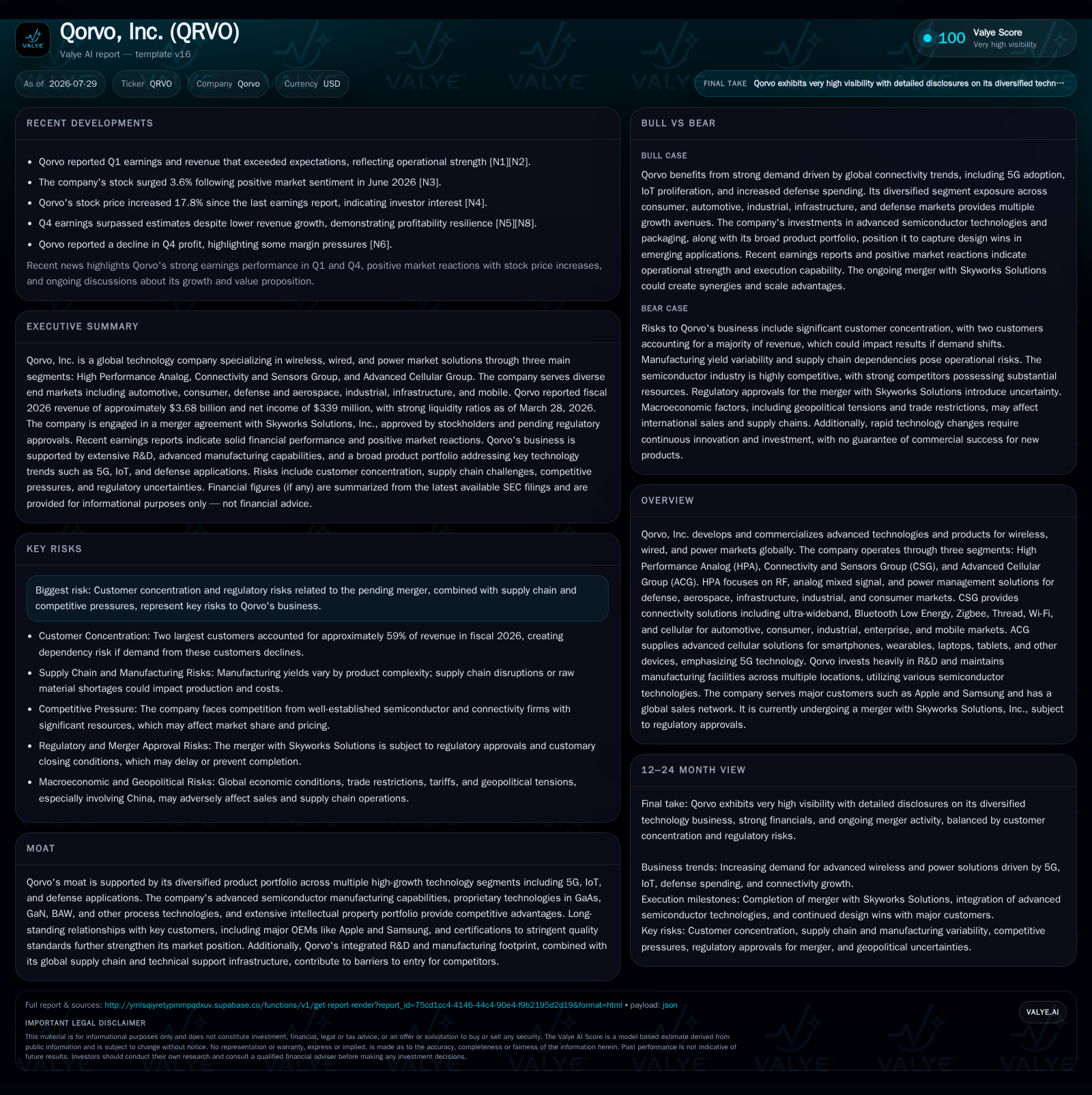
In its latest quarterly filing, Qorvo demonstrated consistent demand across its diversified segments with particular strength in connectivity products, supporting revenue stability despite broader supply chain challenges. The company’s merger with Skyworks Solutions remains on track pending regulatory approval, though integration risks and customer concentration persist as key considerations. Qorvo's manufacturing optimization and sustained R&D investment underpin its competitive positioning in RF and advanced cellular markets, while near-term milestones including backlog trends and clearance status will be critical to monitor for execution clarity.
Q2 FY2027 Operating Update Highlights: Revenue Dynamics And Segment Trends
Qorvo’s latest quarterly disclosure for fiscal Q1 ending June 27, 2026, affirms steady operational momentum across its three core segments: High Performance Analog (HPA), Connectivity and Sensors Group (CSG), and Advanced Cellular Group (ACG) [S2]. The company underscores resilient demand particularly for connectivity solutions that include ultra-wideband (UWB), Wi-Fi, Bluetooth Low Energy (BLE), Zigbee, Thread, and next-generation cellular protocols. This diversified product exposure mitigates reliance on any one vertical or end-use case.
Design wins continue to drive pipeline visibility, especially as customers incorporate more complex RF modules catering to evolving 5G architectures featuring wide frequency bands, carrier aggregation, MIMO features, and power-class advancements [S16]. While some cyclical softness persists due to macroeconomic factors impacting consumer device launches globally, the underlying book-to-bill ratio signals near-term order inflows roughly matching shipments — a sign of stable demand hygiene in a traditionally lumpy semiconductor supply environment.
Gross margins reflect the impact of product mix shifts favoring higher-value integrated modules alongside efficiency gains from manufacturing footprint optimization efforts including the consolidation of fabrication capacity out of North Carolina [S12]. These initiatives help reduce costs despite inflationary pressures on materials and logistics encountered industrywide.
Merger Milestones And Integration Risks Shaping Strategic Outlook
A defining strategic event is the pending merger with Skyworks Solutions which received stockholder approval at both companies’ special meetings early in calendar year 2026 but remains subject to final regulatory clearances including antitrust and foreign investment approvals [S1][S3]. The transaction is anticipated to close early in calendar year 2027 barring unforeseen delays.
The filings emphasize typical integration challenges: potential diversion of management attention away from new product introductions or customer engagements; risk that merger benefits such as cost synergies or broadened combined R&D productivity may be deferred or diluted by regulatory conditions; and possible negative market perception affecting stock value post-closing [S1]. Persistence of these uncertainties necessitates active monitoring as they could materially influence operational execution or strategic flexibility during the transition phase.
Furthermore, merger agreement clauses restrict Qorvo from pursuing alternative transactions post-approval which raises governance stakes regarding successful completion. Management’s clear articulation of mitigation plans around system harmonization, employee retention strategies, and supply chain alignment indicates acknowledgment of associated execution risks.
Segmented Product Portfolio Anchors Resilience Amid Industry Volatility
Qorvo’s tri-segment structure represents a deliberate strategic diversification into distinct but complementary technology domains:
- High Performance Analog (HPA): Specializes in RF products using compound semiconductor technologies—GaAs (Gallium Arsenide) and GaN (Gallium Nitride)—targeting defense/aerospace phased array radar systems, electronic warfare platforms, industrial infrastructure, and premium consumer applications. Certifications such as U.S. DoD Category 1A "Trusted Source" status underpin its trusted supplier role here [S8].
- Connectivity and Sensors Group (CSG): Delivers broad wireless connectivity solutions pivotal for the expanding Internet of Things (IoT), leveraging UWB, BLE, Zigbee, Thread standards along with Wi-Fi enhancements supportive of mesh networking. These offerings cater to automotive safety systems, smart home devices adhering to Matter® protocols, industrial sensors, enterprise networks, and mobile ecosystems.
- Advanced Cellular Group (ACG): Focuses on highly integrated RF modules feeding smartphones, tablets, wearables powered by increasingly intricate 5G network requirements. This segment’s product portfolio incorporates envelope-tracking PMICs, antenna tuners, filters using advanced packaging.
This segmentation reduces risk from cyclical downturns by balancing defense-related steadiness via HPA with high-growth commercial adoption drivers in CSG/ACG. It supports pricing power through proprietary IP especially in material sciences for GaAs/GaN wafers plus BAW filters essential for signal integrity in modern RF front ends.
Competitive Positioning In RF And Analog Markets Ahead Of Consolidation
Within the RF semiconductor landscape—which includes players such as Skyworks Solutions (pending merger partner), Analog Devices Inc., MACOM Technology Solutions Holdings Inc., and Renesas Electronics—Qorvo differentiates itself through its extensive intellectual property portfolio comprising GaAs/GaN compound semiconductor processes complemented by BAW filtering technologies [S1][S18]. This tech leadership translates into higher barriers-to-entry given the capital intensity of wafer fabrication facilities designed for these materials.
Qorvo’s recent steps to outsource less differentiated manufacturing activities while retaining control over complex process steps strive to optimize capital deployment efficiency without sacrificing quality or innovation velocity [S12]. Its geographic manufacturing realignment seeks proximity advantages near major OEMs like Apple—which accounted for approximately 50% of total revenue in fiscal 2026—and Samsung contributing another ~10%, intensifying the imperative for tight customer collaboration [S8][S9][S13].
Nonetheless, intense competition from specialized analog/mixed-signal suppliers puts pressure on pricing elasticity over product life cycles while raising stakes for securing multiple design wins across successive device generations.
Growth Catalysts: Design Wins, Advanced Connectivity, And Manufacturing Optimization
Design wins remain the primary short-to-medium term driver underpinning revenue growth trajectories for Qorvo [S16]. These wins require extensive upfront R&D investment paired with application engineering support ensuring module integration meets stringent OEM specifications including power consumption limits and signal coexistence demands inherent in dense multi-radio environments found within modern smartphones or IoT gateways
Advancements supporting Wi-Fi 6/7 standards alongside ultra-wideband implementations fuel end-market expansions particularly in consumer electronics and automotive safety domains where spatial awareness enabled by UWB is gaining traction [S1].
Manufacturing strategy emphasizing specialized GaN capability for defense/radar combined with efficient BAW filter production plays into capturing rising defense budgets globally as well as commercial infrastructure deployments supporting 5G densification [S12]. The sale of older fabrication assets aids in reducing capital intensity—a notable factor enhancing free cash flow potential going forward
Risk Factors To Monitor: Customer Concentration, Supply Chain, And Regulatory Hurdles
The company's concentrated customer base raises cautionary flags. Reliance on Apple alone approaching half of revenues exposes Qorvo to volatility tied to product launch timing changes or component sourcing shifts by contract manufacturers servicing Apple devices [S8][S9]. Similarly concentrated purchases from Samsung maintain this risk profile; combined top-two customers drove nearly 60% of revenues last fiscal year showing limited client diversification despite efforts.
Externally driven supply chain instability persists as an industry-wide challenge; semiconductor process materials subject to geopolitical export controls impact wafer supply continuity. Moreover regulatory trade policies—tariffs or export restrictions—could curtail selling abilities or sourcing flexibility threatening regional sales forecasts [S7][S10]
On merger front regulatory delays or remediations could postpone anticipated synergies or increase integration costs thus diluting projected shareholder value gains. Execution risks linked to possible restructuring initiatives or unfavorable cost overruns during post-merger alignment also remain pertinent uncertainties highlighted by management disclosures [S1].
What To Watch Next: Book-to-Bill Ratios, Backlog Levels And Regulatory Clearance
Key near-term indicators include monitoring book-to-bill ratios trending above one which would signal strengthening order momentum beyond shipments confirming robust demand pipelines amid market cyclicality risks [S2]. Concurrently tracking backlog levels provides insights into inventory build patterns which if excessive may suggest softening downstream consumption requiring cautious interpretation.
Regulatory clearance updates from antitrust authorities represent a pivotal gating factor governing expected timing for merger close early next calendar year. Any conditioning or further inquiries could extend timeline necessitating adaptive management responses communicated transparently to investors and stakeholders alike [S3].
Successful realization of cross-company synergy targets post-close alongside seamless supply chain integration efforts will form decisive markers validating strategy execution over coming quarters.
This analysis synthesizes publicly filed company disclosures without providing investment advice. It should be utilized for informational purposes alongside other research.
Disclaimer: This is research-only, informational analysis and not investment advice. It may include AI-generated interpretation and general industry context. Always verify important details using primary sources.

Comments