
Hanover Insurance Strengthens Profitability on Personal Lines Momentum Despite Revenue Pressures
Hanover Insurance’s Q2 2026 results reveal margin gains driven by disciplined underwriting in personal lines amid modest premium growth challenges.
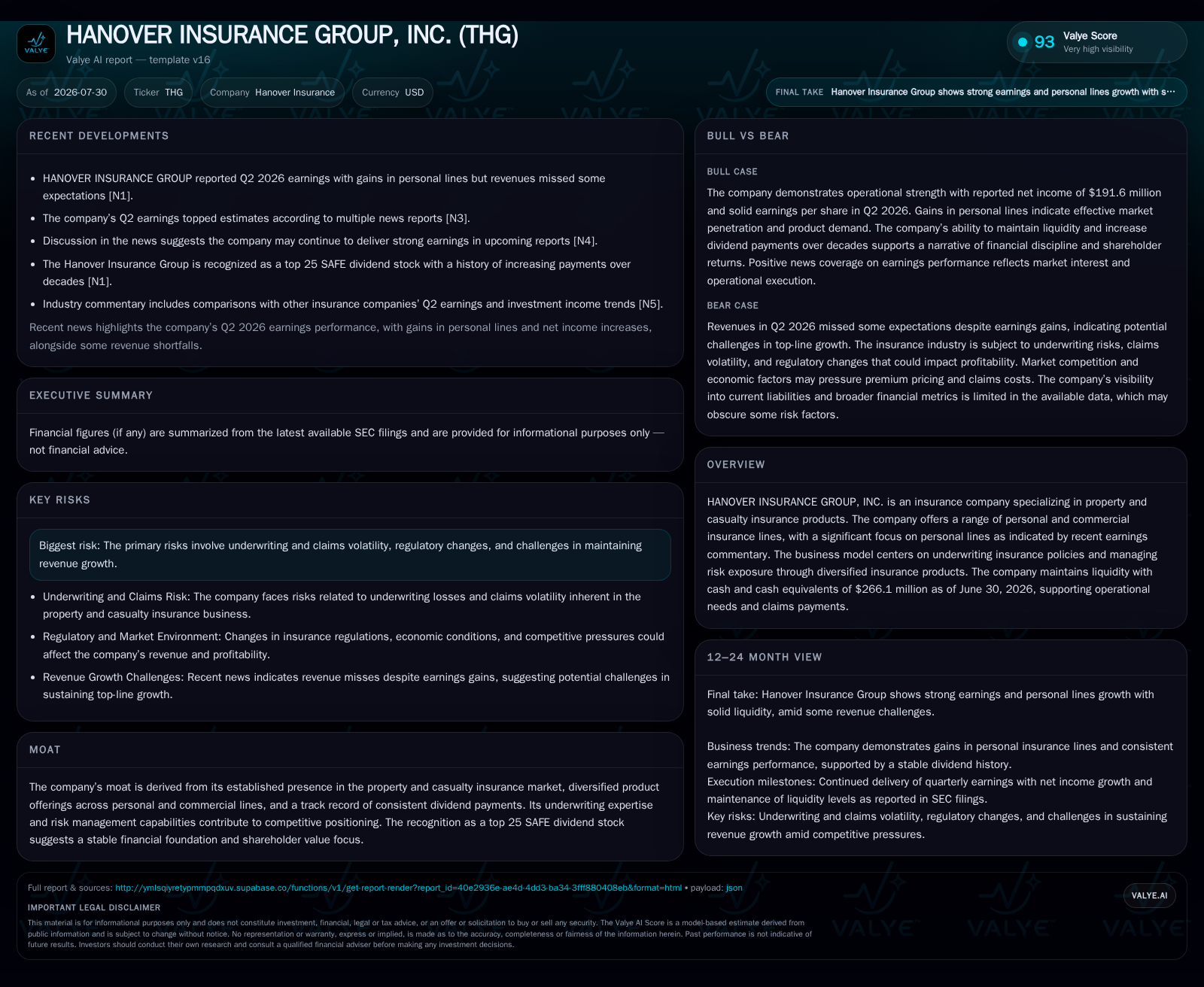
In its July 2026 quarter, Hanover Insurance Group reported improved underwriting profitability primarily fueled by selective growth and loss control in personal insurance lines despite flat overall revenue trends. The company’s disciplined risk selection and conservative reserve approach support margin expansion in a challenging claims environment, reflecting an effective balance of underwriting leverage and investment income from its premium float. Continued focus on retention and diversified product offerings underpins Hanover’s stable dividend track record amid evolving catastrophe and regulatory risks.
Second Quarter Operating Gains Driven by Personal Lines Underwriting Efficiency
The Hanover Insurance Group’s Q2 2026 10-Q filing disclosed a noteworthy enhancement in underwriting margins despite modest revenue pressures. While total premiums showed limited growth or flat trends for the quarter, improved combined ratio dynamics signaled better loss control particularly within personal lines segments. This margin expansion stems from more selective risk acceptance and effective pricing actions that have contained loss costs in an environment otherwise marked by heightened claims volatility [S2][N1][N3]. The combined ratio, which aggregates losses and expenses relative to earned premiums, is a critical sector metric reflecting underwriting profitability. Hanover's ability to reduce this measure while managing policy count underscores operational agility.
This improvement suggests that even amid competitive premium rate environments, Hanover has maintained disciplined underwriting practices leading to enhanced profitability. Evidence points to an operational focus on quality rather than volume growth in underwriting—a strategy supporting earnings resilience during fluctuating claims periods. Future quarterly filings offering detailed loss ratio breakdowns and reserve developments will validate if such discipline sustains beyond isolated periods.
Differentiated Business Model Focused on Risk Management Across Diverse Product Lines
Hanover operates principally as a property and casualty insurer with a product portfolio spanning both personal (e.g., homeowners, personal automobile) and commercial insurance lines. The company’s business model monetizes through the direct underwriting of insurance policies whereby it collects premiums commensurate with assessed risk exposures and liability profiles [S1]. These premiums represent immediate revenue inflows but also require careful actuarial assessment to manage potential claim payouts over time.
Risk management emerges as a core competency for Hanover, balancing premium growth objectives with stringent loss containment initiatives. Diversified product lines dilute concentration risk, mitigating the impact of adverse developments in any single segment or geography. Notably, Hanover engages in catastrophe exposure management practices typical within regional insurers to moderate unexpected large-scale event claims impacts. This includes reinsurance arrangements and reserve conservatism underpinning financial stability even amid environmental or economic shocks.
The blend of personal lines strength alongside commercial underwriting adds operational versatility, allowing the company to leverage cross-segment insights for risk price optimization. Maintaining this diversification while deepening expertise in specific subcategories enhances overall portfolio robustness against sector cyclicality.
Competitive Context: Underwriting Discipline and Reserve Adequacy Versus Industry Benchmarks
Hanover’s recent disclosures align it with peer insurers exhibiting conservative reserve strategies and disciplined underwriting approaches—attributes critical under renewed industry scrutiny over claim frequency shifts and capital deployment efficacy. Although explicit peer metric comparisons are not detailed in filings, qualitative benchmarking against industry leaders such as The Travelers Companies or CNA Financial suggests Hanover’s practices remain within accepted prudential norms [S1][S2].
Reserving adequacy, reflected through minimal adverse development charges in its most recent annual results, indicates judicious actuarial assumptions minimizing future unexpected claim liabilities. This is particularly salient given the insurance sector’s historical challenges surrounding reserve underestimation leading to earnings volatility.
Hanover’s Q2 disclosures show stable retention rates supporting steady policy count levels—a positive indication amidst fluctuating market conditions for new business generation [S2][N1]. Retention stabilizes the premium base essential for predictable revenue inflows while providing opportunities for incremental cross-selling across product lines.
Although revenue growth faces headwinds from subdued premium increases or market saturation levels in certain segments, ancillary investment income stemming from float management offsets some pressure on net earnings. Float—the pool of premiums collected before claim disbursement—generates returns via fixed-income securities investments structured conservatively within Hanover’s portfolio [S1]. In the current interest rate environment, such yields become strategically valuable adjuncts smoothing earnings cycles where underwriting profit margins ebb.
The synergy between underwriting discipline preserving margin integrity and investment income complementing total profitability defines Hanover’s multi-threaded approach to financial performance.
Navigating Risks: Claims Volatility, Catastrophe Exposure, and Regulatory Uncertainty
Despite operational strengths, Hanover faces typical sector risks including unpredictable claims volatility often exacerbated by severe weather catastrophes or economic cycles affecting accident frequency/severity [S2][S1]. Recent quarters highlight these dynamics requiring vigilance in maintaining adequate reserves without excessive conservatism that might hinder competitive pricing.
Catastrophe events demand agile reinsurance programs and capital buffers that can absorb episodic losses without disrupting dividend continuity or credit ratings. Regulatory shifts impacting coverage mandates or capital requirements may impose additional costs pressuring underwriting margins further.
Continued adherence to disciplined underwriting criteria coupled with robust claims management processes remains imperative for mitigating downside exposures while adapting to evolving external policy environments.
Watching the Horizon: Key Execution Milestones and Upcoming Data Points to Monitor
Important near-term milestones include forthcoming quarterly earnings announcements that will shed light on reserve development trends post Q2 accounting updates along with segment-specific underwriting performance updates particularly across commercial lines where macroeconomic sensitivities are more pronounced [S3]
Investor attention will focus on management commentary regarding capital allocation priorities—dividend sustainability measures versus opportunistic share repurchases—both integral components influencing shareholder value perceptions given Hanover’s status as a recognized Stable And Financially Established (SAFE) dividend payer.
Additional checkpoints relate to any material changes in retention rates or policy count dynamics that would confirm pricing power durability or reveal emerging competitive pressures.
Financial Profile Discussion: Liquidity, Debt, And Capital Return Posture
As of June 30, 2026, Hanover held cash and cash equivalents amounting to $266.1 million along with total debt near $800 million resulting in net debt approximating $534 million—a level indicating moderate leverage within an insurance context where balance sheet solidity underpins claim-paying capacity [F1]. Liquidity sufficiency supports operational needs including seasonal claims spikes characteristic of property casualty cycles.
The company’s balanced approach to capital management prioritizes maintaining investment-grade financial strength facilitating smooth dividend distributions aligned with long-standing shareholder return commitments. This steadiness amidst underwriting return variability evidences prudent fiscal stewardship ensuring flexibility for market contingencies without sacrificing shareholder yield reliability [N1][S3].
Overall, Hanover Insurance exhibits a financially stable foundation leveraging diversified underwriting profits combined with investment income while managing inherent sector risks through disciplined risk selection, reserve diligence, and cautious leverage utilization.
Disclaimer: This is research-only, informational analysis and not investment advice. It may include AI-generated interpretation and general industry context. Always verify important details using primary sources.

Comments