
Quad/Graphics Strengthens Profitability Amid Print Volume Challenges in Q2 2026
Quad/Graphics reports Q2 earnings above estimates, supported by operational efficiency and marketing service diversification.
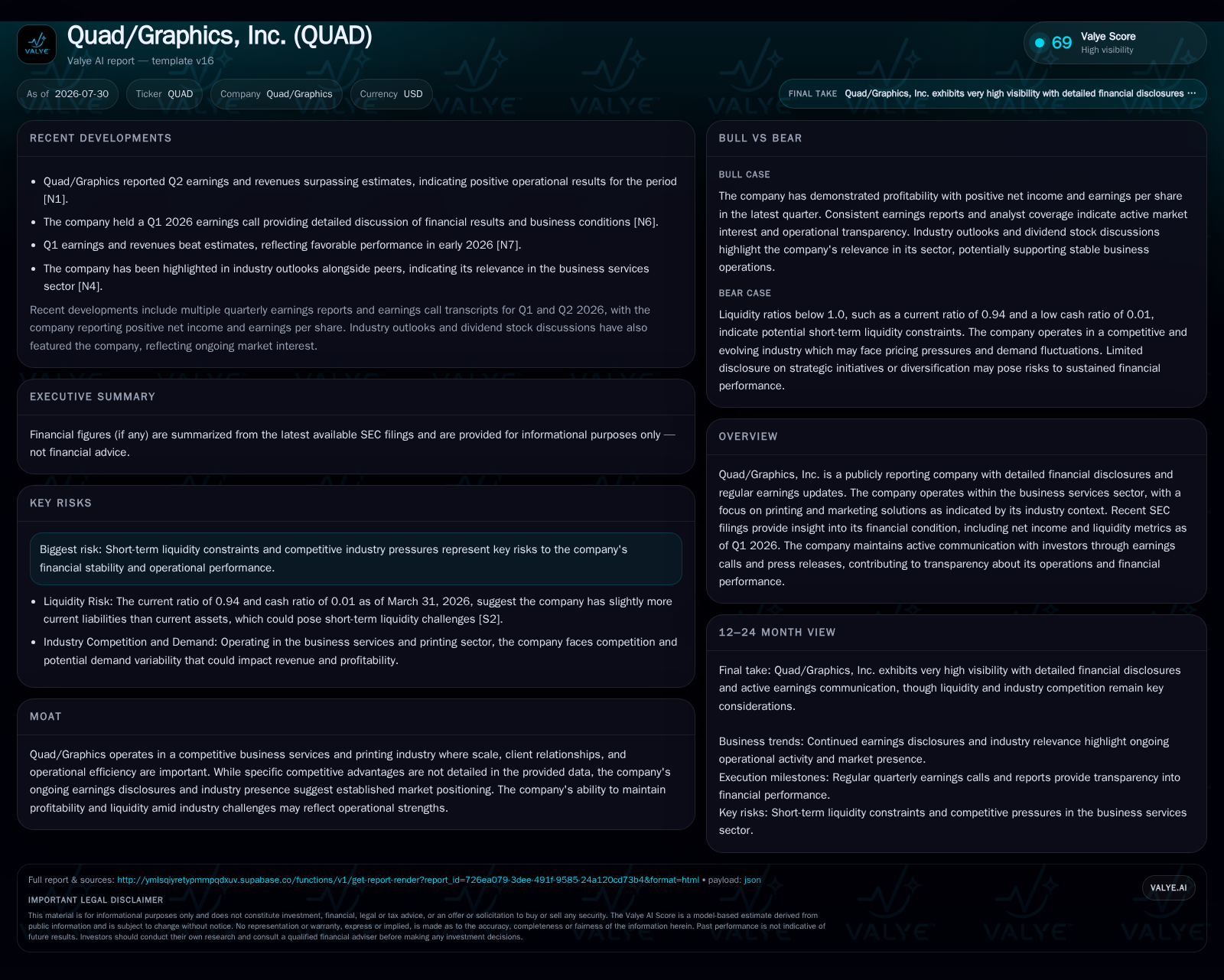
Quad/Graphics, a major commercial printing and marketing service provider, exceeded Q2 2026 earnings expectations driven by disciplined cost management and integration of digital marketing solutions [S3][N1]. While print volume demand remains pressured from ongoing digital substitution trends, the company’s focus on capacity utilization and client retention supports revenue resilience [S2][S1]. Liquidity and balance sheet metrics indicate manageable short-term constraints reflecting an industry-wide capital intensity challenge [F1]. Growth relies on cross-selling digital services alongside traditional print and leveraging e-commerce packaging opportunities.
Recent Operating Update Highlights
Quad/Graphics released its second quarter results for period ended June 30, 2026, demonstrating solid operational performance above market expectations [S3][N1]. Management cited better-than-anticipated revenue driven by improved pricing on core printing contracts coupled with growth in integrated marketing solutions. This blend of traditional print services with evolving digital offerings underscores the company's strategic pivot to stay relevant against structural declines in print volumes [S2]. The quarterly MD&A emphasizes cost control measures and productivity gains as fundamental drivers behind margin expansion despite persistent pressure on print demand.
Business Model Overview
Quad/Graphics operates primarily as a commercial printing service provider specializing in high-volume direct mail, catalog printing, magazine production, and packaging—a portfolio reflecting long-term client relationships often structured through medium- to long-term contracts with major brand owners and marketers [S1]. Revenue is generated based on contracted volume commitments or project scope involving physical printed materials complemented increasingly by value-added marketing solutions such as campaign analytics and digital media integration. The monetization mechanics rely on balancing variable costs tied to print volumes (paper, ink) with substantial fixed costs embedded in production facilities.
This fixed-cost intensity makes capacity utilization rates a pivotal profitability lever. Underutilized capacity leads to disproportionate margin erosion as fixed overheads persist regardless of volume fluctuations. Therefore, effective throughput planning and order backlog management become essential KPIs guiding operational health. Client retention further stabilizes revenue streams due to switching costs related to quality consistency requirements, fulfillment accuracy standards, and logistics coordination integral to delivery schedules.
Cross-selling digital marketing services represents a strategic move toward enhanced client engagement while diversifying revenue beyond declining traditional print usage levels. This integration helps mitigate secular headwinds affecting physical media consumption caused by ongoing shifts toward online advertising channels.
Industry Structure and Competitive Position
The commercial printing industry is typified by mature market demand with intense price competition amplified by ongoing digital media substitution. Competitors such as RR Donnelley share similar business compositions centered around large-scale print production combined with marketing services offerings. Quad/Graphics benefits from sizeable scale advantages that provide operational leverage, enabling investments in both process efficiencies and technology adoption aimed at enhancing product quality.
However, industry-wide challenges persist including customer consolidation resulting in higher customer concentration ratios which elevate dependency risks on key accounts. Contract renewals are influenced by factors such as order turnaround times, fulfillment accuracy, customization capabilities (e.g., personalized direct mail), and evolving client preferences for integrated campaign solutions blending print with digital touchpoints.
Supply chain management remains critical given exposure to raw material cost volatility—print paper prices especially susceptible—as well as ink supply consistency. Operational efficiency programs focused on reducing cost per unit produced help buffer margin pressures arising from these supply-side fluctuations.
Growth Drivers
Several growth avenues exist amid structural challenges:
- Integrated Marketing Solutions: Quad’s push to combine print with digital analytics enhances value propositions for clients seeking multi-channel campaigns using data-driven targeting techniques.
- Direct Mail Personalization: Increasingly sophisticated variable-data printing allows for tailored communications improving response rates compared with standard mass mailings.
- E-commerce Packaging Print: The rise of online shopping boosts demand for branded packaging materials—an adjacent growth segment benefiting from expanding e-commerce ecosystems.
- Outsourcing Trends: Large brands continue outsourcing printing and marketing execution to specialist providers like Quad/Graphics offering scalability benefits and supply chain expertise.
- Technological Advancements: Investments in automation and process innovation foster improved production throughput enabling better capacity utilization without proportional increases in overhead costs.
These growth opportunities are linked directly to KPIs such as sales backlog quality (indicating future demand), client retention rates reflecting satisfaction with combined service offerings, average contract sizes signaling deeper wallet share penetration, and overall operating margin improvements driven by optimized production costs.
Risks and Growth Constraints
Careful management of these risks along with strategic investments will be essential to sustaining growth momentum.
What to Watch Next
Future quarterly updates should provide clarity around several key indicators:
- Trends in print volume recovery or further declines,
- Capacity utilization percentage shifts indicating improved productivity or emerging slack,
- Renewal rates of major contracts highlighting client loyalty,
- Progress in digital marketing service revenues showing success of diversification efforts,
- Gross margin stability or improvement reflecting cost controls amidst raw material price changes,
- Capital expenditure plans aimed at modernizing production versus legacy asset maintenance.
Close monitoring of these metrics will reveal the sustainability of recent positive earnings surprises and guide understanding of underlying structural business health.
This analysis synthesizes recent filings alongside industry context to provide a grounded view into Quad/Graphics' position within evolving commercial printing markets. It highlights strategic adaptation efforts anchored by operational discipline balanced against enduring sectoral headwinds typical for incumbent players navigating the shift towards integrated marketing communications solutions.
This report does not constitute investment advice but aims to deepen understanding of Quad/Graphics’ business fundamentals given the latest public disclosures.
Disclaimer: This is research-only, informational analysis and not investment advice. It may include AI-generated interpretation and general industry context. Always verify important details using primary sources.

Comments