
Bunge Global SA Expands Integrated Agribusiness Operations with Viterra Acquisition Amid Margin Pressures
Bunge Global’s Q2 2026 earnings reflect volume-driven sales growth tempered by commodity price volatility and integration costs from its recent Viterra acquisition.
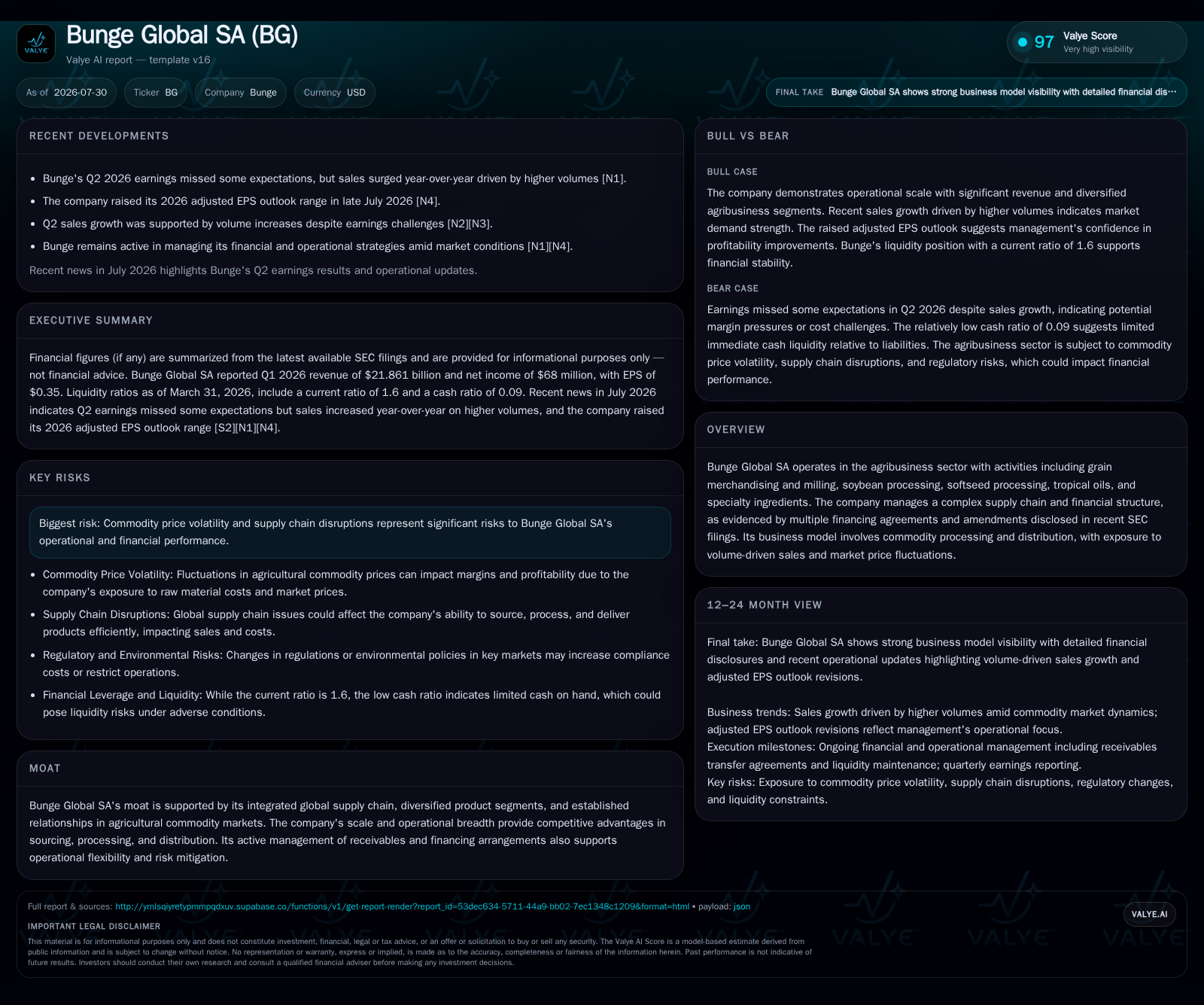
In Q2 2026, Bunge Global SA reported a sales surge driven by higher commodity volumes but missed earnings estimates due to margin compression tied to market price fluctuations and integration expenses. The company’s complex global supply chain and diversified processing segments provide competitive scale, but profitability remains sensitive to commodity price cycles and operational execution. The recent acquisition of Viterra enhances Bunge’s footprint and supply capabilities, adding significant goodwill but also integration risks. Financially, Bunge maintains a healthy liquidity position with a current ratio of 1.6 and manageable leverage given its expansive capital base. Key watchpoints include operational synergies realization, hedging effectiveness amid commodity volatility, and capital investment in storage and processing capacity.
Recent Operating Update: Margin Pressure during Volume Growth
Bunge Global SA’s second quarter 2026 results highlighted a significant increase in sales volume compared to prior periods; however, reported earnings missed estimates reflecting margin compression primarily linked to commodity price volatility [S2][N1][N3]. This dynamic underscores the agribusiness sector’s intrinsic sensitivity to market fluctuations despite operating scale. The company adjusted fair values for assets acquired in its December 2025 acquisition of Viterra during Q2, recording a $574 million goodwill increase mainly attributed to property plant and equipment as part of finalized purchase accounting [S2]. While this bolsters Bunge's asset base and geographic reach—particularly in key grain merchandising hubs—the integration costs present near-term pressures on profitability.
Business Model: Integrated Commodity Processing and Merchandising
Bunge operates as an integrated agribusiness firm positioned midstream/downstream within the agricultural value chain. It manages grain merchandising alongside extensive processing operations including soybean crushing and refining, softseed oil processing (e.g., sunflower), tropical oils handling, and specialty ingredients production [S1]. The model generates revenue primarily by sourcing raw agricultural commodities from farmers or traders at prevailing market prices and adding value through processing activities such as crushing oilseeds into meal and refined oils. These products are then sold predominantly to industrial customers (food manufacturers, retailers) or biofuel producers under varying contract structures.
Monetization levers include volume throughput at processing plants (measured in metric tons processed daily), product mix between bulk commodities versus specialty ingredients offering higher margins, and pricing realized against fluctuating global commodity benchmarks. The integrated supply chain—comprising storage facilities (with capacity exceeding tens of millions metric tons globally), port terminals for export access, refining packaging lines, and freight logistics—facilitates efficient commodity flows across diverse geographies including North America (largest capacity cluster), South America (notably Brazil/Argentina), Europe, and Asia-Pacific [S1]. Capacity utilization rates at these facilities directly influence gross margins; underused assets diminish operational leverage while sustained high throughput supports margin expansion.
Bunge supplements physical operations with financial risk management strategies designed to hedge against upward commodity cost spikes or weakening selling prices. However, these hedges rely on derivatives markets which can present basis risk or imperfect offsets during extreme volatility periods [S1]. Customer contracts typically combine spot purchasing with medium-term supply agreements; fluid pricing environments challenge stable margin capture.
Industry Structure and Competitive Position
The global agribusiness sector is characterized by capital-intense midstream firms operating vast networks of processing plants coupled with grain merchandising desks managing exposure to volatile agricultural commodity markets. Key peers include Archer Daniels Midland (ADM), Wilmar International specializing in tropical oils, Ingredion Incorporated focusing on specialty food ingredients, alongside privately held Cargill which competes broadly across commodity merchandising and processing.
Bunge differentiates through its sizable integrated footprint spanning over 100 oilseed crushing facilities worldwide complemented by extensive storage capacity—over 40 million metric tons aggregate—which enhances ability to manage logistics costs and supply timing advantages relative to regional competitors [S1]. Its diversified product slate offers resilience when single-commodity prices face idiosyncratic shocks. Still, industry-wide challenges such as tightening environmental regulations on palm oil sourcing or sustainability compliance add operational complexity demanding ongoing investments.
Growth Drivers
Global demand for protein-rich foods alongside vegetable oils continues to grow driven by rising consumption in emerging markets—their increasing middle-class populations expanding the edible oils market. Concurrently biofuel policies boosting renewable diesel production elevate feedstock needs for soybeans and softseeds oil processing segments where Bunge has core capabilities.
Technological improvements targeting crushing efficiency and refining yields present incremental margin expansion opportunities while vertical integration initiatives seek to internalize downstream specialty ingredient functions that command premium pricing. Geographic diversification through acquisitions like Viterra synergistically expand grain origination channels into Canada’s rich farmland belt enhancing raw material sourcing security.
Investments into logistics infrastructure such as port terminals reduce bottlenecks during peak seasons allowing smoother throughput at processing plants thus better matching customer demand patterns. Specialty ingredients remain a strategic focus offering value-added differentiation beyond commoditized oils or meals.
Risks and Constraints
Despite scale advantages mitigating certain cost pressures relative to smaller players, Bunge remains exposed to pronounced commodity price cycles prone to rapid reversals impacting gross margins unpredictably. Supply chain disruptions from inclement weather events or geopolitical tensions—especially affecting export routes—could constrain throughput reducing revenue volume.
Currency fluctuation risk across regions affects both input costs paid locally versus USD-denominated selling prices impacting net margins unless effectively hedged. Counterparty credit risk arises within commodity trading activities necessitating robust risk monitoring frameworks.
Energy cost shocks influence refining expenses since crushing operations depend on electricity or natural gas inputs; persistent increases could depress profitability absent swift pricing pass-throughs. Regulatory shifts concerning sustainability reporting or import tariffs create compliance burdens potentially limiting market access or raising costs.
Integration delays following large-scale acquisitions such as Viterra pose execution risks; failure to realize anticipated operational synergies timely could weigh on near-term free cash flow generation.
What to Watch Next
Market participants should track the progression of synergy realization from the Viterra acquisition through sequential quarters; improvement in asset utilization rates at expanded facility footprints would validate integration success. Monitoring price/mix trends between bulk commodity products versus rising specialty ingredient sales will reveal margin trajectory signals.
Effectiveness of the company's hedging program should be evaluated especially if volatile global agricultural markets persist due to climate variability or geopolitical instability influencing crop yields or trade flows.
Capital expenditure disclosures touching storage capacity expansions or plant upgrades provide insight into strategic priorities aimed at sustaining competitive positioning amid tightening regulatory landscape focused on sustainability compliance.
Earnings releases incorporating updated guidance can highlight shifts in management expectations about growth opportunities or margin pressures helping clarify operational momentum beyond seasonal effects.
Financial Profile Discussion
At the end of Q1 2026 (latest available data), Bunge held $839 million in cash equivalents against total debt approximating $11.3 billion yielding net debt around $10.47 billion [F1]. With current assets of approximately $27.1 billion versus current liabilities near $16.9 billion this equates to a solid current ratio of about 1.6 indicative of adequate short-term liquidity headroom supportive of working capital-intensive trading activities familiar in agribusiness sectors [F1].
Depreciation expense jumped significantly post-acquisition period onset signaling increased asset base utilization with larger non-cash charges aligned with property plant valuation uplift reported during Q2 2026 settlement adjustments [S2]
Free cash flow generation will be pivotal over coming quarters to fund both organic growth initiatives plus any further bolt-on acquisitions targeting specialty ingredient segments known for higher margin profiles yet requiring upfront spending.
This analysis synthesizes publicly filed quarterly information anchored on SEC filings dated July 29, 2026 ([S2], [S3]) supported by annual business context ([S1]) alongside companyfacts financial snapshots ([F1]). External news sources provide supplementary insights ([N1], [N3]). It does not constitute investment advice but aims to deliver an informed industry analyst perspective on Bunge Global SA's operating dynamics amid ongoing market conditions.
Disclaimer: This is research-only, informational analysis and not investment advice. It may include AI-generated interpretation and general industry context. Always verify important details using primary sources.

Comments