
Virtuix Expands VR Treadmill Adoption with Strategic Partnerships Amid Liquidity Challenges
Virtuix Holdings accelerates hardware and software integration across gaming and defense sectors while managing near-term financial constraints.
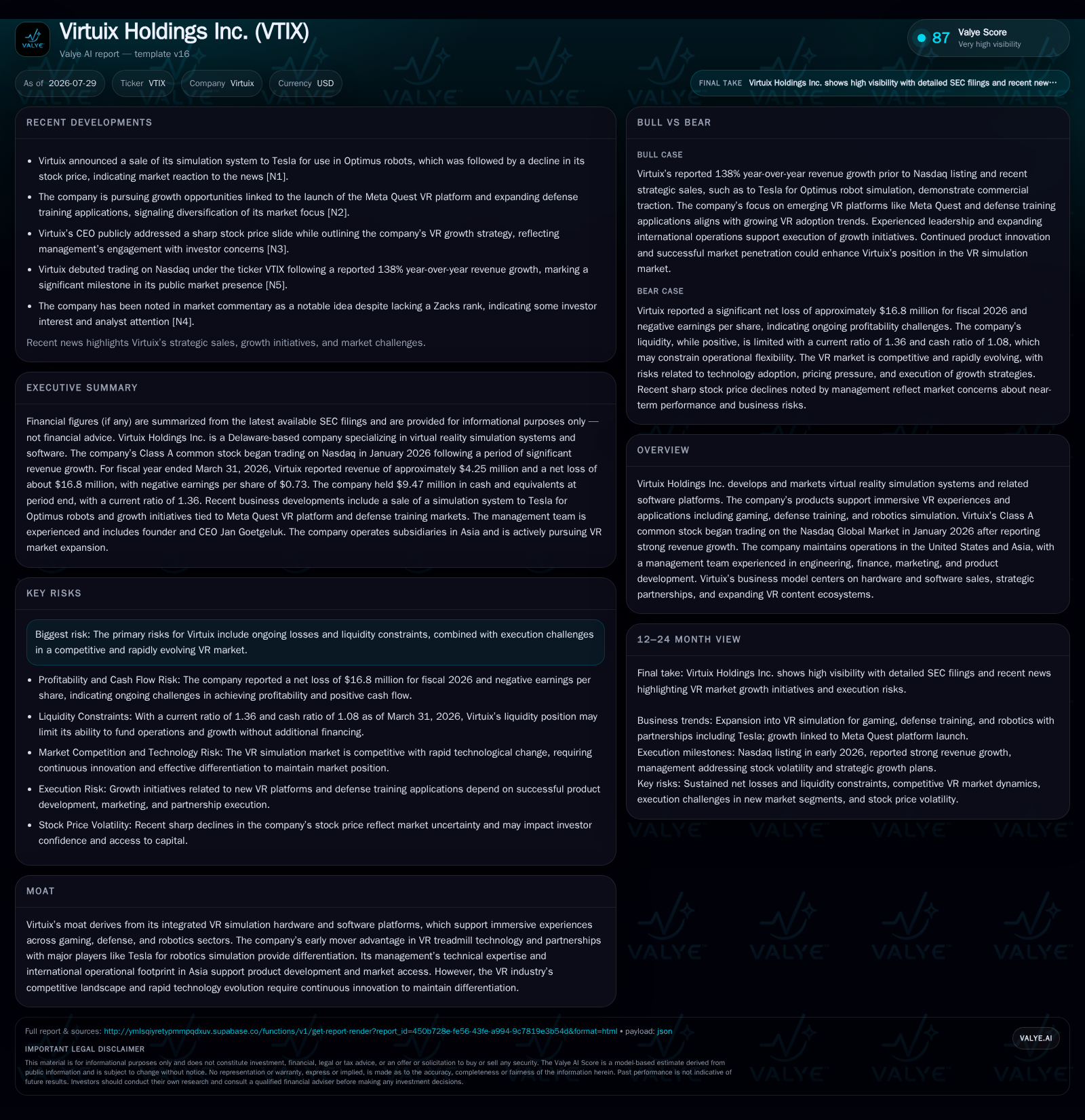
Virtuix Holdings, a Nasdaq-listed developer of integrated virtual reality (VR) simulation systems, reported ongoing operational progress in the fiscal year ended March 2026 driven by new product launches and partner engagements. The company continues to rely on strategic partnerships—such as with Oculus Quest platforms and Tesla for robotics simulation—to broaden adoption of its VR treadmill hardware and software ecosystems. However, Virtuix faces liquidity pressures with a moderate current ratio and net debt position, underscoring the need for careful cash management as it invests in research and development amid a competitive VR industry landscape.
Recent Operating Update
Virtuix Holdings Inc., which recently debuted its Class A shares on Nasdaq in January 2026, disclosed continued operational progress as of its fiscal year ended March 31, 2026. The company posted $4.25 million in revenue for this period but recorded substantial operating losses totaling over $10.3 million resulting in a net loss close to $17 million [F1][S2]. These figures highlight Virtuix's early-stage growth profile prevalent among emerging VR hardware and software integrators still investing heavily in technology development.
In early 2026, Virtuix launched its flagship Omni One VR treadmill designed explicitly for compatibility with Meta’s Oculus Quest platform. This move strategically lowers the entry barrier for consumer gamers seeking immersive locomotion experiences without requiring dedicated bulky setups or PC tethering [S4][N1]. By leveraging the market reach of the Oculus Quest ecosystem—a leader in untethered standalone VR devices—Virtuix aims to capitalize on rising user demand for realistic physical movement simulation within virtual worlds.
Beyond gaming expansions, Virtuix diversified its application base by engaging Tesla to deploy its simulation system technology for Optimus robotics training purposes. This contract serves as credible validation of the company's product relevance in high-precision industrial simulations aiding autonomous robot navigation and task rehearsal [N2][S1]. Such collaborations signify Virtuix's efforts to transcend gaming-centric use cases into defense training simulations and robotics—a multifaceted approach necessary given the industry's fragmented demand drivers.
Business Model
Virtuix operates at the nexus of VR hardware manufacturing and software platform development. Its core offering centers on proprietary omnidirectional treadmills enhancing user immersion via motion tracking hardware tightly integrated with software platforms supporting various content scenarios such as games, defense drills, or robotic control simulations [S1]. Revenue is primarily generated through direct hardware sales complemented by software licenses, updates, and potential service agreements embedding recurring revenue streams.
A critical strength lies in Virtuix's vertical integration enabling optimization of both physical device ergonomics—crucial for user experience (UX)—and software responsiveness across multiple VR headset platforms including Meta Quest devices. This dual-layer integration forms a defensible moat against competitors who typically specialize either in hardware peripherals or standalone software environments but rarely both cohesively paired—increasing switching costs for customers reliant on full-system compatibility.
Monetization mechanics further benefit from strategic licensing partnerships that expand the content ecosystem size—quantified by compatible applications supporting Virtuix's treadmill input standard—and from incremental upgrades enhancing average selling prices (ASPs). Marketing channels include direct-to-consumer e-commerce supplemented by enterprise contracts within government and industrial robotics sectors feeding into elevated customer acquisition cost (CAC) but potentially higher lifetime value contracts.
Industry Structure and Competitive Position
The virtual reality hardware-software sector is characterized by rapid innovation cycles driven by relentless R&D investments from major players such as Meta Platforms (Oculus), HTC Vive (hardware), Unity Technologies (content development), alongside defense simulators like Lockheed Martin leveraging advanced immersive training solutions. Virtuix positions itself distinctly through its specialized treadmill locomotion technology serving niche yet expanding segments focused on full-body immersion rather than mere visual or manual interaction alone.
Competitors often lack equivalent integrated hardware-software solutions or focus on purely entertainment domains without crossover into industrial simulation markets. Nonetheless, established giants possess scale advantages in research breadth, distribution networks, and brand recognition that constrain smaller entrants' market penetration efforts.
Virtuix partially mitigates these structural competition risks through its geographic presence spanning North America and Asia enabling localized manufacturing efficiencies and access to global tech talent pools. The company's management boasts engineers experienced in international operations—a factor enhancing agility amid supply chain disruptions endemic to hardware production lines.
Growth Drivers
Increasing adoption of VR technologies across consumers and enterprises fuels long-term growth potential. Consumer interest related to gaming manifests through expanding VR headset sales volumes compounded by demand for more intuitive locomotion solutions embodied by devices such as Omni One.
Enterprise applications grow concurrently; defense agencies prioritize hyper-realistic training simulations reducing live-exercise costs while improving soldier preparedness. Robotics firms seek advanced simulation tools to accelerate autonomous system development cycles safely—Tesla's adoption underscores this trend.
Technology advances increasing hardware performance metrics while improving user comfort address critical barriers historically limiting daily usage durations—this enhances user engagement metrics like session length contributing to stickier ecosystems benefiting Virtuix's platform strategy.
Strategic partnerships underpin accelerated market access; channeling products through leading HMD providers reduces customer acquisition friction while licensing agreements facilitate growing third-party developer participation enlarging compatible content libraries.
Plummeting component costs partially offset capital intensity inherent in hardware manufacturing allowing margin improvements if unit sales scale accordingly—a key KPI to monitor going forward is ASP trends along with unit shipment volumes reflecting economically sustainable growth trajectories.
Risks and Watchpoints
Rapid technological obsolescence remains paramount risk mandating continuous innovation investments risking periodic margin dilution if new releases do not meet performance benchmarks or pricing expectations relative to competitors with deeper pockets.
Intense competitive pressure arises from tech giants advancing proprietary locomotion methods or immersive experience technologies potentially eroding Virtuix’s unique value proposition unless differentiation steepens via exclusive partnerships or patented innovations.
Market adoption uncertainty persists: consumer willingness to invest time/money into peripheral devices like treadmills is unproven at scale; likewise, enterprise buyer procurement cycles can be lengthy involving regulatory approvals especially for defense applications complicating revenue visibility.
Supply chain disruptions notably affect hardware manufacturing outcomes; availability issues may inflate CAC or delay product fulfillment jeopardizing customer satisfaction metrics critical for retention.
Dependency on third-party content developers constrains control over ecosystem breadth impacting platform attractiveness relative to closed or fully owned solution competitors requiring monitoring engagement metrics tied to developer activity volume.
Liquidity constraints emerge as prominent concern given operating losses exceeding $10 million yearly combined with net debt positioning approximating $5.2 million at fiscal year-end March 31, 2026; sustained cash flow management alongside warrant amendment negotiations serve pivotal roles in maintaining solvency [F1][S3]
What To Watch Next
Key near-term milestones include achieving measurable increases in Omni One unit sales linked to Meta Quest launches alongside expansion of enterprise contracts particularly within defense training segments evidenced by pipeline announcements or award wins.
Monitoring terms around amended warrants extending their expiration through mid-2026 provides insight into capital structure flexibility supporting ongoing R&D spending without precipitating immediate dilution events [S3][S29]
Further articulation from management regarding roadmap timing on new software platform enhancements or ecosystem growth initiatives will illuminate innovation cadence potential sustaining competitive differentiation.
Any shifts in operating loss trends supported by evidence of margin improvement through scaled revenue or cost efficiencies are vital financial markers validating business model scalability assumptions.
New disclosures concerning geographic market penetration progress—especially heightened activity within Asian industrial markets—would reinforce management's claims on operational footprint benefits enabling future growth sustainability.
Finally, regulatory developments affecting export control or compliance within defense-related simulation applications warrant attention as potential growth constrainers or accelerants depending upon outcomes.
Financial Profile Discussion
As of March 31, 2026—Virtuix held approximately $9.5 million in cash and equivalents against total debt nearing $14.7 million resulting in net debt around $5.2 million indicating moderate leverage levels coupled with ongoing negative free cash flow dynamics typical for emerging tech companies still scaling commercial traction [F1][S2]
The current ratio stands at approximately 1.36 reflecting reasonable short-term liquidity cushioning near-term obligations versus current liabilities slightly below $8.8 million [F1]. Despite this cushion, reliance on amendments extending warrant exercise periods evidences continuing financing dependency reflecting operating losses above $10 million annually necessitating equity-linked capital infusions to bridge cash burn gaps [S3][F1].
R&D expenditure remains significant obscuring near-term profitability but crucially supports pipeline robustness fundamental to long-term viability amidst rapid technology evolution challenges prevalent across the VR industry segment where competitors invest aggressively to capture share [S1].
Capital expenditures align predominantly with manufacturing equipment deployment linked to scaling Omni One production meeting nascent demand signaling initial capacity buildout phases rather than mature operations sustaining margins at scale.
Liquidity watchpoints should focus on tracker cadence around monthly redemption rights tied to outstanding notes commencing mid-2026 plus covenant adherence embedded within various debt instruments limiting incremental financial maneuverability absent refinancing actions [S24]
Overall financial positioning portrays a firm balancing early commercialization ambitions against constrained resources necessitating prioritization of high-return investment opportunities paired with effective cash management policies essential for prolonged operational runway expansion.
This analysis is based exclusively on publicly filed SEC documents dated through July 29, 2026 (), supplementary news sourced from Nasdaq reports (), and verified financial facts ([F1]). It does not constitute investment advice but aims to illuminate Virtuix Holdings’ business dynamics amid evolving virtual reality industry conditions.
Disclaimer: This is research-only, informational analysis and not investment advice. It may include AI-generated interpretation and general industry context. Always verify important details using primary sources.

Comments