
Tyler Technologies Accelerates SaaS Transition While Capitalizing on Public Sector Digitalization
Strong Q2 execution and a sizable share repurchase plan underscore Tyler’s growing recurring revenue base amid ongoing public sector IT modernization.
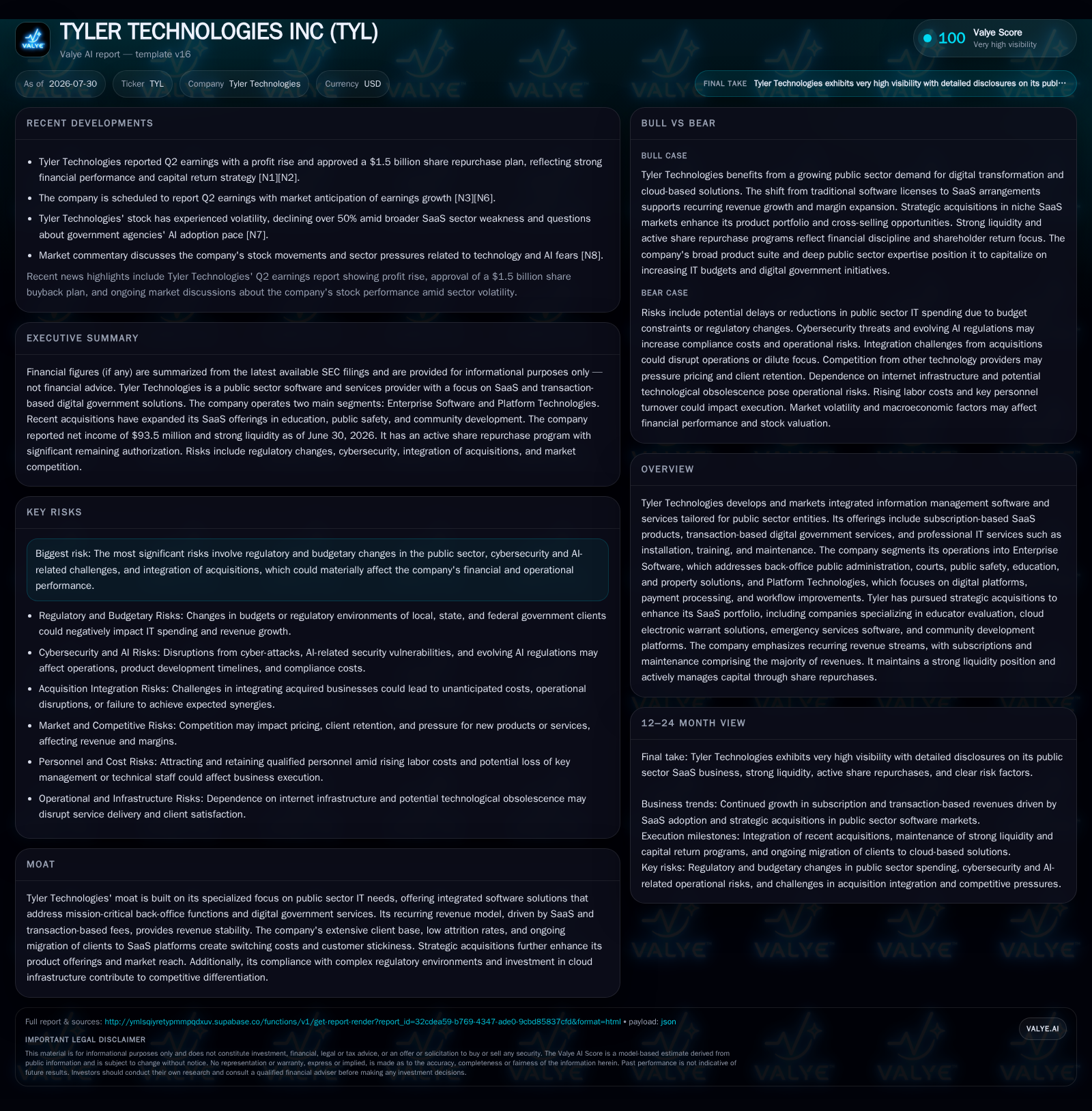
Tyler Technologies’ latest quarterly filing highlights sustained momentum in its SaaS migration and recurring revenue growth, bolstered by strategic acquisitions and a $1.5 billion share buyback authorization. The company’s dual-segment model—Enterprise Software for mission-critical public administration and Platform Technologies for digital government platforms—generates stable subscription and transaction-based revenues, supporting attractive operating margins. Continued public sector digitization, regulatory requirements, and platform-driven workflow automation underpin organic growth, while acquisition activity deepens vertical capabilities. Key risks remain linked to public budget variability, cybersecurity threats, and integration challenges as the market evolves.
Q2 2026 Operating Update Highlights Renewed Growth and Capital Return
Importantly, Tyler announced a significant capital return initiative with its board approving an additional $1.5 billion share repurchase authorization [S3], expanding on the $1.0 billion plan approved earlier in 2026. This aggressive buyback reflects management’s confidence in robust free cash flow generation underpinned by strong operating margins and recurring revenue inflows amid steady government IT spending patterns seen across local and state agencies [N7]. Share repurchases may also help offset dilution from stock-based compensation programs prevalent in software firms.
Integrated Public Sector Software: How Tyler Monetizes Through Recurring Revenues
Tyler operates primarily through two reportable segments: Enterprise Software (ES) and Platform Technologies (PT) [S1][S14]. ES focuses on mission-critical back-office functions for public administration including courts, public safety operations, education administration, and property appraisal solutions. PT offers digital platforms emphasizing payment processing, workflow automation, data streamlining for government agencies, and other transformative digital government services.
Monetization is anchored on subscription-based SaaS contracts paired with transaction fees mostly generated under multi-year government contracts. These contracts provide highly predictable annualized revenue streams given the ongoing need for compliance updates and public service digitization [S1][S18]. Professional IT services such as implementations, training, customization work, ongoing maintenance subscriptions alongside hosting fees complement these revenue streams but constitute a smaller portion of total revenues.
This business model creates durable cash flows characterized by long contract durations with built-in renewal cycles that reduce volatility. The mix shift toward SaaS notably improved gross margins in recent years by increasing high-margin subscription fees relative to legacy license sales or one-time professional services [S9]. Subscription revenue grew strongly by about 18% in 2025 [S17], highlighting success transitioning clients onto cloud-hosted solutions that support scalability without commensurate cost increases.
Competitive Moat Rooted in Platform Breadth and Client Stickiness
Tyler’s moat rest on its specialized focus on public sector IT needs coupled with highly integrated software suites spanning numerous local government operational areas [F1][S1]. The complexity of integrating multi-agency workflows with stringent regulatory compliance requirements—and often extended procurement cycles—creates substantial switching costs for clients.
Customer retention remains high driven by continuous innovation in platform technologies such as workflow automation tools and digital payment processing capabilities that tightly embed Tyler products into daily agency operations [S17]. The company reported low churn rates consistent with peers like NIC Inc. and CentralSquare Technologies who operate under similar client dynamics. As clients migrate fully onto SaaS platforms hosted on robust cloud infrastructure, operational disruptions become less frequent while product enhancements enhance end-user satisfaction.
By owning both enterprise application layers and platform services including payment gateways regulated under complex legal frameworks, Tyler enjoys economies of scale difficult for smaller vendors to replicate. This breadth supports cross-selling opportunities within existing customers increasing wallet share via seat expansion or functional upgrades.
Acquisition Strategy Enhances Vertical Specialization and SaaS Penetration
Recent acquisitions form a crucial element of Tyler’s growth strategy enhancing both vertical specialization within the public sector and accelerating SaaS adoption [S7]. In 2025 alone, acquisitions such as Edu.Link (education performance management), CloudGavel (cloud electronic warrant solutions), Emergency Networking (emergency services software), and MyGov (community development platforms) expanded Tyler’s product portfolio significantly.
These targets generally provide differentiated SaaS offerings tightly focused on specific public subsectors where tailored compliance or operational functionality is critical. Integration of these firms into the Enterprise Software segment bolsters cross-sell capacity whilst enabling rapid adoption of cloud-native technologies among traditionally conservative government IT buyers.
While acquisition integration carries inherent risks including cultural fit challenges and capital deployment efficiency concerns [S1], the complementary nature of these targets aligns well with Tyler’s migration roadmap toward full SaaS delivery models alongside recurring transaction fee expansions.
Growth Catalysts from Digitization, Regulatory Mandates, and Workflow Automation
Demand drivers for Tyler reflect broad secular trends reshaping government IT landscapes: continued digitization efforts within state/local agencies accelerating workflow automation; rising mandates around compliance reporting; online payment methods prevalence; and general modernization replacing aging legacy platforms.
These factors necessitate multi-year investments by agencies in integrated SaaS platforms that can evolve rapidly while meeting regulatory oversight.[N1] Tyler’s expansive solution set helps governments meet such mandates—especially courts modernization or tax appraisal system upgrades—providing stickiness via embedded workflows fostering platform dependency.
Peers such as NIC Inc. experience similar tailwinds underscoring structural opportunity beyond cyclical funding variations typical of government budgets.
Risks: Budget Cyclicality, Regulatory Change, Cybersecurity, and AI Integration Challenges
Several risk vectors could materially affect Tyler’s performance if realized [S1][S2][F1]. First is reliance on public sector funding cycles which fluctuate based on political priorities potentially delaying IT project approvals or renewals affecting near-term booking visibility.
Cybersecurity risks heighten with increased cloud deployment amid evolving sophisticated cyber threats targeting sensitive government data; breaches or system downtime would damage reputation and contractual performance metrics. Additionally, regulatory developments governing AI use present compliance complexities modifying product feature roadmaps or increasing development costs due to ethical oversight demands.[S1]
Acquisition integration risks also remain salient given the regularity of bolt-on deals that require harmonizing disparate technology stacks without disrupting existing customer service levels.
Mitigation efforts focus on rigorous security protocols hosted within certified cloud environments plus proactive legal monitoring concerning AI regulations shaping future product design cycles.
Key Near-Term Milestones: Customer Metrics, Acquisition Results, Product Pipeline
Investors should closely monitor quarterly updates on ARR growth trajectories post-deal integrations along with relatively leading indicators like net retention rate improvements or churn stabilization reflecting customer satisfaction amidst ongoing platform migrations [S2][N1]
Integration progress of recently acquired firms into core platforms will signal capital allocation efficacy while product rollouts targeting expanded use cases across judicial or emergency response domains will indicate innovation cycle health supporting organic growth.
Renewal rate transparency will gauge resistance to competitive displacement or pricing pressure particularly important given protracted sales cycles common in government contracts.
Financial Position Discussion: Balance Sheet Flexibility Supports Buyback Program
Tyler maintains a solid financial profile balancing liquidity with prudent leverage management [F1][S3]. The company holds approximately $895 million in cash and equivalents against total debt near $1.44 billion, resulting in net debt around $542 million as of June 30, 2026 [F1]. This reflects a moderate leverage position relative to the enterprise scale.
The company’s current ratio stands at about 1.55, indicating healthy short-term asset coverage against liabilities and supporting operational flexibility amid varying budget cycles [F1]
Overall financial strength underpins confidence in continued organic investment combined with selective acquisition spend supporting Tyler's growth ambitions.
Disclaimer: This is research-only, informational analysis and not investment advice. It may include AI-generated interpretation and general industry context. Always verify important details using primary sources.

Comments