
Sono-Tek's Ultrasonic Edge: Shifting To High-Value OEM Systems Amid Industry Changes
Sono-Tek advances from component sales toward integrated, high-ASP ultrasonic coating systems with robust OEM adoption and expanding medical device traction.
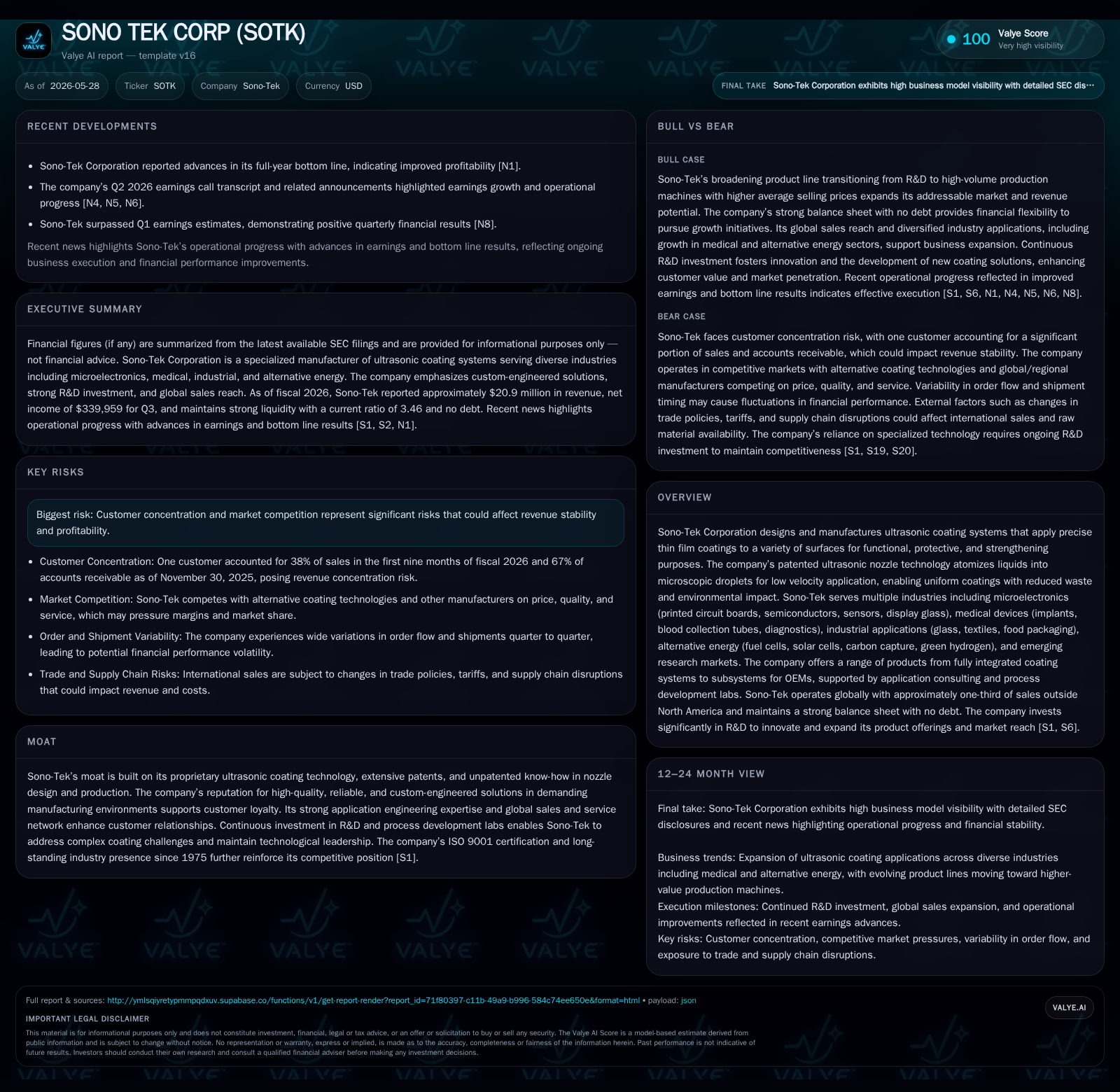
In its latest quarter, Sono-Tek reported a notable strategic evolution marked by significant revenue growth in OEM ultrasonic coating systems, driven by penetration into medical and electronics sectors. While overall sales remain broadly stable year-to-date, the shift toward high-value machine solutions is lifting operating margins and profitability. The company’s patented ultrasonic nozzle technology and deep application engineering underpin its competitive moat despite customer concentration risks and regulatory headwinds in alternative energy. Key near-term drivers include order backlog expansions and higher medical device market adoption, with financial strength supporting growth initiatives.
Recent Operating Highlights Drive Strategic Transition
The most recent quarterly filing (Q3 fiscal 2026 ending November 30, 2025) reveals vital shifts in Sono-Tek's revenue composition that illuminate its evolving strategic posture [S2]. The business has decisively moved from primarily selling ultrasonic nozzles and component parts toward high-value complete machine solutions and subsystems tailored for OEMs. This transition is evidenced by a sharp 64% increase in OEM systems revenue for Q3 compared to the prior year quarter and an 18% increase year-to-date across the first nine months of fiscal 2026
This transformation emphasizes Sono-Tek's capability to embed its ultrasonic coating technology deeper into customer production lines rather than just supplying standalone components. The shift not only reflects growing industry trust but drives significantly higher average selling prices (ASPs), as these integrated systems command premium pricing over individual nozzles.
Operational results benefit notably from this revenue mix improvement. Gross profit rose by $452,000 (6%) sequentially to $7.77 million with a gross margin uplift to approximately 51% due to mature high-ASP system sales alongside manufacturing efficiencies and reduced warranty costs [S4]. Operating income surged over 60% to $319,000 for the quarter as operating leverage took effect during stable expenses. Net income followed similarly with a 24% sequential rise [S2], affirming operational scalability accompanying this product line evolution.
Segmentally, gains were broad-based within electronics (notably fluxing-related OEM customers), medical devices (balloon catheter systems and stent coatings), industrial applications (textiles), while alternative energy experienced softness linked to reduced US electrolysis demand caused by shifting government policy incentives affecting carbon capture and fuel cell segments [S2, S4].
Business Model and Proprietary Ultrasonic Technology Insights
Sono-Tek's core revenue model hinges on designing and manufacturing custom ultrasonic coating equipment that applies ultra-thin uniform liquid films onto various substrates using its proprietary patented ultrasonic nozzle technology [S1]. The nozzle emits high-frequency vibrations converting liquids into microscopic droplets delivered at low velocity—offering superior control compared to traditional spraying methods.
Customers pay for complete coating solutions ranging from fully integrated machines to subsystems which are incorporated into original equipment manufacturers’ production lines. Pricing depends primarily on system complexity, volume requirements, integration depth (OEM vs. end user systems), plus after-sales application consulting and process development services.
The value delivered surpasses mere equipment provision—Sono-Tek's precision coatings add functional properties such as anti-coagulation to medical tubes or uniform flux layers on printed circuit boards critical for electronic device manufacturing. Other applications cover protective glass coatings enhancing clarity or durability in automotive and construction sectors; novel roles in alternative energy (fuel cells, solar cells); plus emerging research domains.
Strong switching costs arise from the company's combination of patented hardware design paired with extensive application engineering expertise that optimizes customer-specific coating recipes. Customers rely on Sono-Tek’s ongoing consulting services and process labs globally (notably in New York and China) for customization support—a key differentiator underscoring their holistic solution offering beyond mere hardware supply [S1].
Competitive Landscape and Industry Positioning
Operating largely within niche segments utilizing ultrasonic thin-film coating technology places Sono-Tek apart from competitors who often leverage conventional spray or dip-coating methods subject to higher waste or less precision [S1]. This technological moat is reinforced by an expansive patent portfolio protecting specific aspects of their nozzle design alongside unpatented specialized know-how in manufacture.
The company's ISO 9001 certification since 1998 signals mature quality assurance processes bolstering customer confidence alongside a third-decade market presence dating back to its founding by the inventor of the ultrasonic nozzle.
Competitors vary by end market but tend to compete on price or product features without matching Sono-Tek's specialized application engineering service model or global support footprint—which includes direct salesforces complemented by distributors trained extensively on the particularities of ultrasonic coating technologies worldwide (USA, Asia Pacific hubs) [S1].
While some emerging R&D markets exhibit less direct competition due to nascent demand characteristics tied closely to Sono-Tek’s unique capabilities, more mature sectors such as microelectronics face typical industry pressures demanding continuous innovation and cost management.
Growth Drivers: High-Value Systems and Expanding OEM Partnerships
Critical growth vectors stem from accelerated shipments of sophisticated high ASP coating systems targeting flux application needs in electronics OEMs coupled with health-care sector expansion [S2]. Medical device sales grew impressively by roughly 37% year-over-year during Q3 fiscal 2026 driven by robust balloon catheter system deployment across key geographies including the US, Europe, and China along with steady stent coating activities plus introduction of new diagnostic device applications utilizing Sono-Tek’s precision coatings
Simultaneously, large-scale In-Line systems used principally by major solar customers saw a remarkable increase (126%), boosting revenues substantially despite declining multi-axis systems associated with electrolysis falling off due to policy changes impacting alternative energy demand [S4].
The adoption rates within these OEM partnerships fuel order backlog expansion—a meaningful KPI that advanced to a record $12.26 million as of quarter-end November 2025—up roughly 16% year-on-year highlighting sustained future revenue visibility in high-value product categories [S2]. As Sono-Tek deepens integration into customers’ production architectures through subsystems rather than isolated products alone, it enhances recurring revenue potential while improving gross margin profiles.
Risks and Constraints: Customer Concentration and Market Sensitivities
A pronounced risk factor remains customer concentration wherein one client accounted for approximately 38% of total sales during the first nine months of fiscal 2026—a noteworthy potential volatility vector should purchasing patterns materially change or contract dynamics shift unfavorably [S7]. Such reliance underscores exposure vulnerability particularly when combined with industry cyclicality.
Additionally, alternative energy segment dynamics are subject to external policy risks as evidenced by recent declines linked explicitly to US government incentive modifications curtailing electrolysis project economics affecting relevant system demand in Q3 results [S2]. These headwinds introduce sensitivity regarding regulatory environments influencing procurement timing or volume adjustments.
Legal risk appears minor currently; no pending litigation was reported at Q3 period-end November 30, 2025 though general claims exposure persists per filing disclosure without adverse outcomes noted thus far [S2]
Outlook: Key Milestones and Demand Indicators to Monitor
Looking forward, several critical milestones warrant investor attention though explicit guidance remains prudently cautious:
- Continued growth momentum within medical device OEM segments tracked by order flow trends and backlog conversion rates will be pivotal signals.
- Monitoring governmental policy shifts impacting alternative energy incentives especially around electrolysis-driven hydrogen projects could dictate near-term volume stability.
- Execution on further product rollouts integrating enhanced automation or improved component subsystems may influence operating leverage gains.
- Adoption velocity among electronics manufacturers deploying fluxing-system upgrades can serve as bellwethers for broader industrial uptake.
- Capacity utilization improvements enabled by lean manufacturing initiatives may amplify earnings quality further if sustained alongside revenue gains [S1,S2,S4]
Financial Overview: Strong Balance Sheet Enables Growth
Financially Sono-Tek maintains robust footing supporting its strategic ambitions. As of November 30, 2025, it reported zero outstanding debt coupled with a strong liquidity position including $12.26 million in cash, equivalents, and marketable securities—a material cushion affording operational flexibility amidst competitive pressures [S2]
Operating income demonstrated a substantial increase of over 60%, reaching $319,000 aided by favorable product mix shifts favoring higher ASP systems with improved gross margins—about 51%, up from prior periods—reflecting manufacturing efficiencies plus lower warranty expenses [S4]
Net income increased commensurately (+24%), reaching around $340,000 for the quarter while maintaining consistent revenue levels near $5 million per quarter over seven consecutive periods indicating resilient top-line stability despite market fluctuations across segments [S2]
A current ratio of approximately 3.46 signals strong short-term liquidity coverage supportive of working capital needs linked to growing order backlogs [F1]
This financial profile underpins Sono-Tek’s capacity to fund continued R&D investments beyond $1.9 million per nine months period while pursuing global sales expansion efforts including direct sales force augmentations plus international laboratory deployments enhancing application service capabilities [S1]
Disclaimer: This analysis synthesizes information publicly available through SEC filings and company disclosures as of May 28, 2026. It does not constitute investment advice or research views regarding Sono-Tek Corporation securities. Readers should consider additional sources and perform independent due diligence before forming any strategic conclusions.
Disclaimer: This is research-only, informational analysis and not investment advice. It may include AI-generated interpretation and general industry context. Always verify important details using primary sources.

Comments