
Scholar Rock’s Financial Trajectory Signals Critical Inflection in Clinical-Stage Biotech
Escalating R&D investments and regulatory hurdles confront Scholar Rock’s novel TGF-β targeting platform with pressing funding and development challenges.
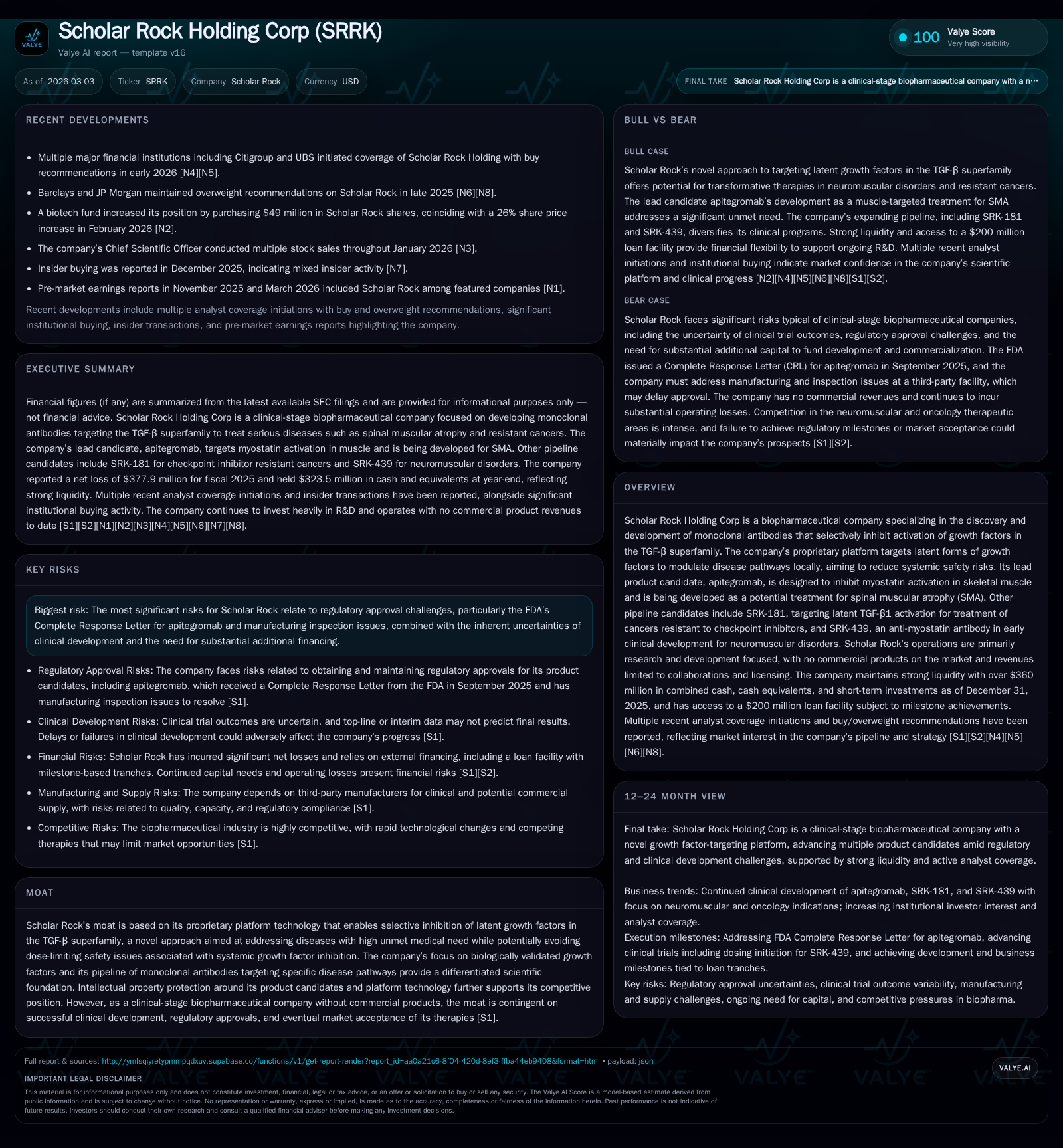
Scholar Rock Holding Corp has intensified its operating losses correlating with stepped-up research and development on its proprietary latent growth factor inhibition platform, chiefly aimed at spinal muscular atrophy and oncology indications. While its monoclonal antibodies apitegromab, SRK-181, and SRK-439 represent differentiated biological strategies, regulatory setbacks—such as the FDA’s Complete Response Letter—and manufacturing compliance issues dampen near-term prospects. The company's capital structure features extended debt interest-only periods and a current cash runway supported by equity sales and credit facilities. Monitoring clinical readouts, regulatory resolutions, financing environment, and insider trades will be essential to gauge the sustainability of operations and pathway to commercialization.
Historical Operating Performance: Escalating Investment in R&D
Scholar Rock's financial evolution from FY2022 through FY2025 underscores an intensification of investment aligned with advancing its developmental pipeline. Operating income deteriorated sharply from a loss of $134.4 million in 2022 to a widened $384.6 million deficit by the end of 2025, representing a -52.6% year-over-year decline between FY2024 and FY2025 alone [F1]. Net income mirrored this trajectory, with net losses ballooning to nearly $378 million in FY2025—a 53.5% deepening relative to the prior year [F1].
The principal driver behind these expanding losses is a substantial increase in research and development spending focused on clinical trials for lead assets including apitegromab and candidates targeting oncology indications such as SRK-181. Operating cash flow likewise contracted significantly from -$201 million in 2024 to -$300 million in 2025 (-49.3% YoY), accentuating the ramped-up cash burn intrinsic to late-phase biologics development without commercialized products or offsetting revenue streams [F1].[S1]
Capital expenditure levels remain restrained relative to operational burn but surged five-fold to $602,000 in FY2025 from $98,000 the previous year—likely reflecting investments in laboratory, manufacturing partnerships, or technology scale-up necessary for regulatory filings and subsequent commercial readiness [F1].
Historical performance (annual)
| FY | Net ($mm) | CFO ($mm) | OpInc ($mm) | Capex ($) | Net YoY |
|---|---|---|---|---|---|
| 2025 | -378 | -300 | -385 | 602000 | -53.5% |
| 2024 | -246 | -201 | -252 | 98000 | -48.6% |
| 2023 | -166 | -145 | -171 | 71000 | -23.3% |
| 2022 | -135 | -133 | -134 | 1064000 |
Source: SEC companyfacts cache [F1].
Capital returns and efficiency (annual)
| FY | FCF ($mm) | ROE% |
|---|---|---|
| 2025 | -301 | -154.0 |
| 2024 | -201 | -66.8 |
| 2023 | -145 | -73.6 |
| 2022 | -134 | -51.7 |
Source: SEC companyfacts cache [F1].
Platform Innovation as a Scientific Moat: Leveraging Latent Growth Factor Inhibition
Central to Scholar Rock's differentiation is its proprietary platform that enables selective inhibition of latent growth factors within the transforming growth factor beta (TGF-β) superfamily—a crucial signaling cascade implicated across muscle wasting and cancer biology [S1]. Unlike systemic inhibition strategies that often engender dose-limiting toxicities due to broad pathway blockade, Scholar Rock's monoclonal antibodies target precursor or latent forms localized inside diseased tissue microenvironments.
This biological precision aims not only to improve efficacy by modulating disease pathways locally but also promises superior safety profiles by mitigating off-target impacts commonly observed with TGF-β pathway therapeutics—a persistent challenge within the sector.
The platform underpins multiple antibody drug candidates moving through clinical phases with extensive intellectual property protections surrounding their molecular targets and mechanisms granted or pending globally [S1]. This strategic scientific moat requires successful translation beyond bench science via regulatory approval to prove commercial viability.
Pipeline Progress and Upcoming Milestones: Apitegromab and Late-Stage Candidates
Apitrogermab stands as Scholar Rock's flagship candidate targeting myostatin activation implicated in skeletal muscle degradation for spinal muscular atrophy (SMA). The pivotal Phase 3 trial "SAPPHIRE" announced positive top-line efficacy results in October 2024 marking a critical proof point for clinical benefit of muscle-targeted TGF-β modulation [S1][N1].
Despite these encouraging data, regulatory progress encountered significant headwinds when the FDA issued a Complete Response Letter (CRL) in September 2025 citing both data package concerns and manufacturing site deficiencies—a facility involved received an "official action indicated" classification following a July inspection raising compliance alarms [S1][S8][S3]. These findings mandate corrective measures that delay potential approval timelines.
In parallel, early-stage programs like SRK-181 aim at latent TGF-β1 inhibition addressing checkpoint inhibitor-resistant cancers—positioning Scholar Rock at an innovative crossroad between neuromuscular disease treatment and immuno-oncology resistance mechanisms [S1]. Additionally SRK-439 advances preclinically targeting myostatin biology pertinent to neuromuscular disorders broadly.
Key milestones investors should track include resolution progress against FDA’s CRL stipulations concerning manufacturing standards; anticipated clinical data readouts from ongoing trials particularly for late-stage assets; trajectory of launch preparations contingent on regulatory green lights; and potential strategic collaborations enhancing commercial capabilities or pipeline breadth.
Regulatory and Developmental Risks Shaping the Company’s Outlook
Scholar Rock's forward path is fundamentally impacted by typical biotech R&D volatility augmented by explicit recent regulatory friction points outlined in SEC filings [S8][S19]. The CRL constitutes a non-trivial setback given its implications on licensing timing while manufacturing compliance challenges introduce operational risk.
Moreover, inherent scientific uncertainties around translating monoclonal antibody latent TGF-β inhibition into durable clinical outcomes persist—clinical trial failures or adverse events could critically impair valuation.[S21] In addition to external market competition pressures within SMA therapeutics space against established agents compounds execution risks.
The company's filings also highlight potential capital market sensitivity tied to financing needs emerging from heavy clinical investment absent product revenues.[S8][S21] Management acknowledges need for additional financing rounds typical of clinical-stage biopharma firms navigating protracted approval processes.
Capital Allocation: Debt Refinancing, Cash Reserves, and Investment Priorities
Financial stewardship increasingly centers on managing capital structure flexibly during extensive R&D expenditure cycles which generated net losses well exceeding hundreds of millions annually.[F1]
Amendments to loan arrangements with Oxford Finance notably included an extension of interest-only payment obligations from original maturities through March 2029–2030 with possible maturity extension up to February 2031 contingent on meeting milestone triggers [S4][S5]. These terms offer crucial breathing room against principal repayments while sustaining access up to $200 million across tranche advances.
Equity capital markets further complement debt fundraising efforts—with net proceeds topping $324 million after underwriting fees via October 2024 public offering plus active ATM share programs raising close to $97 million over recent quarters underpinning cash cushion increases[S6][F1][S17].
The allocation focus remains primed toward advancing clinical study execution particularly pivotal Phase III runs alongside preparatory infrastructure buildup across manufacturing scale-up scenarios aligning with regulatory expectations[S6].
Liquidity Position and Cash Flow Dynamics: Sustainability of Operations
As of December 31st, 2025 Scholar Rock reported cash plus equivalents totaling approximately $323.5 million supporting near-term operational cash needs comfortably against current liabilities approximating $55.4 million—the resulting current ratio rounds near seven indicating ample working capital buffer[F1][S2].
However inherent clinical-stage negative free cash flows intensify liquidity demands—the latest full-year free cash flow estimate approximates a negative $300 million according to combined operating cash flow minus capex outlays[F1], illustrating continuing funding necessity unless offset by novel revenue streams or financing events.
Quarterly disclosures signal consistent quarterly cash burn patterns linked primarily to escalating clinical trial expenditures[S2], emphasizing that sustainability hinges on successful capital infusions matched timely with program execution milestones.
Future Growth Constraints: Market, Clinical, and Financing Challenges to Monitor
Scholar Rock faces several binding constraints from which future growth prospects must be evaluated analytically rather than speculatively:
- Market adoption uncertainties persist absent any approved commercial products; pricing negotiations may be complicated by novel mechanism novelty[S21].
- Clinical progress remains subject to typical stage-gate risk compounded presently by unresolved FDA observations limiting timeline visibility[S8][S21].
- Sustained negative cash flow profile necessitates continued access to investor capital; deteriorating financing environments could restrict ability to raise funds efficiently[S21].
- Insider selling activities highlighted by multiple January 2026 stock disposals executed by Chief Scientific Officer suggest internal hedging strategies worth monitoring as potential sentiment signals[N3].
Stakeholders must weigh these factors carefully especially around key upcoming catalysts such as regression or remediation outcome on CRL issues plus next pivotal trial readouts which could materially reframe valuation narratives.
Disclaimer: This report is prepared solely for informational purposes regarding Scholar Rock Holding Corp based on publicly available financial reports and news disclosures as of March 2026. It does not constitute investment advice or recommendations. All financial figures cited correspond directly to verified filings per company XBRL data or authoritative SEC documents referenced herein.
Disclaimer: This is research-only, informational analysis and not investment advice. It may include AI-generated interpretation and general industry context. Always verify important details using primary sources.

Comments