
Solidion Technology Confronts Liquidity Challenges While Advancing Silicon Anode and Solid-State Battery Innovations
Recent quarterly disclosures highlight Solidion's technological progress juxtaposed with severe liquidity constraints that raise questions about operational continuity.
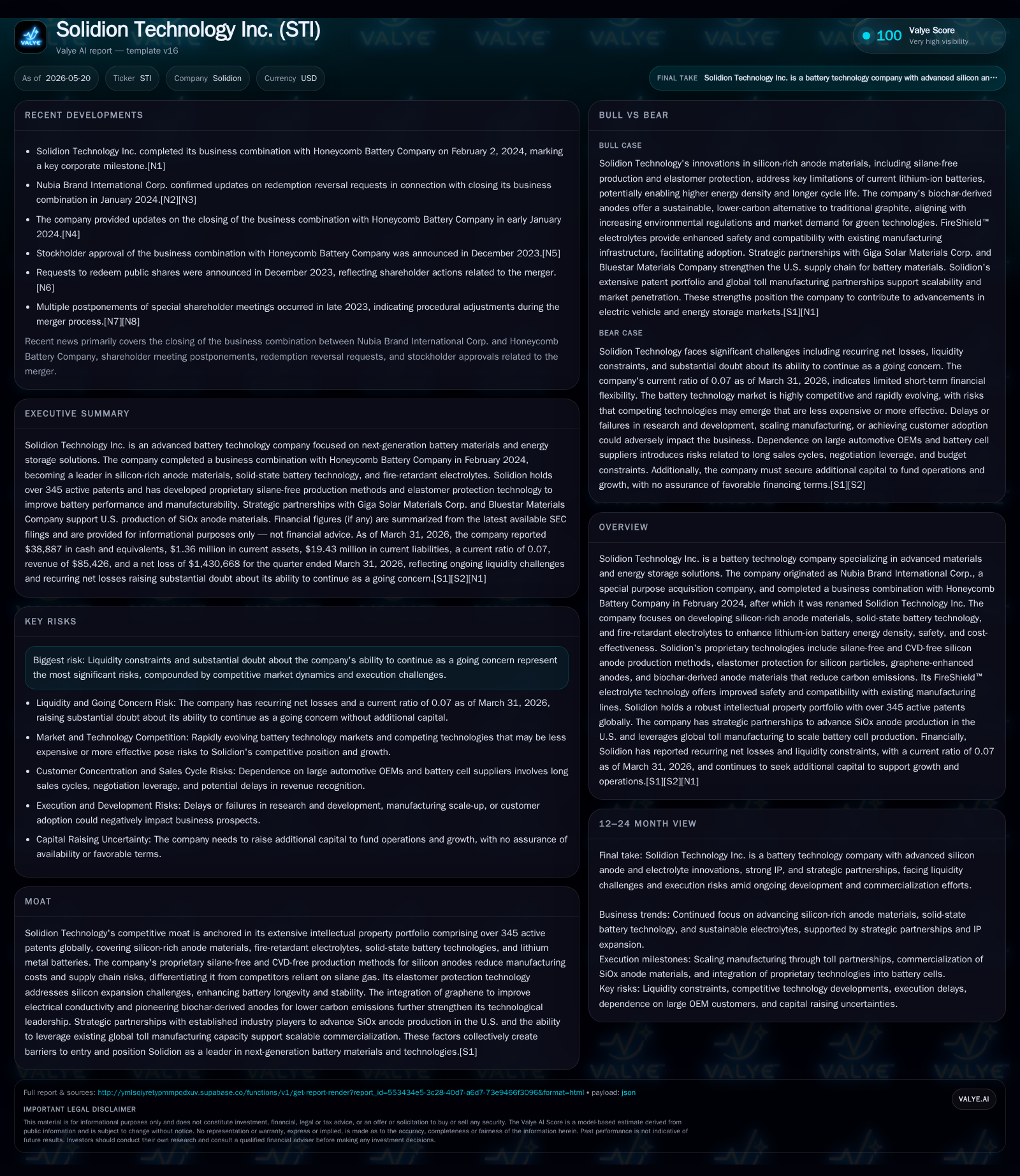
Solidion Technology Inc., a developer of advanced silicon-rich anode and solid-state battery technologies, reported escalating net losses alongside a critical working capital deficit in its latest quarter, underscoring substantial doubt on its going concern status. The company’s business model leverages proprietary IP to innovate next-generation battery components serving EV and energy storage markets, relying on partnerships and toll manufacturing to scale production. Despite cutting-edge product developments like silane-free silicon anodes and FireShield™ electrolytes, financial pressures and competitive dynamics from established industry leaders constrain near-term growth. Key risks include financing access, market adoption timing, and execution of scaling plans. Upcoming milestones around pilot manufacturing expansion and strategic partnerships will be pivotal for Solidion’s trajectory.
Recent Operating Update: Critical Liquidity Constraints Amid Technological Progress
Solidion Technology's most recent quarterly filing (10-Q dated May 20, 2026) starkly reveals the company's precarious financial position. Cash and equivalents stood at a mere $38K as of March 31, 2026, against current liabilities exceeding $19 million reported as of June 30, 2025, yielding an acute current ratio of approximately 0.07—a clear indicator of severe short-term liquidity stress [S2][F1]. Meanwhile, total debt approached $2.6 million net of cash, further pressuring the balance sheet. These metrics underscore substantial doubt concerning the company's ability to continue as a going concern without immediate infusion of capital or operational turnaround.
This liquidity strain coexists with ongoing operating losses; the year ended December 31, 2025 reflected a $41 million net loss driven predominantly by non-cash fair value remeasurements of derivative liabilities tied to complex warrant instruments [F1][S1][S14]. Importantly, subsequent accounting error corrections related to Series A and B warrants exercises were reported via an 8-K filing in March 2026 but did not influence actual cash balances or shareholder equity [S3].
Business Model: Intellectual Property-Centric Development with Toll Manufacturing Leverage
Solidion Technology operates primarily as an advanced materials innovator in the lithium-ion battery supply chain with strategic emphasis on silicon-rich anode materials and solid-state electrolytes designed to boost energy density while enhancing safety and sustainability. Originating from a SPAC merger consummated in February 2024 with Honeycomb Battery Company, Solidion transitioned from merely developing materials towards commercializing high-energy cylindrical cells incorporating proprietary technologies [S1]
Revenue mechanics pivot on licensing agreements with automotive OEMs and tier-one battery cell producers who pay for access to Solidion's patented silicon anode compositions (notably silane-free manufactured), fire-retardant FireShield™ electrolytes compatible with existing lithium-ion processes, and emerging solid-state battery components [S1]. This model favors relatively low fixed asset intensity as Solidion relies on global toll manufacturing partnerships for scale production samples critical for customer validation—targeting reductions in capital expenditure burdens typical of vertically integrated competitors
Product volume expansion—and thus revenue growth—depends primarily on successful customer adoption following technical validation milestones often measured by delivered battery sample volumes in large format cells for automotive applications. Pricing power is nascent but supported by unique IP coverage across more than 345 patents worldwide protecting cost-effective silicon production methods that avoid silane gas usage—a notable supply chain risk for peer technologies—and durability enhancements via elastomer protection addressing silicon particle swelling during charge cycles.
Industry Structure and Competitive Position
Solidion competes within the rapidly evolving advanced battery materials segment serving electric vehicle (EV), energy storage system (ESS), and consumer electronics sectors. The segment is characterized by entrenched incumbents like CATL (Contemporary Amperex Technology Co.), LG Chem Ltd., Panasonic Industry Co., Samsung SDI Co., and Murata Manufacturing—firms possessing vast scale production capacity, robust supply chains, and long-standing customer relations with automotive OEMs around the globe [S1][S23]
Despite these hurdles, Solidion’s approach leverages differentiated technology moats: silane-free/CVD-free silicon anode production enables lower cost structures compared to rivals reliant on silane gas; elastomer protection mitigates electrode degradation from volume expansion—a historical Achilles heel for silicon-based anodes—and graphene integration improves electrical conductivity enhancing performance. Additionally, pioneering biochar-derived anode materials align with decarbonization trends increasingly demanded by customers seeking greener supply chains.
Strategically, partnerships facilitating U.S.-based production sample capacity emphasize agility over scale ownership—this fits a cooperative industry trend wherein innovators license technology while outsourcing mass manufacturing via toll facilities—streamlining investment risks but placing execution reliance on external operators.
Growth Drivers
Growth hinges on several intersecting vectors:
- Commercialization Milestones: Securing tier-one automotive OEM customers through delivery of application-relevant large-format sample cells remains critical. Early positive results can catalyze licensing revenues and scale manufacturing arrangements.
- Technology Adoption: Broad market transition towards higher energy density batteries propels demand for silicon-dominant anodes combined with safer solid-state electrolytes—all areas aligned with Solidion's patented innovations.
- Capacity Expansion via Toll Manufacturing: Leveraging established global partners enables rapid scale-up without massive capital deployment—this accelerates time-to-market responsiveness crucial for first-tier OEM qualification.
- Environmental Sustainability Demand: Biochar-derived material development supports ESG-driven procurement decisions among major buyers seeking lower carbon footprint components.
- Patent Portfolio Leverage: Broad IP exclusivity creates barriers to entry enabling licensing fee generation once clients commit commercially; intellectual property also underpins potential joint venture negotiation leverage.
Risks / Watchpoints / Growth Constraints
Numerous risks temper Solidion’s prospects:
- Liquidity Limitations: The existential threat posed by current cash burn rates paired with prohibitive working capital deficits necessitates urgent capital raising efforts—failure here risks insolvency.
- Execution Complexity: Scaling pilot programs into reliable production batches requires coordination across multiple partners; any delay could stall commercialization timelines adversely impacting customer confidence.
- Competitive Intensity: Dominant incumbent suppliers wield pricing leverage and established quality certifications; penetrating these accounts demands sustained technical validation coupled with competitive pricing.
- Regulatory Compliance Burdens: Complex battery safety standards across jurisdictions impose costly design verification regimes; non-compliance risks product launch delays.
- Governance Issues: Nasdaq Audit Committee composition shortcomings flagged compliance gaps might affect investor sentiment until resolved.
- Market Acceptance Timing: Adoption cycles in automotive battery tech are long and cautious; technology incorporation may lag innovation releases owing to rigorous qualification processes.
- Derivative Liabilities Volatility: Past fair value adjustments due to derivative warrants introduced significant non-cash volatility complicating earnings predictability despite no direct cash flow impact.
What To Watch Next
Critical upcoming milestones encompass:
- Annual Meeting Compliance: The company aims to restore Nasdaq Audit Committee compliance by the June 11, 2026 annual shareholders’ meeting—a governance requisite impacting investor confidence [S19][S22].
- Capital Raising Success: Outcomes from ongoing financing negotiations are vital; absence of funding could precipitate insolvency [S7][S9][S14].
- Manufacturing Scale-up Progress: Demonstration of repeatable sample production at partner facilities marks transition from R&D towards revenue generation [S1].
- Customer Engagements: Announcements related to binding licensing agreements or OEM validations provide tangible commercialization signals.
- Technology Validation Results: Third-party testing outcomes validating performance gains foster broader market acceptance metrics.
Financial Profile Summary
Though finances are secondary to operating advances here due to early-stage status, brief context is essential: As of Q1 2026 end ([F1]), Solidion held only $38K in cash against approximately $2.6 million total debt net of cash—reflected in an insolvency-level current ratio of just 0.07 despite assets including patented IP valued over $1.9 million. Reported net losses ballooned to $41 million in fiscal year 2025 largely driven by accounting adjustments tied to derivative warrant liabilities but also reflecting elevated operating expenses necessary for ongoing research activities [F1][S14][S25]. Operational cash burn remains substantive at nearly $4.5 million annually per latest disclosures suggesting urgent need for external financing to support near-term scalability.
Disclaimer: This analysis is based solely on publicly available regulatory filings and company disclosures through May 20, 2026. All figures are cited explicitly without extrapolation or prediction beyond stated evidence. This document does not constitute investment advice or research views.
Financial position in context
As of 2026-03-31, companyfacts shows $38887 in cash and equivalents and $3mm of total debt [F1]. The same snapshot implies net debt of roughly $3mm, keeping balance-sheet context relevant but secondary to the operating story [F1].
Disclaimer: This is research-only, informational analysis and not investment advice. It may include AI-generated interpretation and general industry context. Always verify important details using primary sources.

Comments