
Teradata's Transition to Subscription Revenue Models Moderates Growth and Elevates Execution Risks
Teradata's financials reflect stable revenues amid strategic cloud and AI platform shifts, with capital returns maintained through active share repurchases.
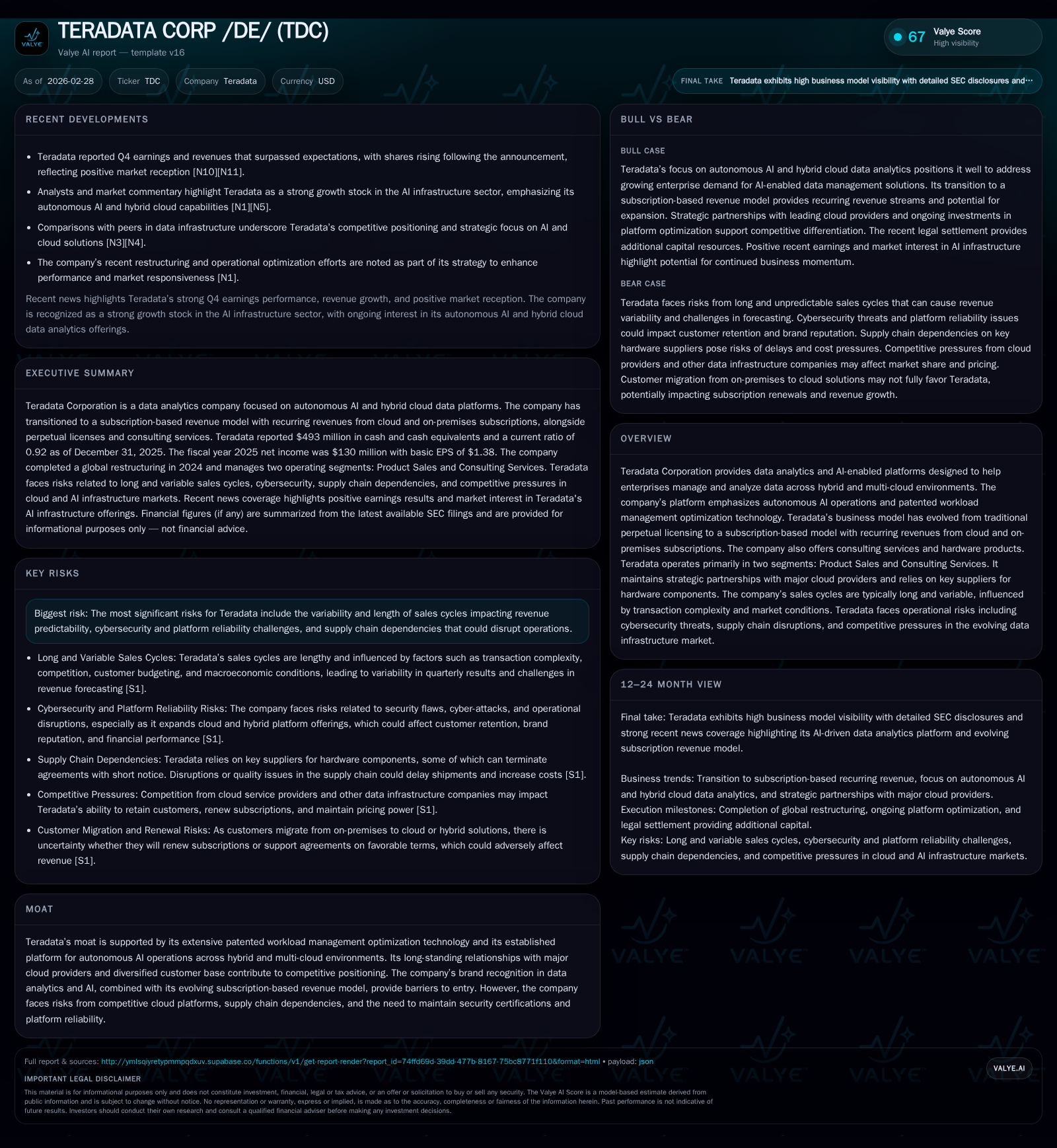
Teradata Corporation operates in data analytics and AI-enabled hybrid cloud platforms, evolving its revenue from traditional licensing to subscription models. While revenue growth has plateaued at around $626 million since 2017, operating income has improved modestly, reflecting operational gains. Key 2025 milestones include a $480 million legal settlement inflow and steady operating cash flow contributing to robust free cash generation. Challenges persist in lengthening sales cycles, competitive cloud platforms, and execution risks related to business transformation. The company sustains capital returns via aggressive share buybacks supported by solid cash flows. Monitoring sales cycle variability and successful platform scaling remains central to future growth trajectories.
Company Overview and Strategic Positioning
Teradata Corporation provides enterprise-class data analytics software and AI-enabled data platforms optimized for hybrid and multi-cloud environments. Its offerings are rooted in autonomous AI operations complemented by patented workload management optimization technologies. The company has migrated away from a traditional perpetual license model toward subscription-based revenue streams encompassing both cloud-hosted and on-premises deployments. Alongside product sales, consulting services form a substantial part of Teradata's portfolio. Key partners include leading public cloud providers enabling broader platform integration.
Teradata's strategic evolution is focused on capturing the growing market for hybrid cloud analytics while balancing new model risks such as longer customer sales cycles and increased operational complexity stemming from technology integration efforts. The firm maintains a diversified global footprint with approximately half its revenue generated internationally [S19][S22].
Historical Financial Performance
The company's annual total revenue has remained largely stable around the $626 million mark since at least 2017, indicating limited top-line expansion over recent years. Operating income showed some progress, rising from $118 million in 2022 to $205 million in 2025, demonstrating improved operational efficiency despite static revenues [F1]. Net income followed a similar trajectory with a notable step-up from $33 million in 2022 to $130 million in 2025 supported partly by non-recurring legal settlement receipts.
Operating cash flow has been strong relative to net income trends but has shown erosion from $419 million in 2022 down to about $305 million in 2025. Capital expenditures have been tightly managed near ~$19 million annually recently. This dynamic results in robust free cash flow generation (approximately $286 million in 2025), underpinning funding flexibility for capital returns and business investments [F1].
Historical performance (annual)
| FY | Net ($mm) | CFO ($mm) | OpInc ($mm) | Capex ($mm) | Net YoY |
|---|---|---|---|---|---|
| 2025 | 130 | 305 | 205 | 19 | +14.0% |
| 2024 | 114 | 303 | 209 | 24 | +83.9% |
| 2023 | 62 | 375 | 186 | 19 | +87.9% |
| 2022 | 33 | 419 | 118 | 14 |
Source: SEC companyfacts cache [F1].
Capital returns and efficiency (annual)
| FY | Buybacks ($mm) | FCF ($mm) | ROE% |
|---|---|---|---|
| 2025 | 140 | 286 | 56.5 |
| 2024 | 215 | 279 | 85.7 |
| 2023 | 308 | 356 | 45.9 |
| 2022 | 387 | 405 | 12.8 |
Source: SEC companyfacts cache [F1].
Revenue reflects stated figures with little change; year-over-year percentages reflect latest vs prior available year based on reporting constraints.
Future Growth Prospects
Teradata aims to capitalize on growing demand for hybrid data analytics solutions augmented by AI capabilities. Its continued investment into research & development targets enhancements of autonomous AI functionalities that differentiate the platform amidst intensifying competition from hyperscalers' native solutions.
A pivotal element of future revenue will be expansion within subscription-based software licensing alongside professional consulting services targeting large enterprises transitioning workloads to multi-cloud infrastructures [N3]. However, these prospects carry execution risk given the company’s admission of complex and often lengthy sales cycles influenced by transaction scale, competition intensity, and global macroeconomic conditions [S1][N4].
Further growth may be capped or slowed by operational unpredictability inherent in migrating customers between on-premises and cloud platforms; the necessity to uphold stringent cybersecurity standards; possible supply chain disruptions for hardware components; and evolving regulatory requirements governing AI technologies [S1].
Monitoring indicators such as annual recurring revenue growth rates—particularly public cloud ARR segments—and funnel visibility will be critical to assessing the pace of adoption going forward although explicit forward guidance was not disclosed at this time .
Recent Milestones and Legal Resolution
A landmark development occurred with Teradata's February 2026 settlement with SAP SE pertaining to protracted litigation over alleged trade secret misappropriation and patent disputes. The gross payment amounts to $480 million payable within two months following the agreement’s effective date. After accounting for legal fees and customary success fees, the company expects net proceeds ranging between approximately $355 million to $362 million before taxes [S21][S23]. These funds augment Teradata's liquidity position though management has yet to clarify deployment plans beyond ongoing evaluation [S21].[N3]
Capital Allocation and Returns
Consistent with its strong cash flow profile, Teradata remains committed to returning capital via stock repurchases under an open-ended repurchase program authorized at up to $500 million starting January 2026. In calendar year 2025 alone, approximately $140 million was deployed to reduce shares outstanding at an average share price materially lower than prior years’ levels indicating opportunistic buyback activity amid valuation shifts [F1][S7][N13].
Dividend payments continue alongside buybacks though details on dividend yields or changes were not emphasized in filings.
The company reported equity of about $230 million as of year-end 2025 versus prior-year equity around $133 million reflecting balance sheet strengthening post-settlement funds receipt as well as retained earnings growth [F1]. Return on equity stands near an estimated ~56.5% based on last reported net income relative to equity figures signaling high earnings efficiency albeit influenced by relatively low equity base.
Operational Challenges and Risks
Teradata acknowledges several critical risks arising throughout its ongoing strategic transformation:
- Execution risk linked with scaling cloud/hybrid offerings integrating autonomous AI platforms requiring skilled workforce availability amidst tight labor markets.
- Longer-than-anticipated sales cycles resulting in lumpy quarterly financial results complicating forecasting precision.
- Competitive challenges posed by larger hyperscale cloud vendors offering integrated analytics stacks potentially commoditizing parts of Teradata’s addressable market.
- Supply chain vulnerabilities affecting hardware reliability impacting consulting service delivery quality.
- Regulatory evolution concerning AI usage necessitating agile product adjustments which may increase costs or delay releases.
- Cybersecurity threats that could undermine platform integrity thereby impairing customer trust.
- Geographic concentration exposure is mitigated by diversification but carries intrinsic risks such as currency fluctuations, geopolitical tensions, trade restrictions, and compliance hurdles across more than thirty functional currencies worldwide which could negatively impact international revenue streams [S1][S8][S15][S19][S25].
The recent ERP modernization initiative concluded deployment phase in late 2025 but monitoring continues for any residual operational disruption during stabilization stages that could affect financial reporting or costs structure [S18].
Industry Context Analysis (un-cited)
The competitive environment demands continuous innovation not only internally but also aligned with third-party component providers given fast shortening product life cycles characteristic of advanced analytics sectors. Customers increasingly seek flexible pricing models accommodating consumption variability tied closely to enterprise digital transformation timelines which can complicate vendor revenue predictability further.
What To Watch Forward (Analysis)
While explicit guidance remains unavailable publicly at this juncture, key metrics for investors should center on:
- Total Annual Recurring Revenue (ARR) growth—especially public and hybrid cloud segments—reflecting adoption momentum.
- Quarterly sales cycle duration trends indicative of transaction pipeline health.
- Operating margin sustainability amidst R&D spend levels focused on autonomous AI feature rollouts.
- Effective use of litigation settlement proceeds whether reinvested into growth initiatives or additional capital returns.
- Progress outcomes of ERP system stabilization impacting operational efficiency.
- Responses to evolving regulatory landscapes surrounding AI functionalities impacting product roadmaps.
Continued traction here could translate into restoring top-line momentum beyond historical stagnation combined with margin leverage from subscription uptake supporting incremental profit expansion.
Summary Conclusion
Teradata presents a nuanced profile: a mature software vendor with deep intellectual property assets fueling a differentiated hybrid cloud analytic platform transitioning from legacy models toward subscription dynamics. Its historical revenue plateau underscores the challenges inherent in such transformation including protracted sales cycles that impair forecast visibility. Nonetheless, improving operating income trends combined with resilient cash flows facilitate sustained capital returns highlighted by sizeable share repurchases executed alongside a significant legal settlement inflow bolstering financial flexibility.
Execution risk remains elevated given technological integration complexities compounded by competitive pressure from larger cloud incumbents. Success hinges on effectively scaling autonomous AI-driven offerings meeting enterprise hybrid workloads while managing regulatory compliance risk vectors around emerging AI governance frameworks. International operations diversify opportunity but add layers of geopolitical and currency uncertainty requiring vigilant management.
Stakeholders should track subscription ARR metrics closely along with sales funnel dynamics as prime indicators of progressive value capture potential while acknowledging operational cadence variability remains an ongoing theme intrinsic to Teradata’s transformational journey.
This report is intended solely for informational purposes without any investment recommendation or endorsement regarding Teradata Corporation’s securities.
Disclaimer: This is research-only, informational analysis and not investment advice. It may include AI-generated interpretation and general industry context. Always verify important details using primary sources.

Comments