
Thermon Group Strengthens Its Global Industrial Heating Leadership Ahead of CECO Merger
Thermon’s robust backlog growth and comprehensive heating solutions bolster its market position as it prepares to merge with CECO Environmental.
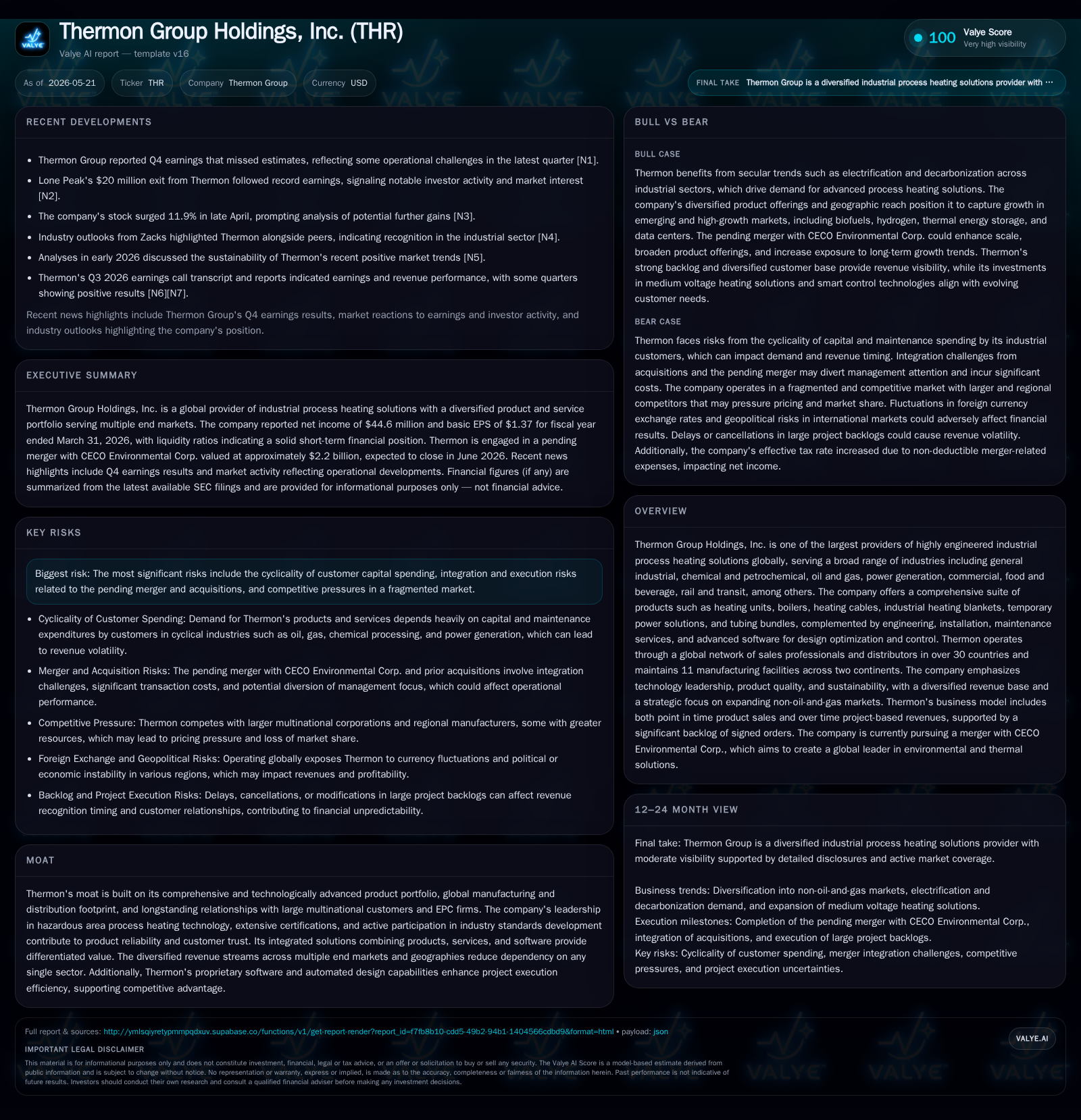
In its latest quarterly filing ending March 31, 2026, Thermon Group Holdings reported a backlog increase to $254.9 million, underpinning revenue visibility amid large project cycles. The company continues to lead in industrial process heating with a broad product and service portfolio supported by advanced technology and global manufacturing. The pending $2.2 billion merger with CECO Environmental, expected to close in June 2026, aims to create a diversified global leader pairing environmental system expertise with process heating capabilities. Despite solid operational momentum, risks remain from the cyclicality of capital spending, integration challenges related to the merger, raw material cost pressures, and competitive fragmentation.
Latest Quarterly Operating Update Anchored by Backlog Expansion
In the quarter ended March 31, 2026, Thermon reported a firm contract backlog of $254.9 million compared to $240.3 million a year prior [S1][S2]. This rise in backlog serves as a crucial forward indicator within the capital-intensive industrial process heating sector where project cycles are long and revenue recognition timing can be uneven due to customer schedule shifts or delays. The backlog reflects signed purchase orders yet to be recognized as revenue and underpins delivered revenue streams over upcoming periods.
During the same quarter, Thermon incurred approximately $13 million in transaction-related expenses associated with its pending merger with CECO Environmental Corp., reflecting significant ongoing professional fees tied to legal, accounting and advisory activities [S1][S2]. These costs have pressured operating income but are viewed as investments towards the strategic combination expected to create a diversified global industrial leader.
Thermon’s Comprehensive Process Heating Business Model and Product Quality
Thermon operates as a leading provider of engineered industrial process heating solutions serving diverse end-markets including chemical processing, oil and gas, power generation, food and beverage processing, rail transit, and commercial infrastructure [S1]. Its product portfolio covers heating units (electrode/gas boilers), industrial heat tracing cables, thermal blankets, tubing bundles, temporary power units alongside sophisticated engineering design services and maintenance programs.
A key differentiation lies in Thermon’s technology leadership especially for hazardous locations where rigorous testing (UL, CSA, FM and ETL certifications) ensures compliance with safety standards critical for customer trust [S1]. Supporting the physical products is proprietary software enabling design optimization combined with wireless network controls that enhance installation efficiency and operational control — factors increasingly influencing customer buying decisions [S1].
This product-service-software integration fosters strong switching costs through holistic solutions rather than commoditized components alone.
Competitive Dynamics and Industry Structural Insights in Industrial Process Heating
The industrial electric heat tracing segment remains fragmented globally with numerous small regional players servicing local markets [S1][S16]. Within this dispersed landscape, Thermon holds scale advantages with operations spanning 11 manufacturing facilities across two continents supplemented by more than 100 independent sales agents distributing in over 30 countries [S1][S7].
Thermon is considered the second largest participant in the industrial electric heat tracing market after Chemelex by scale [S16]. Its moat benefits from deep EPC (engineering-procurement-construction) partnerships and long-standing multinational customers across capital projects requiring reliable process heating. The integrated software-enabled design capabilities also distinguish Thermon from less sophisticated competitors reliant on product-only sales.
Nonetheless, pricing pressure exists given competition against lower-cost regional manufacturers [S1][S16][S24]. Capital project cyclicality adds volatility as large order flows hinge on commodity cycles impacting customers’ capital expenditures particularly in oil & gas sectors
Growth Drivers Fueling Demand across Core End Markets
Key growth vectors include expanding electrification trends within process heating driven by regulatory decarbonization efforts supporting thermal solutions that reduce carbon footprints [S1][S16]. New energy-related end markets such as biofuels production systems, hydrogen handling facilities and carbon capture infrastructure align well with Thermon’s existing certified technologies.
Geographic diversification underpins resilience; approximately 51% of revenues derive outside the U.S., emphasizing footholds across emerging markets in Asia-Pacific and Europe-Middle East-Africa regions where increased infrastructure investments fuel demand [S16]. The company also benefits from growing maintenance aftermarket sales as installed base expands internationally.
Additionally, Thermon has targeted digital transformation of its offering through networked wireless controls and advanced design software facilitating faster project execution and stronger client advisement roles—capabilities that not only improve margins but create stickier customer relationships [S1].
The rapid construction of data centers—a critical infrastructure segment driven by cloud computing growth—has emerged as an incremental demand driver for specialized heating loads such as load bank testing and freeze protection within commissioning processes [S16][S19].
Risks Related to Cyclicality, Merger Execution, and Competitive Pressures
The cyclical nature of capital expenditures by customers remains the most salient risk factor affecting order volumes and revenue realization timing given exposure to volatile industries like oil & gas exploration [S12][S24]. Project suspensions or delays can defer revenues locked in backlog.
Execution risks are elevated due to the pending CECO merger valued at about $2.2 billion set for anticipated closing in June 2026 pending regulatory approvals and shareholder votes [S1]. This transaction incurs high sunk costs ($13 million spent Q3 alone) regardless of completion outcomes [S1]. If the merger fails to close or if integration proves less effective than expected it may disrupt operations or erode anticipated synergies.
Raw material price fluctuations—covering polymers, copper, stainless steel components—pose margin squeeze risks given Thermon's reliance on external suppliers without assured pass-through pricing [S20]. Competitive dynamics remain challenging particularly from regional low-cost providers compelling continuous innovation investment.
Furthermore, litigation risks linked to merger proceedings or ongoing environmental regulations remain financial uncertainties requiring reserves though no material contingencies are currently expected [S12][S21].
Catalysts and Milestones to Watch in The Short Term
Key near-term value inflection points center on the official completion of the CECO merger by June 2026 subsequent to securing all necessary approvals from both companies’ shareholders and regulatory bodies [S1][S3][S26]. Integration plans disclosure post-close will indicate synergy realization feasibility.
Subsequent quarterly earnings releases will reveal margin trajectory influenced by merger expenses along with underlying organic demand reflected through backlog conversion rates into revenue recognition [S3]. Monitoring backlog fluctuations provides useful insight into order intake momentum amid ongoing industry cyclicality.
Additionally pending developments related to approvals or any emergence of contentious litigation might swiftly influence deal certainty metrics.
Brief Financial Position Overview Reinforcing Operational Strength
As of March 31, 2026 quarter-end data shows Thermon maintains a healthy liquidity position supported by $52.3 million cash & equivalents balanced against total debt near $122 million yielding moderate net debt around $70 million [F1][S8]. The company exhibits strong short-term financial flexibility signaled by a current ratio of approximately 2.69 supported by current assets exceeding liabilities substantially [F1].
Profitability metrics registered net income for the fiscal year ending March 31 at roughly $44.6 million despite merger-related expenses depressing operating income below prior year levels [F1][S18]. Effective working capital management helps sustain cash flow stability crucial when navigating cyclical backlog realization.
This analysis is based exclusively on publicly filed SEC documents up to May 21st, 2026 together with corroborated news items for event chronology context. It reflects no insider information nor forward guidance beyond what is explicitly stated therein.
Disclaimer: This is research-only, informational analysis and not investment advice. It may include AI-generated interpretation and general industry context. Always verify important details using primary sources.

Comments