
United Natural Foods Faces Pressures as Q3 Sales Decline and Guidance Cuts Highlight Margin Challenges
UNFI's latest quarterly report reveals softening revenue momentum, margin compression, and cautious outlook amid ongoing sector compliance demands and operational risks.
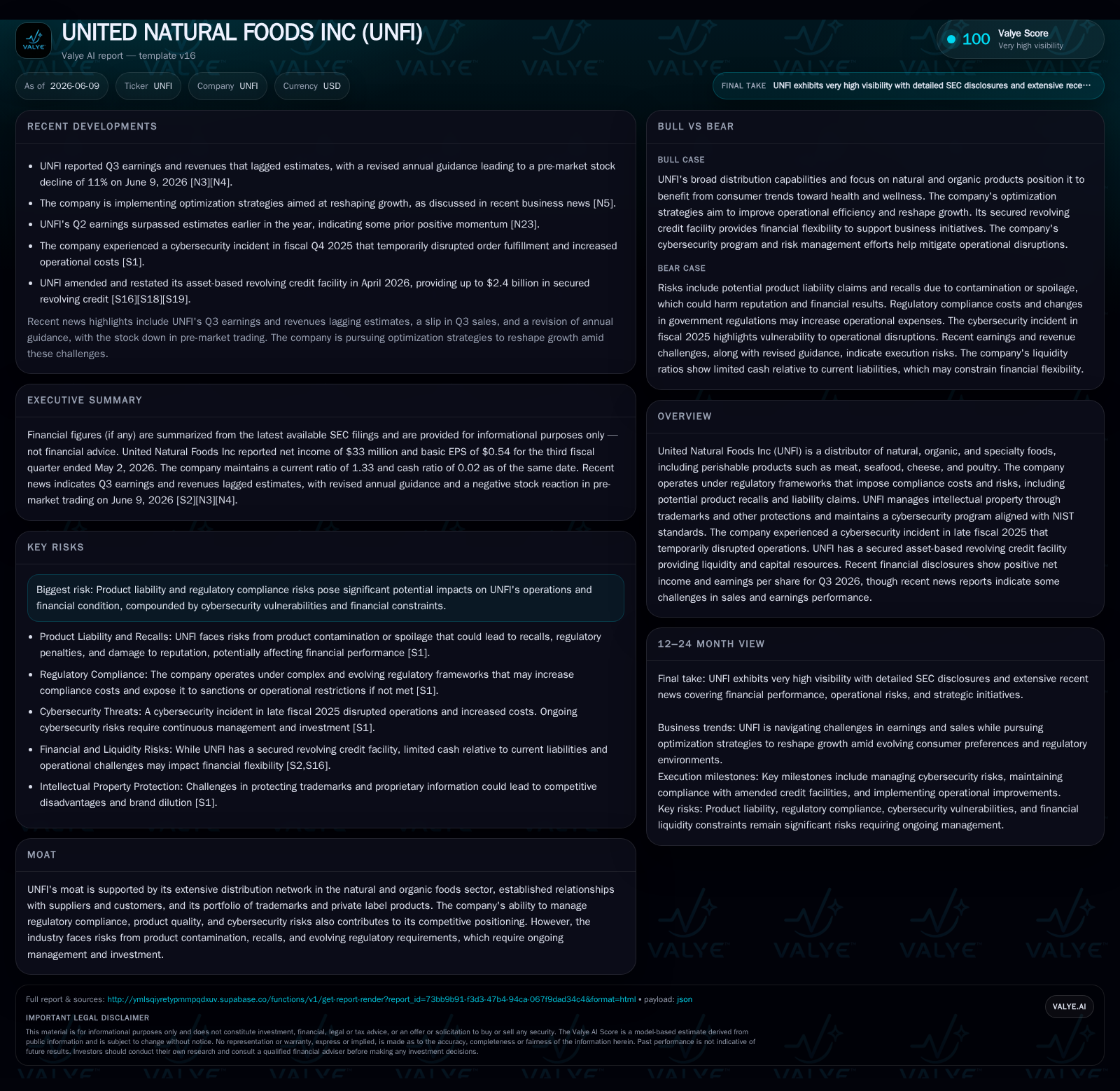
United Natural Foods Inc (UNFI) reported Q3 2026 financial results with sales missing estimates and a revised annual guidance signaling softer demand. The company’s core distribution business confronts structural and cyclical headwinds, including regulatory compliance costs in perishables, elevated product liability risks, and a prior cybersecurity disruption. While UNFI’s broad distribution network and private label trademarks bolster its moat, the near-term operating environment underscores margin pressures from supply chain inflation and competitive pricing dynamics. Continued focus on operational efficiency and risk mitigation remains essential for stabilizing growth.
Recent Quarterly Update Highlights Softening Demand and Margin Pressure
United Natural Foods Inc (UNFI) reported its third quarter fiscal 2026 results on June 9, 2026, revealing a challenging near-term operating environment. The company’s sales declined relative to consensus estimates, leading to a downward revision of full-year revenue guidance [S2], [N1], [N2]. This sales softness reflects weaker volume throughput across key product categories, compounded by ongoing margin compression driven by supply chain inflation and competitive pricing pressures.
The company reaffirmed that its risk factors remain consistent with those disclosed in its prior annual report, including regulatory compliance costs and product liability exposure [S2], [S1], [S4]. UNFI also continues to address operational risks highlighted by a cybersecurity incident in fiscal 2025, which caused temporary disruption but was managed through established NIST-aligned response protocols [S1], [S22]. Cybersecurity remains a key enterprise risk actively monitored by management.
UNFI’s Business Model Anchored in Broad Natural Foods Distribution
UNFI operates as a leading distributor of natural, organic, and specialty food products across North America, servicing grocery retailers, foodservice operators, and e-commerce platforms. Its revenue model is volume-driven, relying on high throughput of SKUs including perishables such as meat, seafood, cheese, and poultry, which require stringent cold-chain logistics and compliance with food safety regulations [S1]
Revenue generation depends on negotiated contracts with customers, where pricing incorporates commodity cost pass-throughs and product mix shifts toward higher-margin private label offerings. Key operational KPIs include order fill rates, SKU velocity, and on-time delivery performance, which directly impact customer retention and margin stability. Supply chain inflation—particularly in freight and fuel costs—alongside evolving regulatory compliance expenses, exert pressure on gross margins.
Operational efficiency initiatives focus on warehouse automation, route optimization, and inventory management improvements to reduce labor costs and enhance service levels, aligning with industry best practices in specialty food distribution.
Competitive Position Within the Specialty Food Supply Chain
UNFI’s competitive moat is anchored in its extensive distribution network tailored to the natural and organic food segment, supported by strong supplier relationships and a portfolio of private label trademarks [S1], [S13]. These assets differentiate UNFI in a fragmented market but require active intellectual property enforcement to mitigate risks of brand dilution.
The company faces competition from broadline distributors expanding into specialty niches and regional players specializing in e-commerce fulfillment for natural foods. This competitive landscape intensifies pricing pressures and necessitates continuous innovation in digital ordering platforms and customer service to maintain market share.
Growth Drivers: Operational Optimization Amid Market Headwinds
Management is pursuing growth through operational optimization programs aimed at improving inventory turnover, order accuracy, and delivery timeliness—critical KPIs for customer satisfaction in food distribution [N12]. These initiatives support omnichannel integration efforts as grocery e-commerce adoption grows, despite challenges related to perishability and consumer preferences.
Selective expansion into organic produce and health-focused consumables, combined with data-driven merchandising strategies, are targeted to enhance SKU velocity and basket size. However, consumer discretionary spending softness in premium natural foods segments presents headwinds, affecting order frequency and average transaction values.
Risks & Watchpoints: Regulatory Compliance & Food Safety Remain Critical
Product liability risk remains a significant concern due to the distribution of perishable goods susceptible to contamination by pathogens such as Listeria monocytogenes and Salmonella [S4], [S6]. Despite adherence to good manufacturing practices and finished product testing, UNFI has limited control over product handling post-distribution, exposing it to potential recalls and reputational damage.
Regulatory compliance costs are expected to rise as food safety laws evolve, with potential penalties including fines, product recalls, and operational restrictions. Intellectual property enforcement challenges also persist amid competitive pressures.
Financially, UNFI operates with a substantial asset-based revolving credit facility subject to borrowing base covenants, which constrains capital allocation flexibility and requires careful liquidity management [F1], [S16]. The current ratio stood at 1.33 as of May 2026 quarter-end, reflecting moderate short-term coverage typical for large distributors reliant on working capital financing.
What To Watch Next: Execution Metrics And Regulatory Developments
Upcoming quarterly reports will be pivotal in assessing whether optimization efforts translate into improved order fill rates, SKU velocity, and margin resilience amid ongoing sales softness. Monitoring private label versus branded product sales trends will provide insights into pricing power and customer loyalty dynamics.
Regulatory developments affecting labeling, traceability, and food safety compliance will materially impact operating costs and risk exposure given UNFI’s focus on high-risk perishables.
Additionally, updates on cybersecurity defenses post-incident will be important as supply chain networks face increasing cyber threats.
Financial Profile Snapshot Highlights Liquidity Cushion Amid Headwinds
As of May 2, 2026, UNFI held approximately $43 million in cash and equivalents against current liabilities of $2.44 billion, yielding a current ratio of 1.33, indicative of moderate liquidity coverage [F1]. Total debt stood near $1.88 billion net of cash, underscoring significant leverage that necessitates adherence to borrowing base covenants tied to the amended asset-based loan agreement effective April 2026 [S16], [F1].
The company reported operating losses up through mid-2025 (operating income negative $31 million; net loss $118 million), reflecting margin pressures and investment in operational improvements [F1]. Continued focus on cost control, selective category expansion, and supply chain efficiencies will be critical to margin recovery if volume conditions stabilize.
This analysis reflects information publicly available up to June 2026 and incorporates SEC filings alongside reputable news sources. It does not constitute investment advice but aims to provide an informed perspective on United Natural Foods Inc's business fundamentals and industry dynamics.
Disclaimer: This is research-only, informational analysis and not investment advice. It may include AI-generated interpretation and general industry context. Always verify important details using primary sources.

Comments