
Tilly's First Quarter Update: Managing Losses Amid Shifting Retail Dynamics
Tilly's Q1 2026 results reveal revenue resilience alongside net losses, framed by a strategic merchandising leadership change aimed at revitalizing growth.
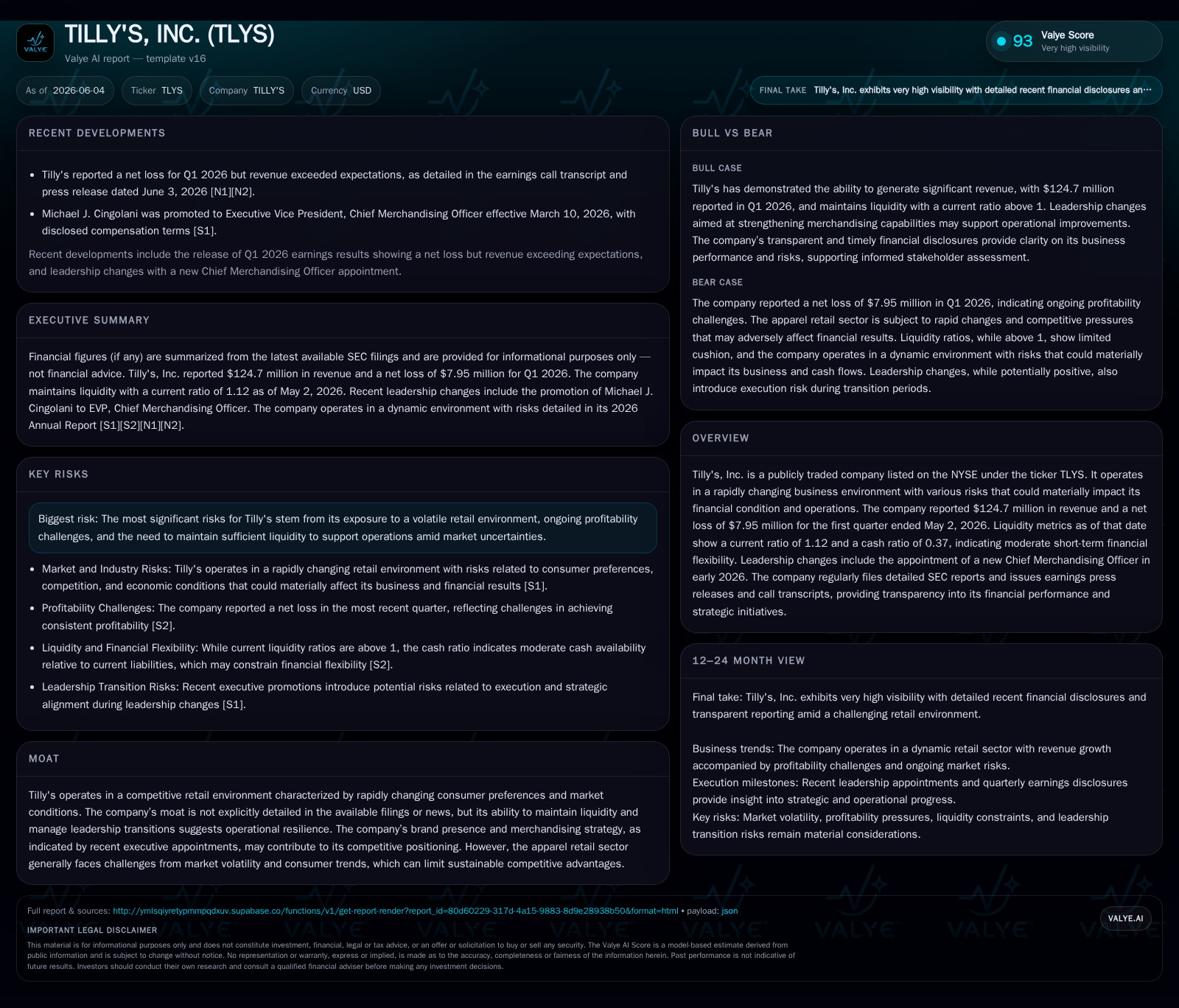
In the first quarter ended May 2, 2026, Tilly's reported revenues of $124.7 million but sustained a net loss of $7.95 million, underscoring ongoing profitability challenges in a volatile retail apparel market. The recent promotion of Michael Cingolani to Chief Merchandising Officer, with bonus incentives tied to comparable net sales and operating income targets, signals a strategic focus on merchandising mix and top-line growth. However, liquidity metrics show only moderate flexibility with a current ratio of 1.12, reflecting tight working capital management amid competitive pressures from digital-native brands and changing youth consumer trends. Near-term growth hinges on execution against merchandising initiatives and stabilization of store-level sales performance.
Latest Quarterly Performance: Losses during Revenue Beats
Tilly's reported first quarter fiscal 2026 revenue of approximately $124.7 million, marking an outperformance relative to analyst expectations and previous periods [S2][N2][F1]. Despite this positive top-line momentum, the company recorded a net loss approaching $7.95 million during the same period. Operating income remained negative at nearly $19.34 million as per the latest filings [F1], illustrating sustained profitability pressure within a challenging retail sector. Liquidity metrics provide a moderate cushion with a current ratio of about 1.12 at quarter end, indicating availability of current assets relative to liabilities but not signaling robust operational flexibility [F1]. This financial snapshot highlights that while Tilly’s maintains revenue momentum, successful transition to profitability remains elusive during competitive headwinds.
Merchandising Leadership Shift: Strategy and Incentives
A pivotal recent development was the March 2026 promotion of Michael J. Cingolani to Executive Vice President and Chief Merchandising Officer from his previous role as Senior Vice President, General Merchandising Manager [S3][S8]. His compensation structure now includes an annual base salary of $500,000 plus a cash bonus targeted at 75% of base salary — potentially reaching 150% — contingent upon surpassing budgeted comparable net sales and pre-bonus operating income targets. This linkage directly aligns merchandising leadership incentives with key operational KPIs focused on driving same-store sales growth and margin improvement.
Strategically, this signals Tilly’s intention to sharpen its focus on optimizing product assortments, pricing strategies, and promotional effectiveness to improve comparable store sales — a critical metric in specialty apparel retail where consumer tastes are fickle. Deploying an executive compensation plan tethered tightly to these measures shows management's commitment to measurable operational progress in merchandising execution.
Tilly’s Business Model: What Drives Revenue and Margin
Tilly’s operates primarily within the youth lifestyle apparel segment, offering apparel, footwear, and accessories with a skew toward skate and surf culture brands favored by younger demographics [S1]. Revenue stems chiefly from two channels: brick-and-mortar stores distributed across select U.S. locations and e-commerce platforms increasingly important given evolving shopper behaviors.
Revenue mechanics depend heavily on (i) volume of goods sold through these channels; (ii) pricing strategies that balance trend relevance with margin preservation; (iii) product mix quality — specifically the blend between higher-margin proprietary merchandise versus lower-margin third-party brands; and (iv) promotional cadence impacting both traffic and conversion rates.
This model necessitates managing inventory turnover efficiently to curtail markdown risks while maintaining freshness in assortments aligned with fast-changing youth fashion trends. These factors collectively determine margin resilience amid a sector strip-mined by frequent discounting cycles.
Competitive Apparel Retail Biology: Peers, Pricing, and Consumer Trends
Within the mid-tier specialty retail landscape targeting youth lifestyles, Tilly’s competes against established names as well as aggressive digital-native brands that have intensified pricing competition through direct-to-consumer models [N5][N6][S1]. These digital-first competitors benefit from lower cost structures and nimble inventory management — raising the bar for merchandising relevance and execution in physical formats.
Moreover, the apparel space faces enduring volatility from shifting consumer preferences driven by social media trends and economic uncertainties affecting discretionary spending patterns. This environment compresses pricing power for traditional retailers who must continuously invest in brand-building while managing cannibalization risks from online channels.
Peer companies engaging comparable merchandise mixes have sought margin recovery via enhanced private label offerings or experiential retail concepts; Tilly’s ability to execute similar differentiation will be critical for stable competitive positioning.
Key Growth Drivers: Merchandising Mix and Operational Execution
Given the appointment of Cingolani coupled with his incentive alignment on comp store sales growth, it is clear that Tilly’s prioritizes improvement in comparable net sales as a lever for overall earnings uplift [S3][N1]. Enhancing merchandise mix—shifting toward higher-margin or trend-right products—and optimizing promotional timing are focal points intended to reverse recent softness in volume or basket size.
Furthermore, e-commerce penetration offers another growth avenue alongside improving customer retention via loyalty programs or exclusive capsule collections aligned with youth culture affinities.
Collectively these initiatives hinge upon Cingolani’s team delivering sharper assortment curation, better inventory flow management to reduce markdowns, and pricing strategies that can withstand competitive discount pressures without sacrificing margin integrity.
Risks and Constraints: Volatility and Liquidity Concerns
Tilly’s emphasizes persistent risks arising from its exposure to rapid consumer behavior changes characteristic of youth apparel markets plus operational challenges linked to ongoing losses [S2][S10]. The current ratio of 1.12 suggests only moderate liquidity available for working capital needs including inventory financing — a crucial factor given fast fashion cycles require agile stock replenishment capabilities [F1].
Other risk factors noted include potential macroeconomic slowdown impacts on discretionary spending; supply chain disruptions which could impair in-season assortment freshening; intensified competition limiting pricing power; and evolving digital channel requirements increasing operating complexity.
Such constraints create an environment where execution missteps could amplify financial strain despite underlying demand opportunities.
Upcoming Milestones: Demand Signals and Execution Checkpoints
Investor eyes will particularly focus on upcoming quarterly results released later in calendar year 2026 for evidence of comparable store sales stabilization or improvement — the core KPI tied directly to merchandising incentives – as reported by management in earnings calls [S2][N1]. Gross margin trends should also be scrutinized to detect progress in product mix enhancement or promotional efficiency gains.
The effectiveness of merchandising strategies led by Cingolani over ensuing quarters will likely define Tilly's trajectory through an uncertain retail market backdrop.
Financial Snapshot: Liquidity Position and Profitability Pressures
As of May 2, 2026 quarter-end, Tilly’s held cash & equivalents totaling approximately $31.2 million with total current assets surpassing current liabilities enough to yield a current ratio near 1.12 — signaling moderate but not ample short-term liquidity resources [F1]
This financial posture offers some operational flexibility but underscores the need for careful capital stewardship given ongoing negative operating income pressures reflected in recent periods (-$19.34 million operating loss per latest available data) constraining free cash flow generation [F1]
This analysis reflects publicly available regulatory filings up to June 2026 combined with company disclosures around leadership changes embedding closer alignment between merchandising leadership payoffs and operating targets critical for breaking loss-making trends. As Tilly's contends with competitive forces shaped by digital entrants and ever-shifting youth culture fashions, effective execution around assortments, pricing discipline, and piecemeal channel growth will dictate near-term resilience prospects.
DISCLAIMER: This report is for informational purposes only without any investment research views or advice regarding securities mentioned herein.
Disclaimer: This is research-only, informational analysis and not investment advice. It may include AI-generated interpretation and general industry context. Always verify important details using primary sources.

Comments