
TOP Financial Group Expands AI and Licensed Operations Amid Concentrated Customer Base
TOP Financial Group advances its multi-jurisdictional brokerage footprint and launches AI initiatives, while managing revenue concentration and credit risks.
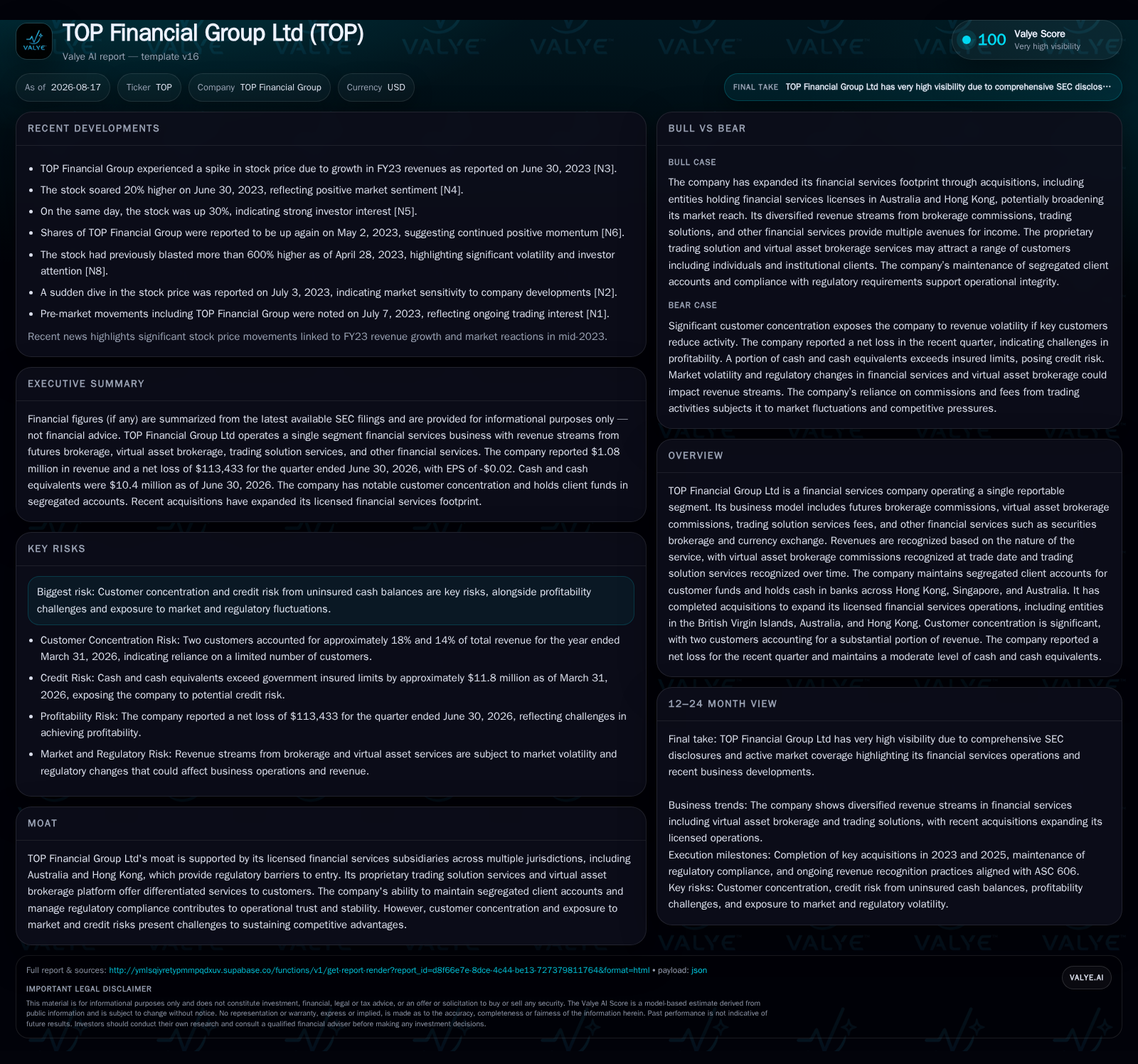
TOP Financial Group Ltd reported in its latest quarter ongoing futures brokerage activity primarily in Hong Kong, supported by licensed subsidiaries across Hong Kong, Australia, and the British Virgin Islands. The company recently approved an artificial intelligence (AI) development initiative aimed at algorithmic order execution and risk management, signaling a strategic pivot toward technology-driven scaling of financial services. However, TOP faces notable customer concentration with two clients representing a significant portion of revenue, alongside credit risk from uninsured cash balances. Its financial footprint shows modest revenue with operating losses reflecting investment in expansion and technology. Growth will hinge on successful regulatory compliance, broadening client adoption, and realizing efficiencies from AI deployment.
Recent Operating Update
TOP Financial Group Ltd’s latest quarterly filing for the period ended June 30, 2026 spotlights continued futures brokerage commission income predominantly through its Hong Kong trading platform operations. The company reported commission revenue of approximately $25.9K from futures broking on the Hong Kong Exchange during this quarter [S2]. While this revenue stream is concentrated geographically in Hong Kong's exchange environment, it forms the core transactional volume underpinning the company's brokerage commissions.
In parallel to steady operational execution in traditional futures brokerage, TOP formally approved an ambitious artificial intelligence development initiative ("AI Initiative") as disclosed in an August 4, 2026 event filing. This program is designed to integrate AI into critical business functions such as algorithmic trade order placement and execution, quantitative asset analysis, margin financing models, risk management frameworks, and customer support automation infrastructure. The Board authorized allocation of technical resources and partnerships aimed at embedding AI-driven efficiencies and scalability within TOP’s core financial services segment [S3], [S6]. This technological push aligns with broader fintech trends where advanced analytics and automation are becoming prerequisites for competitive brokerage platforms.
From a structural perspective, TOP continues operating as a single reportable segment focused on brokerage and related financial services distributed across multiple jurisdictions. The company’s licensed subsidiaries span Hong Kong (Zhong Yang Financial Services Limited), Australia (TOP 500 SEC PTY LTD), and entities incorporated in the British Virgin Islands. Such regulatory licensing across well-established financial centers creates operational barriers against new entrants by mandating compliance capabilities that limit pure technology-only competitors lacking formal licenses [S1], [S4]. Recent acquisitions—some involving related parties linked to senior management—reflect strategic moves to enlarge regulatory footholds necessary for market access in these jurisdictions [S1], [S10].
Business Model Analysis
TOP derives most revenue through commissions tied to futures brokerage trades executed on global exchanges via its trading platform architecture. It supplements this with virtual asset brokerage fees and fees from trading solution services. Commission income is recognized typically at the trade date for virtual assets or over time for ongoing trading solution contracts under ASC Topic 606 revenue recognition rules [S2]. The company’s client funds are maintained in segregated accounts held at banks distributed across Hong Kong, Singapore, and Australia—a standard practice ensuring separation of client monies from firm assets that builds operational trust among institutional clients.
Revenue sensitivity hinges on transaction volume (number of trades) executed via TOP’s digital platform and the mix between higher-margin virtual asset trades versus traditional futures brokerage commissions. Given that the customer base is notably concentrated—with two customers accounting for about a third of total revenue—the firm's top-line could exhibit volatility if these relationships weaken or shift away [S4]. This customer mix also suggests heightened dependence on maintaining service quality and fee competitiveness for a relatively small group of high-usage clients.
Margin pressures appear significant as TOP reported operating losses along with modest commission revenues totaling under $5 million annually based on trailing data. This reflects both the competitive nature of brokerage commission pricing and upfront investments required for technology platform development and regulatory compliance across jurisdictions. Margins are expected to improve only if AI-powered automation reduces labor-intensive processes or if increased trading volumes benefit from network effects or expanded retail/institutional client onboarding.
The company’s strategy also involves margin financing services embedded within its product suite; however, there is limited disclosure about balances or interest income generated from margin loans [S4]. Risk controls related to credit exposures focus partly on segregated accounts.
Industry Structure & Competitive Position
The financial services brokerage sector engages firms across several verticals: traditional securities brokers like Charles Schwab or Interactive Brokers; futures/derivatives intermediaries such as CME Group; virtual asset-centric platforms exemplified by Coinbase or Binance; and integrated multi-asset FinTech providers akin to IG Group. TOP occupies a niche bridging traditional futures brokerage with nascent virtual asset business lines underpinned by licensed subsidiaries facilitating authorized market access.
Regulatory licensing acts as both opportunity and constraint—enabling legal provision of services while requiring continuous capital allocation towards compliance infrastructures. This licensing landscape favors incumbents who can absorb licensure maintenance costs but simultaneously imposes challenges scaling rapidly when compared with purely technology-enabled brokers unbound by such requirements but potentially exposed to legal risks.
The recent AI Initiative reflects industry-wide recognition that competitive advantage increasingly depends on technology differentiation—particularly algorithmic trading execution quality, platform latency reduction, risk analytics sophistication, and onboard customer service digitization. Failure to advance technological capabilities leaves brokers vulnerable to commoditization pressures from zero-commission competitors or decentralized exchanges.
Growth Drivers
Several drivers stand out for TOP's medium-term growth blueprint:
- Expansion of Virtual Asset Brokerage: Increasing adoption of cryptocurrencies globally provides new client segments willing to pay commissions on higher-frequency digital asset trades beyond traditional instruments.
- Geographic Footprint Broadening: Acquisitions acquiring Australian AFSL licenses and Hong Kong entities build multilayered jurisdictional coverage supporting diversified client access.
- AI-Powered Trading Innovation: Deployment of algorithmic order placement systems promises efficiency gains enabling faster execution speeds which can attract sophisticated institutional players.
- Integrated Trading Solutions Adoption: Clients increasingly demand platforms combining multiple market access points bundled with margin financing options enhancing wallet share per user.
- Regulatory Clarity and Compliance: Maintaining robust licensed operations positions TOP favorably against unregulated competitors vulnerable to enforcement actions.
- Digital Client Onboarding: Streamlined onboarding leveraging automated KYC/AML powered by AI can accelerate active client additions reducing churn risks.
Risks & Constraints
Material risks include:
- Customer Concentration: Heavy reliance on two customers (~32% revenue) elevates revenue volatility potential when clients reduce activity or switch providers.
- Credit Risk Exposure: Uninsured cash balances above government insured limits expose the firm to counterparty insolvency risk.
- Profitability Challenges: Negative operating income suggests extended periods before economies of scale or AI efficiency gains translate into positive margins.
- Regulatory Compliance Complexity: Ongoing costs for licensing maintenance across diverse jurisdictions coupled with evolving fintech regulations might strain resources.
- Market Volatility Impact: Futures commissions fluctuate significantly with underlying market volumes which are sensitive to macroeconomic factors.
- Competitive Pressures: Emergence of low/no-fee brokers reduces pricing power forcing innovation investment without guaranteed return on capital.
What To Watch Next
Key milestones that will illuminate TOP’s execution include:
- Quarterly updates quantifying commission revenue growth particularly from virtual asset transactions reflecting new client wins.
- Progress reports on AI Initiative implementation including deployment timelines and initial performance metrics around algorithmic execution accuracy or customer support automation effectiveness.
- Changes in customer concentration metrics signaling whether diversification efforts reduce dependency risks.
- Regulatory developments impacting licensed subsidiaries’ ability to expand product offerings or enter new markets.
- Expense trajectory announcements revealing whether cost bases shrink due to automation or increase due to compliance scaling.
- Balance sheet health signals focusing on cash position stability amid expanding restricted cash allocations supporting more complex trading activities.
Financial Profile Discussion
As of June 30, 2026, TOP reported approximately $10.4 million in cash and equivalents supporting operational liquidity requirements amid expansion initiatives [F1]. Despite this liquidity cushion, the company posted an operating loss exceeding $1.17 million for the quarter ended March 31, 2026 reflecting high expenditure levels relative to franchise scale [F1]. Net losses were largely aligned with operating results indicating limited non-operating income sources.
Capital structure changes within FY2026 included transitions towards a dual-class share system amplifying voting control concentration among founders while enabling equity raises contributing roughly $2.9 million gross in registered direct offerings plus promissory note proceeds aggregating about $81 million aiding funding flexibility [S8], [S10], [S26]. These moves underscore anticipated capital needs driven by technology investments including AI development efforts announced recently.
The balance sheet reveals moderate leverage consistent with typical private-equity-backed fintech brokerages although footnotes confirm limited material long-term debt burdens helping maintain operational flexibility during growth phases. Cash flow patterns demonstrate swing dynamics influenced by investing outflows funding acquisitions balanced partially by financing inflows suggesting active capital management aligned with strategic growth priorities [S19], [S23].
This analysis synthesizes publicly filed company disclosures alongside sector knowledge pertinent to financial services brokerages evolving amid rapid fintech innovation cycles. It refrains from projecting future valuations but aims to clarify current positioning within an intensifying competitive landscape shaped decisively by licensing strength, technology integration capabilities including emerging AI applications, client mix concentration vulnerabilities, and capital resource adequacy.
Disclaimer: This is research-only, informational analysis and not investment advice. It may include AI-generated interpretation and general industry context. Always verify important details using primary sources.

Comments