
UPAY Advances Compliance and Lending Technology with South African Focus and U.S. Ambitions
The latest quarterly filing spotlights UPAY's continuing expansion of integrated credit and compliance software in South Africa alongside preparations for entry into the U.S. market.
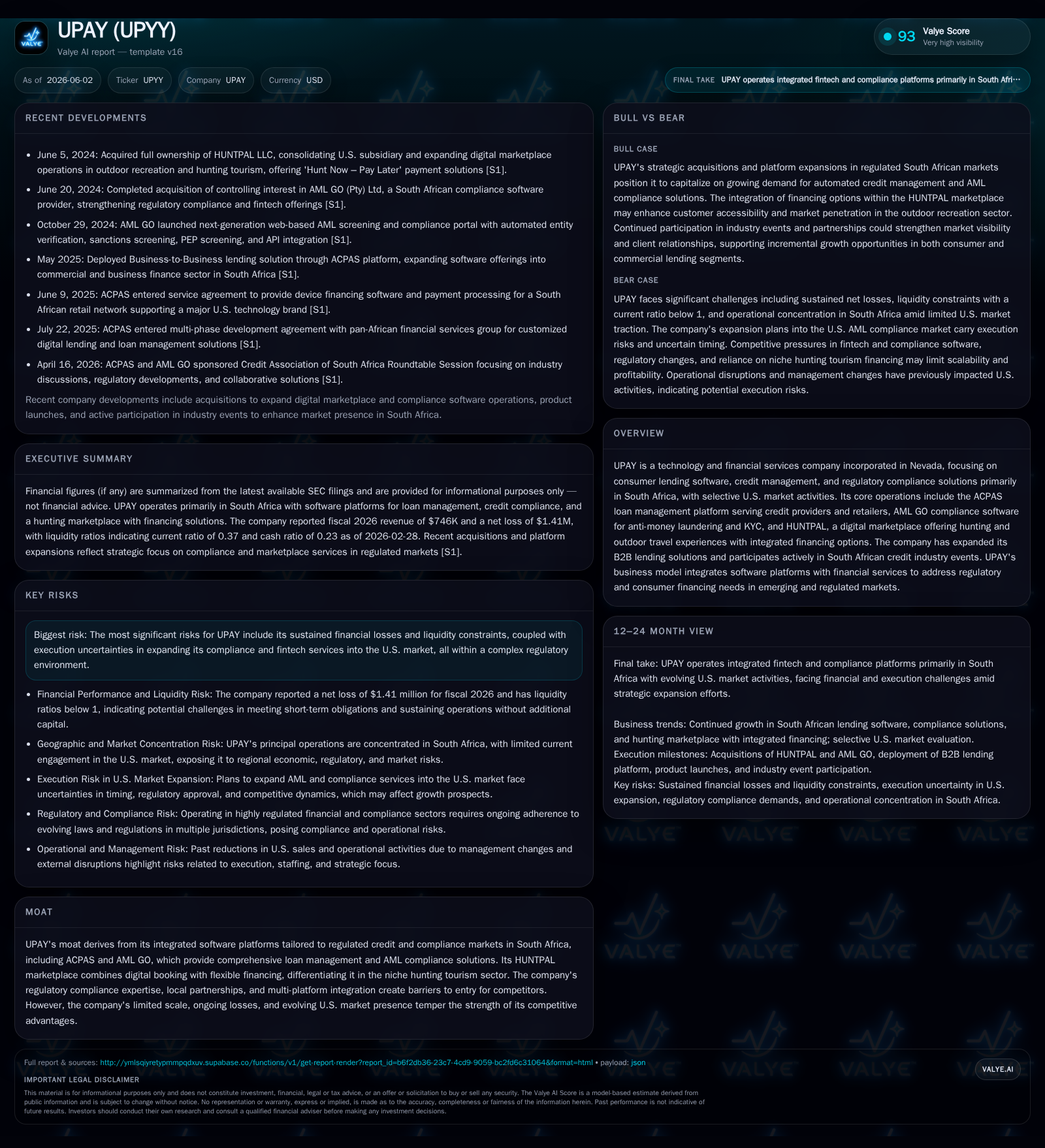
UPAY’s Q2 2026 reporting underscores ongoing growth in its ACPAS loan management platform and AML GO compliance solutions within South Africa, coupled with preparatory moves toward scaling its niche HUNTPAL marketplace in the U.S. The company’s business model revolves around SaaS-based loan administration supplemented by credit bureau services, embedded insurance, and transactional fees, with recent contract wins in device financing bolstering its presence. While UPAY holds a competitive edge among regional lending software providers through regulatory integration and platform breadth, financial losses and customer concentration pose near-term challenges. Growth is fueled by tightening regulatory environments and digital finance adoption, but execution risk looms as the company targets U.S. AML market entry and B2B lending expansion.
Key Changes in the Latest Quarterly Operating Report
UPAY’s Q2 2026 10-Q filing dated January 12 illuminates meaningful operational progress primarily in South Africa alongside strategic positioning for U.S. expansion [S2]. The ACPAS loan management platform saw enhanced activity with new service-level agreements including a notable multi-branch deployment powering device financing for a major U.S tech brand's retail network in South Africa — integrating onboarding, account servicing, and compliance via AML GO [S10]. Concurrently, AML GO accelerated client acquisition with more than 30 financial institutions onboarded in early 2025 reflecting growing demand for anti-money laundering (AML) and know-your-customer (KYC) automation [S12].
On the product vertical front, HUNTPAL consolidated under UPAY following a June 2024 acquisition and continues market development with “Hunt Now – Pay Later” installment financing targeting both U.S. hunters and African outfitters [S4]. Preparations for launching AML GO’s compliance platform in the U.S. are underway with expectations set within six months from mid-2026 [S1], supported organizationally by COO-led efforts to establish operations out of Dallas [S8]. These shifts reinforce UPAY's dual-market strategy balancing an established South African base with nascent U.S. fintech compliance ambitions.
UPAY’s Integrated Business Model: Software Meets Financial Services
UPAY operates at the intersection of SaaS platforms and fintech services centered on regulated consumer credit markets primarily in South Africa but increasingly directed at U.S. compliance sectors [S19]. The core ACPAS system offers cloud-based loan origination compliant with local National Credit Act provisions; licensed monthly on a subscription basis with additional setup fees [S25]. Revenue drivers include markup on bundled credit inquiries sourced from bureaus, embedded commissions from credit protection insurance sold at loan inception points, and percentage-based fees on successful debit order collections enabled through UPAY’s registration as a Third-Party Payment Provider [S8]. Ancillary bespoke software development contracts complement these predictable recurring revenue streams.
AML GO expands this ecosystem by delivering automated workflows for CDD/EDD onboarding, integrated sanctions & PEP screening linked to national watchlists, real-time transaction monitoring aligned with Financial Intelligence Centre Act mandates, configurable reporting tools simplifying regulatory filings, plus API connectivity allowing seamless embedding into client systems [S22], [S25]. This tightly coupled software-financial services approach not only deepens client reliance but also erects switching costs boosted by regulatory embedding — a moat sharpened over more than 14 years of legislative-aware development [S16]. Meanwhile, HUNTPAL leverages digital marketplace mechanics fused with proprietary instant approval installment loans offering interest-free installments across trip durations [S28]. This discrete vertical diversifies revenue while exploiting niche outdoor tourism financing.
Competitive Landscape: Primacy in South Africa with U.S. Market Aspirations
In South Africa’s competitive credit software sector UPAY contends alongside Compuloan, Delter, and Mycomax but distinguishes itself through comprehensive regulatory integration combining credit risk management tools with embedded insurance offerings plus payment processing capabilities all cloud-delivered without need for onsite installations [S7], [S16]. However, competitors benefit from larger scale resources challenging UPAY's footprint expansion efforts.
The U.S. financial compliance landscape is markedly larger and more fragmented; anti-money laundering software competes amidst aggressive incumbents investing heavily in technology innovation driven by stringent BSA/USA PATRIOT Act regulations enforced by FinCEN [S1], [S23]. UPAY faces significant barriers related to product customization for multiple state laws, marketing unproven solutions to a sophisticated buyer base, and operational scalability beyond the Texas hub currently hosting its compliance rollout planning team [S8], [S26]. Despite these hurdles, uptake of automated AML/KYC tools remains a rapid-growth trajectory segment globally supporting UPAY's rationale to pursue phased entry starting mid-2026.
Customer concentration represents both strength—long-term contractual dependence—and vulnerability; two customers accounted for approximately one-third of revenues during 2026 fiscal year reflecting concentrated sales reliance posing retention risks amid evolving competition or economic shocks that may impact key clients’ purchasing decisions [S7]
Growth Catalysts Driven by Regulatory Trends and Digital Financing Adoption
UPAY’s addressable market is structurally buoyed by intensifying regulatory oversight mandating robust credit provider compliance especially under South Africa’s evolving National Credit Act framework focused on consumer protection against reckless lending practices [S16]. Increasing penetration of formalized digital payment mechanisms enhances value capture from debit-order transaction fees which grow commensurate with customers’ adoption of automated repayment channels.
Concurrently, AML GO benefits from expanding requirements on financial institutions as financial crime prevention becomes central to operational risk management amidst surging digital banking popularity necessitating scalable onboarding/monitoring solutions meeting FICA norms [S12], [S23]. The company’s recent penetration gains with over 30 new licensees underscore the tangible demand driven by regulatory imperatives.
HUNTPAL’s novel installment financing model taps into an underserved hunting tourism segment appreciating flexible payments options that facilitate higher booking conversions particularly among millennial outdoor enthusiasts increasingly active online—a trend mirrored by rising affiliate/influencer marketing initiatives planned for the U.S. launch phase [S20], [S28].
Furthermore, shifting focus towards business-to-business (B2B) lending within South Africa opens supplementary avenues where ACPAS technology enables digital loan lifecycle management tailored for commercial borrowers—an area projected to grow alongside SME credit expansion post-pandemic recovery efforts [S10].
Risks: Execution Hurdles, Financial Losses, and Customer Concentration
Notwithstanding clear strategic rationales, UPAY confronts acute execution risks surrounding its geographical diversification plans. Scaling AML GO into the United States entails overcoming substantial obstacles including extensive software customization per federal/state compliance regimes; navigating entrenched competition from specialized large vendors; establishing brand recognition; and building distribution pipelines—all vital yet unproven at present beyond organizational leadership investments [S1], [S8].
Financially, UPAY remains loss-making as reflected by net income deficits exceeding $1.4 million for fiscal year ended February 28, 2026 against trailing revenue below $750K—operating losses nearing half a million dollars highlight continuing cash burn despite a cash balance approximating $96K versus negligible total debt near $1.6K indicating manageable leverage but tight liquidity profiles constrained by working capital deficits evidenced through a current ratio of only 0.37 raising solvency watchpoints should revenue growth falter or cash collections slow further [F1]
Customer concentration amplifies risks since dependency on two principal clients constituting nearly one-third of total revenues exposes the Company to disproportionate impacts from client churn or contract renegotiations impacting short-term revenue continuity given limited alternative resource intensity due to small employee base (~16 full-time staff) focused primarily on South African operations limiting sales bandwidth for both U.S. expansion or further geographic diversification [S7], [F1].
Competitive pressures also persist domestically as well-funded peers widen product offerings influencing price sensitivity while pandemic-era retrenchment of the Texas sales office suggests that execution constraints remain despite lean operational restructuring aiming at cost optimization without sacrificing growth momentum [S8], [S22].
Catalyst Watchlist: U.S. Market Entry and Scaling B2B Lending Platform
Investors monitoring UPAY should track several forward-looking milestones signifying inflection potential: imminent launch of AML GO compliance platform into the United States anticipated within six months carries strategic weight as first concrete step into regulatory-heavy developed markets potentially unlocking sizeable new licensing revenues if effective integration/sales execution succeed [S1], [S23].
Simultaneously expanding ACPAS capabilities beyond traditional consumer lending into B2B commercial finance segments in South Africa via recent service agreements can broaden addressable market size while reinforcing client stickiness through complex solution provision demanding ongoing account management support—the rollout phases here will reveal escalation effectiveness along with renewal rates sustaining ARR profiles amid cyclical credit demand fluctuations typical of emerging economies post-recovery phases [S10]
HUNTPAL’s marketing ramp-up focusing on digital advertising campaigns selectively engaging outdoor enthusiasts across key American states supported by influencer partnerships plus trade show participations may catalyze top-line growth beyond mature core markets; conversion metrics from these efforts alongside outfitter partnerships will enlighten observers on structural scalability prospects within niche travel-financing sectors lacking direct comparable peers presently under public fintech auspices [S20], [N3].
Lastly industry roundtable sponsorships such as those coordinated through Credit Association of South Africa (CASA) signal sustained commitment to sector engagement potentially influencing pipeline generation amid peer-networked trust advantages accrued since inception which remain less vulnerable to commoditization than standalone software products lacking embedded regulatory expertise components [S15].
Current Financial Profile Highlights and Liquidity Considerations
As of February 28, 2026 end-period data shows consolidated revenues totaling approximately $746K alongside an operating loss around $454K driving a net loss close to $1.4 million illustrating persistent investment stage status without current profitability achievement yet maintaining cash reserves near $96K offsetting minimal debt obligations ($1.6K total debt), yielding negative net debt position (~$-94K) underscoring modest balance sheet flexibility albeit constrained working capital dynamics reflected by current assets ($153K) well eclipsed by current liabilities ($420K), producing a critical current ratio of ~0.37 indicating material liquidity caution required going forward absent significant improvements in cash flow generation or external financing inflows to support continued operational scaling endeavors without risking solvency deterioration [F1]
This financial snapshot aligns with commentary citing ongoing losses though mitigated capital structure risk given low debt leverage; nonetheless adequate funding sourcing remains imperative especially amidst expanded internationalization costs related to U.S market entry and software adaptation efforts evidencing near-term funding dependency risk concentrated on equity raises or partnership capital injections punctuated during forthcoming quarters.[S3],[S11].
Disclaimer: This report is prepared solely for informational purposes based on publicly available disclosures including SEC filings up to June 2, 2026. It does not constitute investment advice or research views regarding any securities mentioned herein.
Disclaimer: This is research-only, informational analysis and not investment advice. It may include AI-generated interpretation and general industry context. Always verify important details using primary sources.

Comments