
United States Commodity Index Funds Trust Focuses on Commodity Futures Amid Regulatory and Market Challenges
USCI provides diversified commodity futures exposure tracking the SummerHaven Dynamic Commodity Index with active futures management.
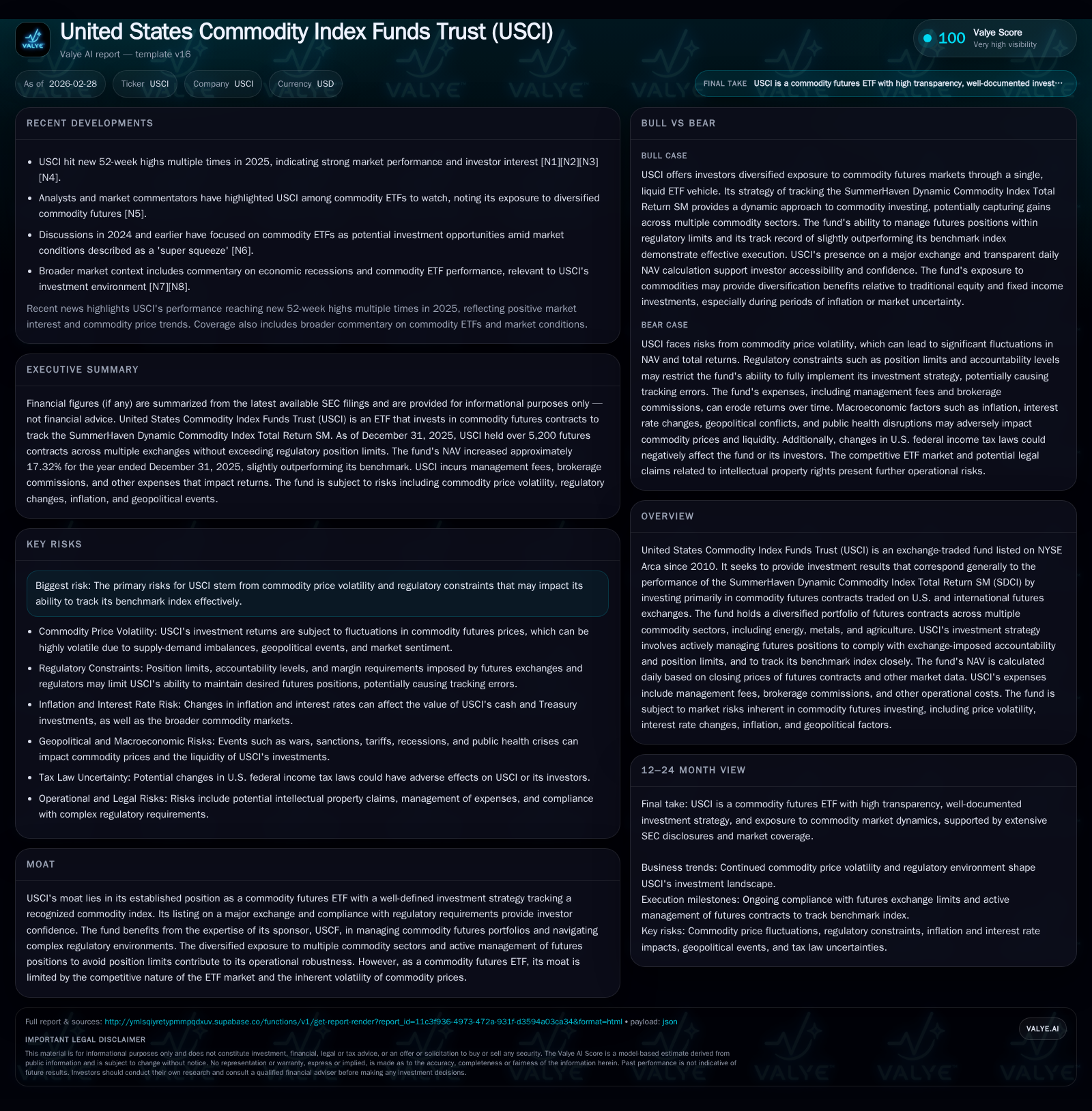
United States Commodity Index Funds Trust (USCI) is an established exchange-traded fund focused on commodity futures, primarily aiming to replicate the performance of the SummerHaven Dynamic Commodity Index. Since its NYSE Arca listing in 2010, it has maintained broad exposure across energy, metals, and agriculture through actively managed futures positions designed to respect regulatory position limits. Despite volatile commodity prices and regulatory scrutiny—including prior settlements with the SEC and CFTC—USCI reported significant net income recovery in 2021 after losses in preceding years, reflecting favorable market conditions and improved fund flows. Liquidity is managed conservatively without leverage, and the fund's operational expenses are transparent. Going forward, macroeconomic drivers such as inflation, climatic policy shifts, and geopolitical tensions will shape its growth trajectory and risk profile.
Overview
United States Commodity Index Funds Trust (USCI) is an exchange-traded fund launched in 2010 and listed on NYSE Arca. Its principal goal is to provide investors exposure that closely corresponds to the SummerHaven Dynamic Commodity Index Total Return SM (the SDCI). The fund invests almost exclusively in commodity futures contracts traded on both U.S. and international futures exchanges ([S1]).
The index it tracks incorporates a diversified basket spanning energy commodities (such as oil and natural gas), metals (including precious metals), and agricultural products. This multi-sector approach aims to smooth returns relative to sector concentration while providing broad commodity market participation.
Historical Performance
USCI's financial results exhibit cyclicality tied closely to commodity price fluctuations and macroeconomic conditions. Below is a summary of key financial metrics over recent years:
Historical performance (annual)
| FY | Rev ($mm) | Net ($mm) | CFO ($mm) | Rev YoY | Net YoY |
|---|---|---|---|---|---|
| 2021 | 75 | 74 | +515.1% | ||
| 2020 | -17 | -18 | -27 | -290.4% | -122.9% |
| 2019 | -4 | -8 | -26 | ||
| 2017 | 34 | 29 | -44 | +469.1% |
Source: SEC companyfacts cache [F1].
Note: Revenue figures reflect market valuation impacts associated with futures contracts rather than traditional operating revenue streams typical for other entities ([F1]).
The fiscal year 2020 was marked by significant losses during extraordinary volatility due to the COVID-19 pandemic and geopolitical conflicts ([S1]). A strong recovery ensued in 2021 with net income increasing over fivefold year-over-year driven by improving commodity prices and fund inflows ([F1], [S17]). Operating cash flow trends followed similar patterns.
Investment Strategy and Portfolio Management
USCI maintains long or short futures positions consistent with benchmark components while actively managing contracts around position limits enforced by exchanges such as NYMEX, ICE Futures, CME Group exchanges (CBOT/CME/COMEX), and LME ([S1]).
As of December 31, 2025:
- Total open futures contracts exceeded 5,200 across multiple exchanges ([S1]).
- No accountability levels or position limits were breached during fiscal year 2025.
- Contracts are routinely rolled ahead of near-month expiry to avoid last-day position limits ([S1]).
This active management differentiates USCI from passively managed commodity ETFs that may be more exposed to contango/backwardation effects.
Risk Factors
Commodity prices are inherently volatile and influenced by global economic cycles. USCI's NAV directly reflects these fluctuations primarily through futures pricing rather than spot prices ([S1]). Economic recessions or geopolitical turmoil can adversely impact performance.
Regulatory risk is significant given oversight by the CFTC and SEC on sponsor operations. Notably:
- USCF consented in late 2021 to cease-and-desist orders from both regulators concerning violations during volatile periods in April-May 2020 ([S5], [S9]).
- Civil penalties totaled $2.5 million split equally between SEC and CFTC.
- Ongoing derivative lawsuits allege fiduciary breaches related primarily to United States Oil Fund litigation involving USCF affiliates ([S7], [S11], [S12], [S13]).
Tax regulation changes introduce uncertainty about future impacts on distributions or valuation ([S2]). Cybersecurity risks affecting operations are also noted ([S19]).
Environmental regulations targeting fossil fuels may pressure energy portfolio components affecting returns ([S19]).
Liquidity and Capital Structure
USCI maintains strong liquidity without borrowing or leverage ([S10], [S16]). Holdings include cash equivalents and U.S. Treasuries totaling approximately $264 million as of year-end 2025 held as margin collateral for futures trading across clearing brokers ([S6], [S14], [S21]). This conservative liquidity supports daily margin requirements.
Shares outstanding were approximately 3.6 million at December 31, 2025 with an NAV per share near $77.48 ([S14], [S17]). Authorized Participants facilitate share creation/redemption typically in blocks of 50,000 shares supporting liquidity alignment with asset values ([S22], [S24]).
Management fees are charged at approximately 0.80% per annum of average daily net assets reflecting typical expenses for actively managed commodity ETFs; prior expense waivers ended by mid-2011 for USCI ([S18], [S25]). Brokerage commissions represent basis points per annum costs due to frequent contract rolling.
Outlook and Growth Prospects
USCI's growth prospects depend on several factors:
- Commodity market recovery post-pandemic supports demand-driven upside.
- Managing roll strategies effectively may mitigate negative roll yield impacts compared to peers.
- Regulatory developments including tax laws will require ongoing compliance vigilance.
- Energy transition policies could reduce traditional energy sector weights but may be offset by metals/agriculture exposures.
- Geopolitical tensions may increase volatility presenting both risks and tactical opportunities.
No explicit guidance on targeted asset growth or distribution policies has been provided; monitoring volume trends alongside regulatory filings remains important.
Returns & Capital Allocation
As an ETF investing primarily in derivatives rather than operating assets,[F1] USCI’s returns derive mainly from changes in underlying commodity prices reflected through asset value fluctuations rather than conventional revenues.
Distributions stem largely from interest earned on Treasury holdings rather than direct dividends from operations; no share repurchases occur since creations/redemptions are facilitated via Authorized Participants mitigating premium/discount imbalances ([S22]).
Conclusion & Monitoring Points
USCI offers broad commodities exposure through a dynamic futures strategy emphasizing regulatory compliance within a transparent fee structure suitable for investors seeking indirect commodities access without physical holdings. Key factors to watch include:
- Macroeconomic inflation trends impacting commodity prices,
- Regulatory changes affecting derivatives ETFs,
- Litigation outcomes related to sponsor activities,
- Sector weight shifts following global energy policies,
- Creation/redemption activity indicating investor demand dynamics. These elements will influence USCI’s capacity for sustainable growth amid a complex market environment.
Disclaimer: This report synthesizes publicly available information as of February 28, 2026. It is intended solely for informational purposes without providing investment advice or recommendations. Readers should conduct their own due diligence before making any investment decisions related to United States Commodity Index Funds Trust or comparable instruments.
Disclaimer: This is research-only, informational analysis and not investment advice. It may include AI-generated interpretation and general industry context. Always verify important details using primary sources.

Comments