
Viewbix’s Revenue Concentration and Acquisition Strategy Test Business Resilience
Heavy reliance on a single major customer and integration of distinct acquisitions shape Viewbix's near-term operational risks and growth opportunities.
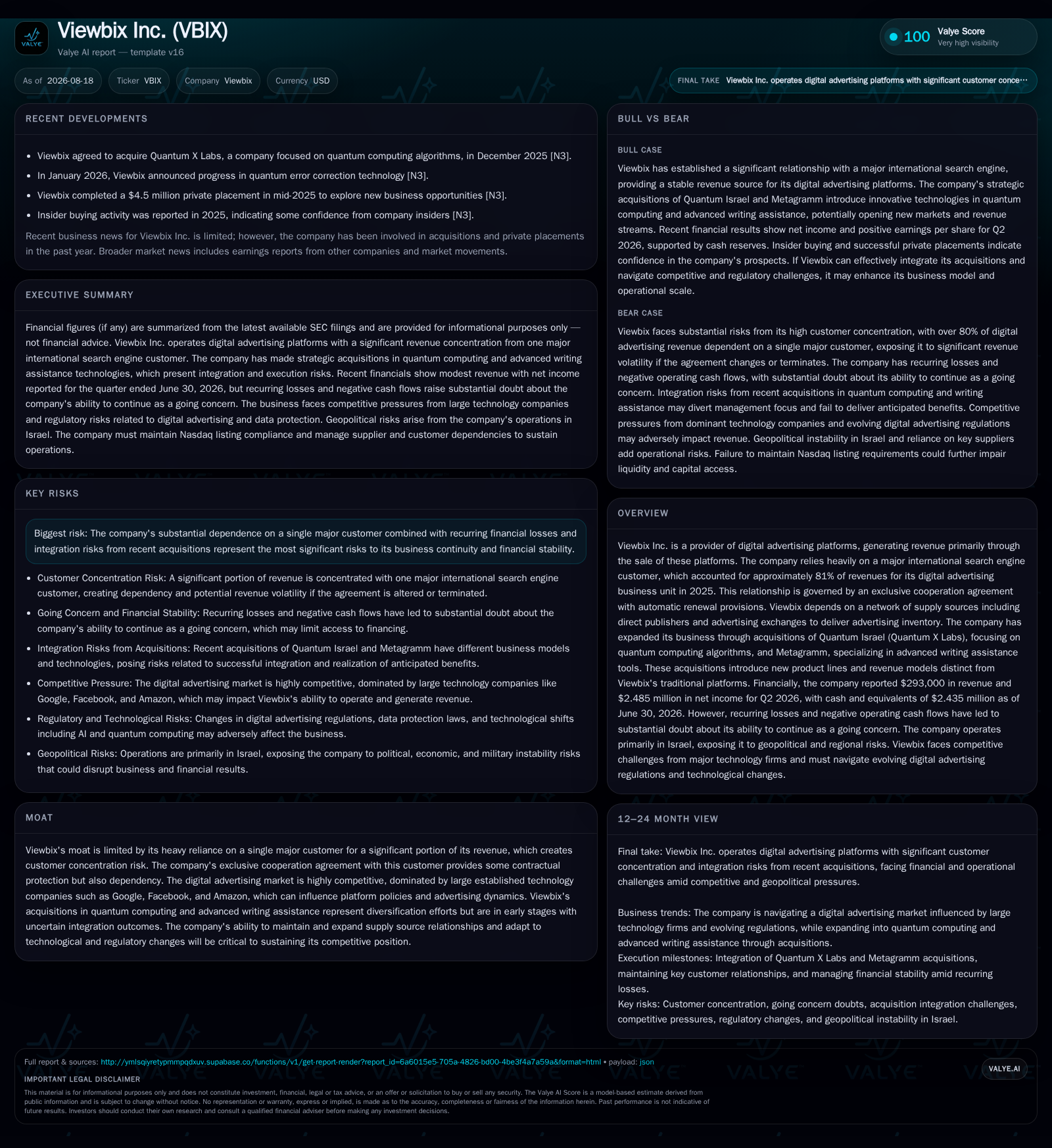
Viewbix Inc. remains heavily dependent on a major international search engine customer, which accounted for approximately 81% of its digital advertising revenue in 2025, underpinning significant customer concentration risk. The company’s latest quarterly filing reiterates substantial doubt about its ability to continue as a going concern due to recurring losses and negative operating cash flow. Concurrently, Viewbix has diversified through acquisitions of Quantum Israel and Metagramm, entering quantum algorithms and advanced writing assistance markets, but faces integration and execution challenges given the starkly different technology and revenue models. The digital advertising software sector poses operational pressures from dominant platforms like Google and Facebook, regulatory changes, and supply-side dependencies that limit pricing power. Monitoring the success of integration efforts alongside maintaining supply relationships and securing additional financing will be critical for stabilizing Viewbix’s financial profile.
Recent Operating Update: Reinforcing Risk Profile Amid Diversification Efforts
In its latest quarterly filing dated August 13, 2026, Viewbix Inc. highlighted ongoing operational challenges despite strategic diversification moves. Management reiterated substantial doubt about the company’s ability to continue as a going concern owing to recurring net losses and negative operating cash flows, emphasizing liquidity strains at current performance levels [S2][S17]. This signals critical near-term funding needs that may impact the company’s ability to sustain operations without fresh financing or operational turnaround.
Crucially, Viewbix acknowledged that anticipated benefits from its recent acquisitions—Quantum Israel (acquired March 2026) focusing on quantum algorithms across transportation, drug discovery, security segments; and Metagramm (acquired March 2025), specializing in subscription-licensed advanced writing assistance tools—have not yet been realized fully [S2][S21]. The contrasting nature of these acquired businesses’ technology bases and revenue models from Viewbix’s legacy digital advertising platform complicates integration prospects.
Business Model: Platform Dependency Meets Emerging Technologies
Viewbix primarily generates revenue through licensing its digital advertising platforms sold mainly as software subscriptions or usage-based fees [S1][S4][S18]. Its platform acts as an intermediary connecting advertisers with supply sources comprising direct publishers and ad exchanges to deliver flexible advertising inventory across channels typical in the digital ecosystem—search engines, social media sites, publisher networks. Annual revenues revolve around transactional fees tied to advertising campaigns run via these platforms. However, this business model confronts structural constraints stemming from platform policies imposed by dominant internet platforms—which can regulate inventory access or algorithmic targeting adjustments—and evolving data privacy regulations that influence advertiser targeting precision
Customer concentration is a defining characteristic of Viewbix’s revenue stream: one major international search engine customer accounted for approximately 81% of digital advertising revenues in 2025 [S1][S18]. This puts the company under material risk if contract terms change or if platform policies restrict its offerings since most revenue flows through this partnership secured by an exclusive cooperation agreement with automatic renewal provisions.
Besides its core offering in digital advertising platforms laden with AI-driven targeting capabilities for campaign management, Viewbix expanded into emerging tech domains via acquisitions. Quantum Israel brings quantum computing expertise with products aimed at highly specialized sectors requiring advanced computational algorithms—a market still nascent with lengthy development cycles before commercial viability [S2][S16]. Metagramm diversifies product lines into writing assistance software monetized through subscription licensing—a SaaS model conceptually aligned yet operationally disparate from digital ad platform sales [S2][S21]. These moves reflect an attempt to hedge core-platform risks through technological diversification but add complexity to revenue recognition patterns and incremental cost structures tied to R&D.
Industry Structure and Competitive Landscape
The digital advertising software industry is fiercely competitive dominated by behemoths such as Google, Facebook (Meta), Amazon—which command vast shares of global online ad inventory and wield control over platform policies directly affecting ecosystem players like Viewbix. These dominant firms both provide essential inventory access via their ad exchanges and set increasingly stringent compliance rules affecting third-party advertising solutions’ reach and effectiveness [S1][S4].
Viewbix operates downstream in the value chain as a platform intermediary rather than owning direct consumer traffic or inventory volume itself. Its reliance on key partners for ad inventory exposes it to supply-side risks if publishers or exchanges shift pricing models or prioritize proprietary solutions. Additionally, regulatory scrutiny surrounding data privacy (GDPR-like regimes) requires ongoing platform adaptations that increase compliance costs while limiting precision targeting techniques crucial for advertiser ROI.
In peer comparison terms, large SaaS marketing automation providers enjoy diversified client bases minimizing concentration risk—for instance, multi-industry marketing platforms with broad SMB client distributions contrast sharply with Viewbix's single-customer dependency. Moreover, dominant players benefit from scale allowing higher gross margins—in contrast to weaker operating leverage observed at smaller firms facing price pressures.
Growth Drivers: Adoption Trends Against Execution Challenges
Growth drivers within the digital advertising ecosystem include expanding marketing budgets directed toward programmatic buying facilitated by real-time bidding technologies integrated into demand-side platforms like those offered by Viewbix. Increasing adoption of AI enhances campaign targeting accuracy potentially improving client retention metrics such as net retention rate and reducing churn among advertisers.
Moreover, subscription-based licensing in marketing tools accounts for rising recurring revenue streams aligned with SaaS financial stability frameworks; however, customer concentration blunts this effect presently for Viewbix. The acquisitions expose potential long-term upside via quantum computing advancements promising breakthroughs in logistics optimization or drug discovery analytics—sectors poised for transformative quantum-enabled gains once scalability hurdles are cleared[S2][S16]. Likewise, metagramm's advanced writing assistance tools ride growing demand for content optimization software charging subscription fees that could diversify future ARR profiles substantially if penetration deepens[S21].
Nonetheless, realizing these growth avenues depends heavily on successful integration execution—managing disparate business models—and sustained capital investment pressures amid liquidity constraints highlighted in recent filings.
Risks and Constraints: Customer Dependence Meets Liquidity Concerns
The paramount risk stems from heavy reliance on a single major customer accounting for over four-fifths of core segment revenues[S1][S18]. Any adverse contract renegotiations or termination would materially deteriorate financials; although exclusive agreements provide contractual protection, they reinforce systemic dependency raising volatility concerns.
Integration risk looms large given recent acquisition targets operate commercially unlike the legacy platform offering; misalignment could lead to cost overruns or failure to unlock synergies resulting in prolonged drag on earnings[S2][S21]. Moreover, emerging stage nature of quantum computing business heightens uncertainty around developmental milestones translating into tangible revenues[S16].
External headwinds include intensifying competition from tech giants controlling ad exchange ecosystems—potentially restricting third-party provider participation—and escalating regulation focused on user data privacy impairing targeted advertising effectiveness[S4][S16]. Cybersecurity threats further accentuate operational risks due to platform infrastructure dependencies[S7]. Financially, ongoing net losses combined with working capital deficits (current ratio ~0.86) constrain runway necessitating new funding rounds under possibly unfavorable terms[F1][S2].
What To Watch Next
Key milestones include monitoring quarterly progress on harmonizing acquired operations' technologies with existing platforms alongside measurable revenue diversification shifts away from the principal customer concentration metric. Additional KPIs worth scrutinizing are the trajectory of operating cash flow improvements reflecting operational efficiencies or cost control related to acquisition integration efforts.
Securing fresh capital under acceptable terms remains critical—any signs of strained liquidity triggering covenant breaches or credit facility reductions would markedly elevate solvency risk.[F1] Furthermore, regulatory developments impacting data usage policies or platform access conditions warrant close attention given their outsized influence on core business viability.
Finally, developments from the quantum computing arm concerning patent filings milestone attainment or coupling quantum algorithm outputs to commercial customers could serve as early indicators validating diversification strategy bets.[S12]
Financial Profile Discussion
As of June 30, 2026, Viewbix held approximately $2.44 million in cash and equivalents against current liabilities of $4.05 million resulting in a current ratio near 0.86—a suboptimal liquidity position reflective of working capital deficits[F1]. Although total debt stood at roughly $480 thousand as of March 2024 does not present high leverage risks directly,[F1] recurring negative cash flow from operations coupled with ongoing losses underscores challenging free cash flow conversion characteristics requiring external financing support[S2]. Historical net income was negative $19.3 million at year-end December 2025 reinforcing profitability issues[F1]. Maintaining financing arrangements is essential given stated going concern doubts noted repeatedly by management since late 2025 filings.[S2][S21] This precarious financial position heightens vulnerability to market disruptions or delays in strategic initiatives’ payoffs.
This analysis incorporates information available through August 18, 2026. It focuses strictly on established facts supported by SEC filings without implying investment advice or forecasts.
Disclaimer: This is research-only, informational analysis and not investment advice. It may include AI-generated interpretation and general industry context. Always verify important details using primary sources.

Comments