
VCI Global Faces Operational Cost Surges Despite Technology Revenue Growth
The Malaysian technology and financial services firm reported a revenue decline in 2025 amid rising expenses and internal control challenges.
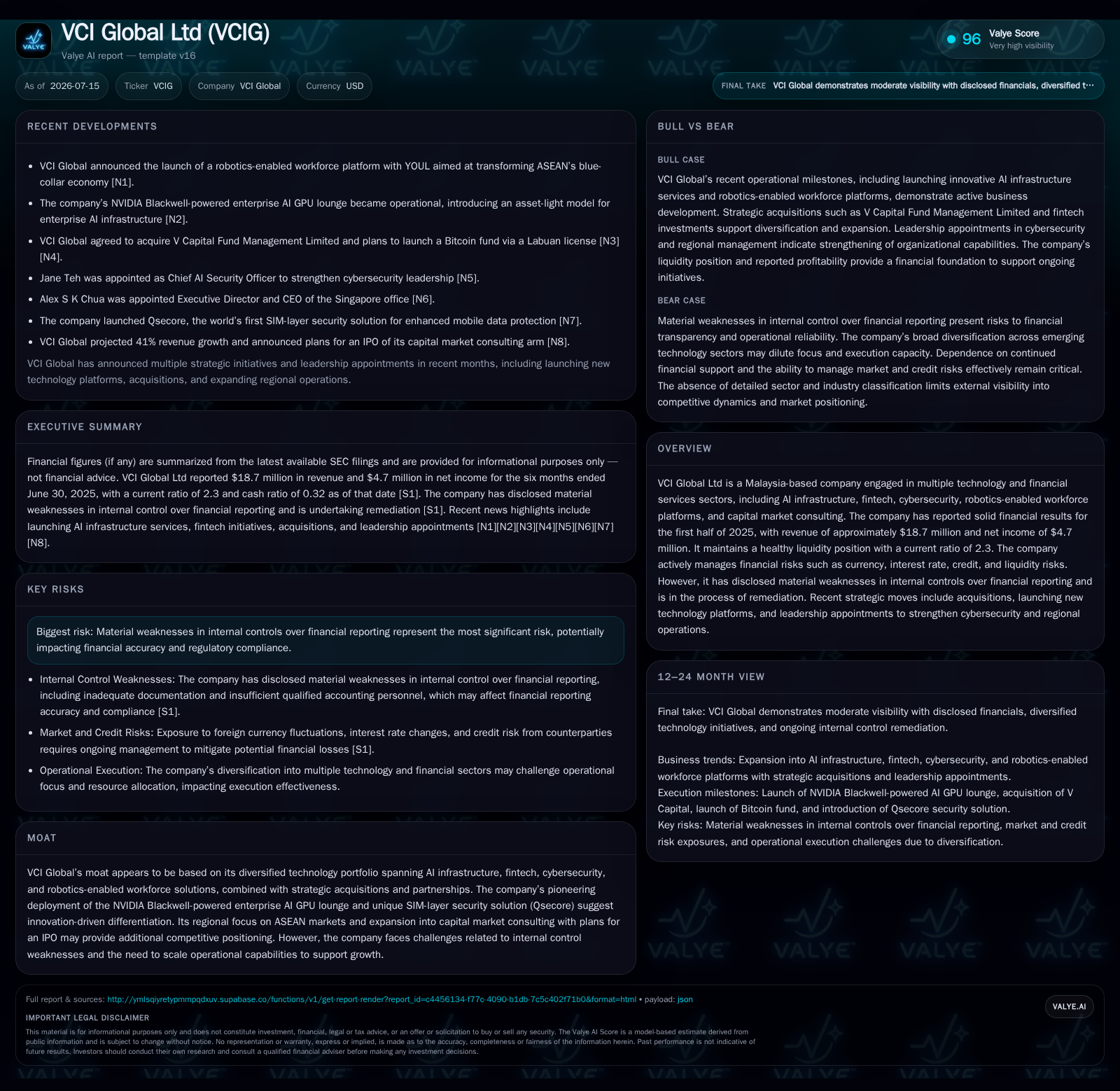
VCI Global Ltd experienced a 6.2% revenue decline to $26.1 million in fiscal year 2025, driven by a sharp decrease in business consultancy revenue offset partially by growth in technology development and interest income. The company’s operating expenses surged significantly, leading to a net loss after years of profit. Material weaknesses in internal controls remain a key risk as VCI balances expansion into AI infrastructure, fintech, and cybersecurity with pressing cost management needs. The company maintains adequate liquidity but must demonstrate improved operational execution and financial reporting controls to sustain growth.
Recent Operating Update
VCI Global Ltd's latest quarterly filing dated June 26, 2026 [S2] reveals the company entered a settlement agreement resolving litigation related to reporting breaches concerning warrants held by Esousa Group Holdings. This agreement includes issuance of ordinary shares and various warrants while restricting certain corporate actions for 90 days post-settlement to comply with Nasdaq requirements [S2]. Additionally, on June 3, 2026 [S3], VCI completed the exercise of over 818,000 pre-funded warrants into ordinary shares at nominal price, updating its equity base and shareholder composition.
These corporate developments underscore ongoing capital structure adjustments amid operational headwinds. The latest annual filing dated July 15, 2026 [S1] provides critical context on full-year fiscal 2025 performance: total revenue fell by approximately $1.7 million or 6.24% compared to the prior year to $26.1 million, driven mainly by a near-30% decline in business strategy consultancy revenues as major milestones were completed in prior periods [S21]. In contrast, technology development offerings including generative AI solutions and digital human platforms contributed a healthy 13.3% revenue increase to $12.9 million [S21]. Interest income nearly doubled due to expanded loan portfolios in microfinancing activities [S21].
Business Model
VCI operates across a diversified spectrum within technology and financial services: AI infrastructure hosting utilizing enterprise-grade GPUs; fintech lending products generating interest income; cybersecurity platform deployment through proprietary SIM-layer solutions; robotics-enabled workforce automation; plus capital market consulting targeting ASEAN IPOs [S1]. Revenue is derived primarily via project-based consulting fees, SaaS subscriptions for technology platforms, interest income from loan portfolios, and licensing proprietary technology like the Qsecore security solution.
The technology development segment drives growth through innovation-led product commercialization such as AI livestreaming platforms and gaming aggregators that generate recurring SaaS or license revenues supplemented with bespoke solution consultancy [S21]. The fintech unit monetizes via loan processing fees plus net interest margins on customer loans that have shown rapid expansion [S21]. Business strategy consultancy historically contributed steady project fees associated with advising clients on regional capital market access but saw compression reflecting milestone timing differences and early-stage new engagements [S21].
Operating costs are heavily influenced by director remuneration levels—indicative of senior leadership hires for regional operations—and legal/professional fees linked to contracts and regulatory compliance efforts possibly connected to recent litigation settlements [S17]. Employee-related expenses constitute the largest portion of overhead given specialized talent requirements for AI development and cybersecurity teams.
Industry Structure and Competitive Position
VCI occupies mid-to-upper value chain positions: developing proprietary AI infrastructure powered platforms akin to NVIDIA GPU hosting peers; delivering fintech solutions somewhat comparable to regional niche players; providing cybersecurity offerings paralleling specialized firms leveraging unique IP layers; all accompanied by capital advisory services with analogs in consultancies like Deloitte but focused geographically on ASEAN markets.
The company's innovation edge is reflected in early adoption of NVIDIA Blackwell-powered enterprise GPU lounges—a capital-intensive space where capacity utilization rates critically influence profitability—and deployment of SIM-layer security technology pioneering differentiated approaches to telecom-level data protection [N/A but inferred from overview]. However, scaling infrastructure capacity alongside margin management amid competitive pricing pressures from cloud hyperscalers represents an ongoing challenge.
Peer comparisons illustrate that while large players like NVIDIA or FIS operate at scale with vastly larger R&D investments, VCI leverages agility through targeted technological niches and ASEAN regional expertise. Its smaller scale necessitates measured growth strategies heavily dependent on project execution rates, client retention, licensing renewals (recurring revenue KPIs), and timely commercial rollouts of AI-driven platforms.
Growth Drivers
Key growth vectors include increasing adoption of AI/ML technologies among enterprises prompting demand for high-performance computing infrastructure where VCI’s NVIDIA-powered GPU lounges can capture share if utilization rates improve.
Rising cybersecurity threats catalyze demand for innovative protection layers like VCI's Qsecore SIM-layer solution that offers novel market risk management advantages amidst regulatory tightening across jurisdictions.
Fintech expansion leverages growth in microfinancing within emerging ASEAN economies capitalizing on digital transformation trends accelerating lending digitalization and financial inclusion efforts.
Capital market consulting supports regional IPO preparations exploiting growing ASEAN capital markets integration efforts coupled with strategic acquisition activities enhancing intellectual property and service range.
Strategic partnerships with technology vendors and target geographic focus underpin these drivers alongside continuous R&D investments crucial given rapid tech obsolescence risks.
Risks and Watchpoints
Foremost risk stems from disclosed material weaknesses in internal controls over financial reporting [S1], exposing VCI to potential inaccuracies impacting investor confidence and regulatory compliance which management is actively remediating.
Operationally, significant surges in operating expenses—up over 120% in director remuneration plus sizable legal costs—challenge margin sustainability absent commensurate top-line growth [S17]. Integration complexity from acquisitions adds execution risk especially amid evolving product mix transitions.
Revenue concentration risk exists given uneven timing of major consultancy projects with cyclical troughs evident in fiscal 2025 results reflecting milestone completions rather than structural declines [S21]. Sustaining consistent GPU infrastructure utilization poses balancing capex/cost leverage challenges critical to profitability.
Currency fluctuation exposures remain modest but present within diverse ASEAN currency operations requiring ongoing hedging considerations as noted under market risk management disclosures [S1]. Finally, competitive pressures from better-capitalized cloud providers could cap pricing flexibility for VCI’s hosted AI infrastructure offerings.
What to Watch Next
Key milestones include monitoring quarterly revenue segmentation for signs of rebound or stabilization within business strategy consultancy services versus continued traction in technology development revenue streams supported by new product launches like generative AI platforms.
Execution progress on internal control remediation processes will be critical for restoring investor trust in financial accuracy.
GPU utilization metrics or contract ramp-ups signed under service-level agreements will indicate efficiency gains directly impacting margins.
Capital market advisory deal flow activity especially related to IPO support among ASEAN clients could serve as barometers for consulting growth sustainability.
Watch also for further corporate action announcements following expiration of the February-June settlement-related corporate restrictions affecting strategic deals or equity issuance plans impacting capitalization structure.
Financial Profile Discussion
Net cash generated from operations was positive at $2.6 million leveraging non-cash adjustments linked to acquisitions yet investing activities consumed substantial outflows totaling approximately $73 million primarily linked to intangible asset acquisitions and investments in subsidiaries demonstrating appetite for growth via external ventures [S5]
Financing activities provided offsetting inflows exceeding $66 million consistent with equity raises including convertible notes issuance helping fund aggressive capex on AI infrastructure projects albeit raising leverage considerations if cash flow generation does not normalize swiftly [S5]
Capital allocation emphasis appears weighted toward scaling emerging technology platforms but requires close monitoring of cash burn versus incremental recurring revenue gains vital for long-term viability within competitive financial services technology ecosystems.
This analysis synthesizes public filings up to mid-2026 without investment research view intent. It highlights operational shifts amid evolving product mix complexities typical for diversified tech-finance companies advancing into next-generation AI infrastructure while navigating cost pressures and control remediation obligations.
Disclaimer: This is research-only, informational analysis and not investment advice. It may include AI-generated interpretation and general industry context. Always verify important details using primary sources.

Comments