
Viking Holdings’ Strategic Brand Uniformity Fuels Market Share and Financial Turnaround
Viking's unified luxury cruise brand and disciplined capital management underpin its market dominance and significant profitability gains.
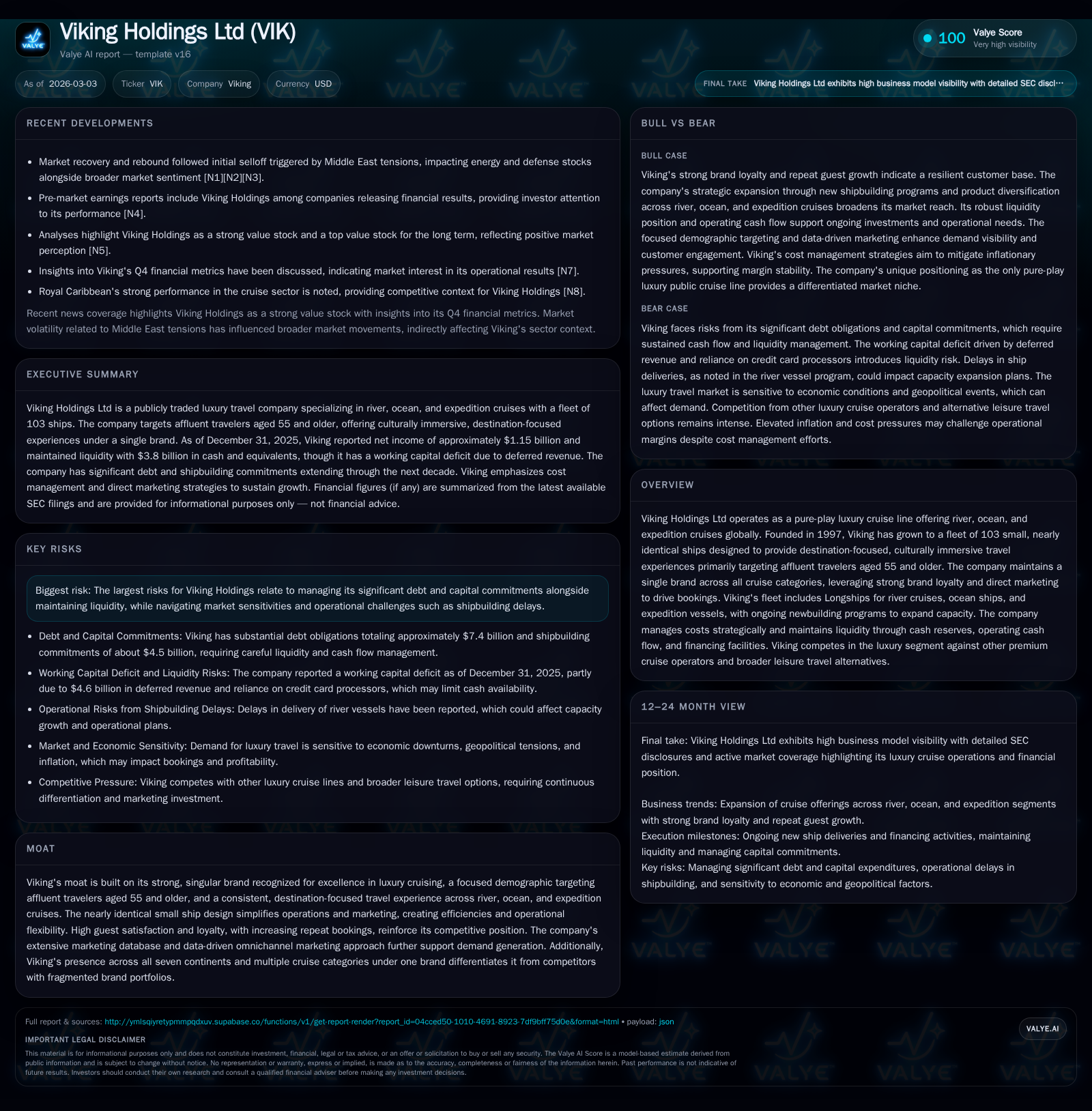
Viking Holdings Ltd has leveraged a singular luxury brand identity, targeting affluent travelers aged 55+, with a fleet of nearly identical small ships across river, ocean, and expedition cruises. This strategy has fostered strong guest loyalty and operational efficiencies, contributing to a 650% net income surge in FY2025 to $1.15 billion post-IPO. Amid an aggressive fleet expansion and sizable capital commitments, liquidity management remains a focal challenge. Viking’s direct marketing investment and premium pricing differentiate it within the luxury segment, while cautious capital allocation balances growth with deleveraging priorities.
Brand-Driven Growth and Operational Model: The Viking Difference
Viking’s hallmark is its single-brand approach spanning all three primary cruise categories—river, ocean, and expedition—allowing it to serve a clearly defined demographic: affluent English-speaking travelers aged 55 and older who seek culturally enriching experiences rather than traditional onboard entertainment [S1]. This focus leads to operational simplifications through nearly identical small ship designs within each category: the river Longships hold about 190 guests; ocean vessels accommodate up to approximately 998 passengers; expedition ships carry around 378 guests [S1]. These uniform fleets generate efficiencies in marketing, crew training, maintenance, and procurement.
The company’s philosophy emphasizes destination immersion over onboard excess, deliberately excluding amenities like casinos or child passengers under 18 [S1]. This strategy resonates strongly with its "Thinking Person" traveler segment; repeat guest percentages have doubled over a decade, reaching 54% by the 2025 season [S1]. Brand cohesion thus produces compounding loyalty that facilitates robust early booking rates.
Financial Performance Prior to and Following IPO: A Transformational Year
Fiscal year 2025 marked a pivotal financial inflection for Viking. Net income exploded by over six-fold (+650%) from $153 million in FY2024 to approximately $1.15 billion in FY2025 [F1], propelled by rising operating income alongside elevated revenues connected to fleet expansion and market share gains [S2][F1]. Operating cash flow increased significantly to $2.56 billion in FY2025 from roughly $2.08 billion a year prior [F1].
Capital expenditures rose to about $949 million in FY2025 vs $854 million the preceding year, reflecting aggressive newbuild programs [F1]. Despite this spending surge, Viking's liquidity position strengthened due to IPO capital infusion ($244 million net proceeds) plus debt refinancing activity that optimized interest costs [S3][S11].
Historical performance (annual)
| FY | Net ($mm) | Net YoY |
|---|---|---|
| 2025 | 1148 | +650.5% |
| 2024 | 153 |
Source: SEC companyfacts cache [F1].
Capital returns and efficiency (annual)
| FY | Div ($mm) | ROE% |
|---|---|---|
| 2025 | 18 | 102.4 |
| 2024 | 19 | -69.9 |
Source: SEC companyfacts cache [F1].
Net income surged spectacularly post-IPO; capex grew moderately reflecting ongoing newbuild investments.
Fleet Expansion and Market Leadership in River, Ocean, and Expedition Cruises
Viking operates a fleet of 103 small ships characterized by their near-identical design to streamline operations [S1][S23]. The flagship Longships dominate the European river cruise market with a >50% North American outbound market share in river cruising for the 2025 season—three times larger than the nearest competitor [S1]. Strategic docking locations such as Paris near the Eiffel Tower and Luxor at Karnak Temple enhance cultural immersion opportunities unavailable to mass-market cruisers.
Ocean voyages leverage ships with nearly one thousand berths designed for destination-rich itineraries primarily across Europe and the Mediterranean rather than mass-market Caribbean routes. Expedition vessels specialize in remote locales providing scientific enrichment aligned with guest interests [S1][S23].
Newbuilding programs include scheduled deliveries through mid-2030s involving multiple river Longships (notably some delayed into late-2026), ocean vessels with accelerated delivery plans for Ships XXI–XXII around 2030-31, plus options extending into mid-decade [S12][S14]. These expansions steadily increase capacity but require careful timing given execution complexities.
Capital Structure, Liquidity Management, and Debt Maturities
As of December 31, 2025, Viking held approximately $3.8 billion in cash equivalents against a working capital deficit of about $1.2 billion due largely to substantial deferred revenue balances ($4.6 billion) from advance bookings [F1][S6]. The current ratio stands at about 0.79 indicating tight short-term liquidity coverage but supported by operating cash flows.
Debt obligations total around $7.4 billion with maturities staggered through to 2037; shipbuilding contracts add roughly $4.55 billion more in capital commitments mainly due between now and end of decade [S11][S13]. Viking’s credit facilities include an undrawn revolving credit line of $1 billion maturing in late-2030 used as liquidity backstop [S4]. Certain vessel financings carry covenants requiring minimum free liquidity levels which were recently amended or removed reflecting evolving credit flexibility [S12].
Refinancings undertaken post-IPO reduced interest expenses while extending maturities on select notes including the issuance of ~$1.7 billion senior notes due in 2033 during FY2025 [S5][S11]. Though leverage remains high given capital intensity of cruise operations, Viking’s cash flow generation capacity provides some buffer amid modest dividend payouts.
Marketing Strategy: Direct Booking and Affluent Demographic Focus
A cornerstone of Viking’s competitive edge is its data-driven direct marketing engine bolstered by a cumulative investment exceeding $3.6 billion since inception [S1][S21]. The proprietary consumer database encompasses over 57 million North American households—2 million have traveled previously with Viking—which feeds precise targeting campaigns using machine learning algorithms for look-alike modeling and attribution analysis.
Over half the bookings are direct channel sales bypassing costly travel intermediaries resulting in superior yield per passenger ($8,213 revenue per passenger in FY2025) compared to luxury peers reliant on broader distribution networks [S1][S23]. The omnichannel strategy integrates traditional direct mail with digital advertising aligned to guest media preferences like PBS programming or art institutions enhancing brand resonance within its niche demographic.
Risks from Capital Commitments and Cost Pressures Amid Newbuild Programs
Despite robust growth prospects, Viking faces inherent risks tied to elevated debt loads compounded by hefty newbuild commitments exceeding $4.5 billion through early next decade [S10][S13]. Delivery delays announced earlier postponed eight river vessels into late-2026 adding scheduling uncertainty [S12].
Inflationary pressures on operating expenses—including fuel costs subject to volatility—prompt defensive supplier diversification strategies along with fixed-price fuel contracts where available to mitigate ongoing cost headwinds without sacrificing guest experience quality [S10][S16]. Credit card processing reserve requirements also pose potential liquidity impacts if tightening occurs unexpectedly.
What to Watch: Booking Trends, New Ship Deliveries, and Debt Reduction Milestones
Market-sensitive indicators include continued strength or softness in early booking volumes which historically correlate with repeat guest loyalty surpassing half of total bookings annually [N1][N9]. Timely delivery of new vessels under revised schedules influences capacity growth potential critical for sustaining revenue momentum given high fixed cost structure.
Debt repayment cadence—highlighted by redemption of certain senior notes financed partly through proceeds from new issuances—will be important milestones knit closely with broader credit market conditions affecting Viking’s refinancing flexibilities [N9]. Upcoming quarterly earnings releases may further clarify trajectory on margins amid cost inflation trends.
(Analysis: Absence of explicit forward guidance suggests watching these operational KPIs closely alongside industry peers’ pricing behavior.)
Capital Allocation: Dividends and Cash Flow Generation
Viking’s capital allocation policy is focused predominantly on reinvestment into fleet growth and deleveraging rather than returning capital via dividends or buybacks. Dividend payouts amounted only around $18 million for FY2025 versus operating cash flow generation exceeding $2.56 billion evidencing restraint amid expansion phase [F1][S19].
The modest dividend reflects prudent navigation of sizeable capital requirements while maintaining financial flexibility incumbent upon public company status complemented by previous shareholder incentive program settlements post-IPO [S11][S19]. Free cash flow after capex supports steady reduction of outstanding debt principal where feasible though major repayments are scheduled well into future years.
This report synthesizes publicly available SEC filings and verified news sources as of March 3rd, 2026 without speculation beyond documented disclosures. It aims solely to provide rigorous company analysis without investment recommendations.
Disclaimer: This is research-only, informational analysis and not investment advice. It may include AI-generated interpretation and general industry context. Always verify important details using primary sources.

Comments