
Viomi Technology Advances AI-Enhanced Smart Water Systems Backed by Xiaomi Partnership
Latest quarterly updates reveal Viomi’s reinforced reliance on its Xiaomi alliance and advances in AI-driven water purification as growth catalysts.
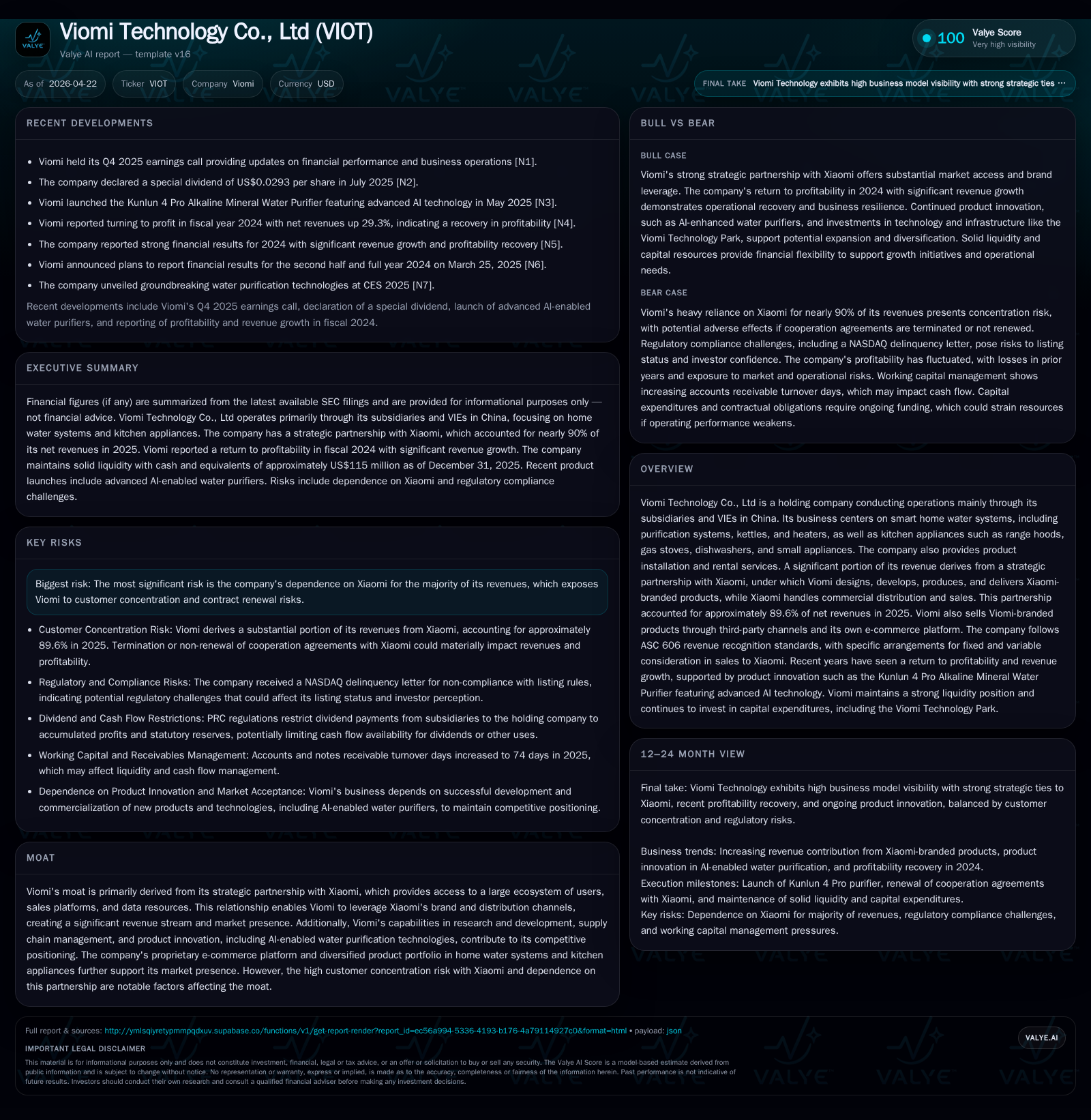
Viomi Technology’s Q4 2025 results underscore the durability of its strategic partnership with Xiaomi, accounting for nearly 90% of revenues, while the company continues to innovate in AI-enabled smart water appliances. Product launches like the Kunlun Mineral Series and international expansions highlight efforts to capture a growing middle-class demand for higher-quality, tech-enabled home solutions in China and abroad. Despite promising innovation and access to Xiaomi’s ecosystem, risks remain from customer concentration and regulatory complexities in China. Monitoring upcoming product rollouts, R&D investment trends, and partnership developments will be key to assessing Viomi’s trajectory.
Latest Quarterly Operating Highlights
Viomi Technology's most recent operating disclosure for Q4 2025 [S2] reconfirms the centrality of its revenue relationship with Xiaomi, which accounted for approximately 89.6% of net revenues during 2025 [S1]. This deepening revenue concentration reflects sustained commercial distribution of Xiaomi-branded smart home water systems and kitchen appliances designed and produced by Viomi. The operating update highlights continued momentum in product innovation, particularly within AI-enhanced water purification technologies.
During the earnings call held simultaneously [N1], management emphasized incremental market traction for recently launched products such as the Kunlun Mineral Series under-sink purifiers domestically and the Master 1 purifier internationally via Amazon — showcasing their strategy toward premiumization through artificial intelligence integration.
Notably, Viomi's overall revenue growth remained modest against macroeconomic pressures influencing China's consumer spending landscape. Seasonality effects combined with cautious discretionary spending among middle-class consumers acted as near-term dampeners on volume expansion. Nonetheless, the strong backing from Xiaomi's sizeable sales infrastructure offers resilience against broader cyclical headwinds.
Business Model and Product Innovation
Viomi operates primarily through two channels: manufacturing Xiaomi-branded products under an exclusive strategic partnership that includes design, R&D, production, and delivery duties; and selling Viomi-branded products via proprietary e-commerce platforms as well as third-party channels [S1][S6].
This dual-branding approach allows Viomi to benefit from Xiaomi’s established ecosystem—its user base, distribution platforms including Youpin e-commerce channel—and concurrently cultivate independent brand equity through direct consumer engagement.
Core product offerings focus on smart home water systems encompassing purification units, kettles, heaters alongside kitchen appliances like range hoods, gas stoves, dishwashers, and select small-appliance categories. Importantly, Viomi is increasingly embedding AI capabilities into its flagship products: the Kunlun series adopts mineralization alongside purification mimicking natural processes via AI algorithms; similarly, the Master 1 purifier integrates precision filtration stages complemented by an interactive smart faucet controlled through AI interface [S1].
Value capture extends beyond one-time appliance sales to encompass consumables such as filter replacements and value-added services including installation and product rental solutions — fostering repeat purchase dynamics critical to sustaining long-term margins.
R&D expenditure remains robust at approximately 6.8% of annual net revenues (RMB165.6 million or US$23.7 million in 2025), reflecting ongoing investments in technology upgrades and product pipeline development [S1][S12].
Position Within China's Smart Home Appliance Sector
The smart home appliance sector in China is distinguished by rapid technological adoption cycles spearheaded by rising consumers’ demand for AI-enabled intelligence embedded within daily-use devices . Competition is fragmented with multiple domestic players vying over price-sensitive yet quality-conscious end-users.
Regulatory oversight influences product safety standards and data security frameworks affecting device connectivity features — key considerations for companies leveraging AI functionalities [S15]. In this context, Viomi's ability to ensure compliance while innovating positions it competitively.
Supply chain robustness is essential given complexity around sourcing components sensitive to cost fluctuations; Viomi outsources manufacturing contractually but retains critical component procurement control enabling cost negotiation leverage [S6]. Pricing strategies strike a balance between affordability for emerging middle-class buyers versus premium differentiation through tech advancements.
Growth Drivers and Industry Challenges
The primary growth catalysts emerge from leveraging Xiaomi’s ecosystem synergy — enabling expansive market reach across diverse demographic segments — combined with Viomi's continuous rollout of AI-integrated products addressing evolving consumer preferences for healthier lifestyle solutions [S1][S26].
International market expansion (e.g., Malaysia launch of Inno dispenser catering to regional drinking habits) signals strategic diversification beyond domestic boundaries [S1]. Furthermore, repeat sales driven by consumables monetization underpin financial stability amidst fluctuating device sales.
However, growth constraints are notable: macroeconomic complexities in China introduce demand cyclicality as disposable income pressures may temper unit volumes despite brand loyalty [S1]; intensifying competitive intensity demands accelerated innovation pace; dependence on single large customer (Xiaomi) introduces execution risk if contractual terms change or renewal uncertainties arise.
Risks and Dependency Factors
Customer concentration is paramount among identified risks — nearly 90% of revenues stem directly from Xiaomi-related contracts [S8], exposing Viomi to potential contractual renegotiation volatility or strategic shifts by the partner. Such dependency creates inherent fragility if market conditions prompt contract realignments.
Regulatory landscapes further complicate operational certainty given Viomi's Cayman Islands holding entity structure operating Chinese subsidiaries through variable interest entities (VIEs) subject to complex approvals around foreign exchange management and profit repatriation restrictions [S15][S10]. These structural elements could delay capital mobility impacting liquidity management.
Evolving data privacy laws affecting connected devices mandate ongoing investments into cybersecurity infrastructure — non-compliance could adversely impact brand reputation and user adoption rates [S15]. Additionally, shifting consumer tastes might render certain legacy product lines obsolete without timely innovation response.
Key Milestones to Monitor
Investors should closely track upcoming quarterly guidance disclosures for signs of demand recovery or contraction tied to macroeconomic trends or new product reception [S2][N1]. Adoption metrics on recently launched AI-enhanced purifiers will serve as litmus tests for the company's innovation effectiveness.
Changes or renewals in Xiaomi partnership agreements will be critical signals regarding revenue visibility given concentration risks [S1]. Further geographic expansion developments can provide insights into diversification success beyond core Chinese markets.
R&D expenditure pacing relative to gross margins will illuminate whether investments are translating efficiently into commercial returns rather than constraining profitability over time.
Financial Overview as Contextual Support
Historical performance (annual)
| FY | Net ($mm) | CFO ($mm) | OpInc ($mm) | Capex ($mm) | Net YoY |
|---|---|---|---|---|---|
| 2025 | 22 | 18 | 6 | ||
| 2024 | 98 | 21 | 4 | ||
| 2023 | -12 | -15 | 16 | +70.1% | |
| 2022 | -40 | -41 | 28 | -387.3% |
Source: SEC companyfacts cache [F1].
Capital returns and efficiency (annual)
| FY | Buybacks ($mm) | FCF ($mm) | ROE% |
|---|---|---|---|
| 2025 | 3 | 16 | |
| 2024 | 1 | 94 | |
| 2023 | 1 | -30 | -6.3 |
| 2022 | 1 | -70 | -19.2 |
Source: SEC companyfacts cache [F1].
Operating income experienced a slight contraction (-14.2%) year-over-year from 2024 to 2025 indicating margin pressures amid sustained investment commitments ([F1]). Net income rebounded relative to prior heavy losses but remains influenced by underlying operational dynamics including cost structures.
Cash flow from operations weakened significantly compared with peak levels but remained positive in 2025 supporting ongoing capital spending initiatives primarily aimed at enhancing R&D capabilities and expanding physical infrastructure such as Viomi Technology Park construction [S4][S12].
Liquidity remains ample with cash balances exceeding $115 million USD at year-end 2025 paired with a conservative current ratio near 2.6 reflecting prudent working capital management despite exposure risks tied to restricted asset pools within PRC subsidiaries subject to local regulations ([F1],[S10]).
Capital allocation also includes measured return of capital via share repurchases totaling $2.5 million USD in 2025 reflecting some confidence in intrinsic value while maintaining substantial reinvestment focus ([F1],[S5]).
This analysis synthesizes Viomi Technology Co., Ltd’s recent quarterly filings and annual disclosures without offering investment guidance or price projections. Readers should consider company-specific developments along with broader macroeconomic factors influencing China’s smart home appliance sector when forming independent assessments.
Disclaimer: This is research-only, informational analysis and not investment advice. It may include AI-generated interpretation and general industry context. Always verify important details using primary sources.

Comments