
Shinhan Financial Group’s Evolving Shareholder Dynamics and Growth Outlook
A recent reduction in the National Pension Service’s stake coincides with Shinhan’s strategic positioning amid intensifying Korean financial sector dynamics.
In Q1 2026, Shinhan Financial Group reported a subtle decline in shares held by its largest shareholder, Korea’s National Pension Service, signaling potential portfolio adjustments. The company operates a diversified financial services platform anchored by a broad customer base and integrated banking, securities, insurance, and asset management businesses providing cross-selling synergy and customer stickiness. Amid industry consolidation in Korea, Shinhan faces margin pressure from increased competition while leveraging AI-enabled risk systems and international expansion to sustain growth. The market awaits detailed Q1 earnings insights in late April to clarify near-term credit demand and margin trends.
Recent Shareholder Changes Indicate Subtle Shifts in Ownership
On April 20, 2026, Shinhan Financial Group disclosed in its latest Form 6-K [S2] that the National Pension Service (NPS), the largest shareholder, reduced its common stock holdings from approximately 43.44 million shares (9.15% ownership as of February 20) to about 42.75 million shares (9.01% as of March 31). While this represents a modest decrease of roughly 0.14 percentage points over about six weeks, the timing aligns with a quarter-end registry update prompting speculation that the NPS might be rebalancing or responding to macroeconomic conditions rather than signaling any strategic divestment.
The NPS is a major institutional investor within Korea’s financial sector ecosystem and usually acts as a stabilizing shareholder. Its slight reduction likely reflects portfolio optimization amid valuations or liquidity requirements rather than governance shifts. However, subtle changes in ownership by such a prominent entity may impact institutional sentiment and could influence Shinhan's share price volatility in the short term.
Business Model: Diversified Financial Services with Cross-Selling Strengths
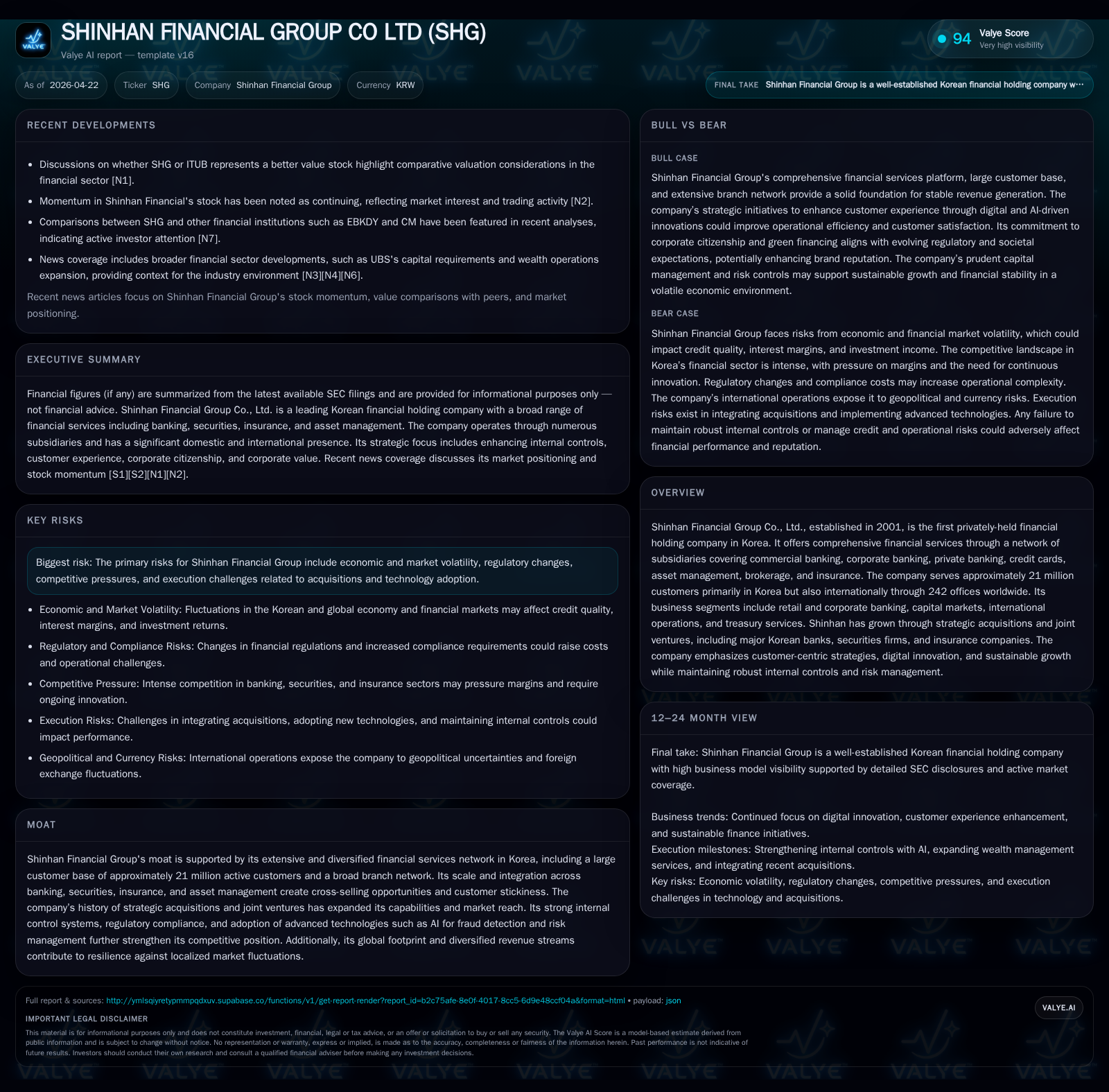
Shinhan Financial Group operates an integrated financial holding company structure encompassing an extensive range of services: commercial and corporate banking (retail lending/deposits; SME & large corporate loans), private banking, credit card operations (via Shinhan Card), asset management, securities brokerage (Shinhan Securities), and insurance subsidiaries [S1][S26]. This multi-vertical footprint enables Shinhan to offer bundled financial solutions through convenient online portals and mobile applications designed around customer-centricity.
Serving roughly 21 million active customers with over 1,344 branches domestically supported by approximately 29,620 employees reinforces scale advantages critical for cross-selling loan products alongside deposit accounts or wealth management offerings [S1]. Cross-divisional integration translates into product stickiness through embedded relationships—clients borrowing from corporate loans may also utilize treasury services or credit cards issued by group entities.
Digital innovation plays a notable role: since 2023 Shinhan Data Center implemented AI-powered cybersecurity defenses utilizing big data analytics to detect anomalies to mitigate fraud risks proactively [S1]. This investment enhances both customer trust and operational stability. Retail segments leverage automation for improved service delivery while targeting high-net-worth individuals for private banking growth.
Competitive Landscape and Industry Forces in Korean Finance
Korea’s financial industry landscape is undergoing continued consolidation accelerating competition among large diversified institutions like Shinhan [S1]. This structural shift brings about increased pricing pressure on deposits and loan products as players vie for market share. As noted in the latest annual filing, intensified rivalry could reduce loan margins adversely affecting future profitability.
Unlike fragmented markets where smaller niche players flourish by specialization, Korea's trend favors scale-backed universal banks capable of offering end-to-end financial solutions fostering customer retention via ecosystems. This sets a high bar on capital adequacy for absorbing risks while pushing profitability optimisation – an ongoing challenge for Shinhan given competitive pressures highlighted in regulatory commentary [S1].
Moreover, evolving regulatory frameworks around capital requirements, deposit insurance expansions effective September 2025 (deposit insurance coverage doubling to KRW100 million per depositor), create an environment where risk management excellence becomes imperative [S18]. The company’s adherence to these standards supports competitive standing but necessitates continuous capital planning.
Key Drivers and Challenges to Shinhan’s Growth Trajectory
Growth drivers include international business expansion focused mainly across Asia — strengthening localized operations combined with diversification into asset management caters to increasing wealth demands among Korean expatriates and regional corporate clients [S1][S26]. Additionally, enhanced digital banking capabilities aiming at seamless user experiences underpin retail segment growth.
On the technology front, AI integration extends beyond cybersecurity into internal risk monitoring enabling proactive adjustments that are crucial amid volatile global environments marked by geopolitical risks (East Asian tensions; trade disruptions) impacting Korean economic activity [S1]. Such technological leverage may provide operational buffer advantages against credit losses triggered by systemic shocks.
Risk factors persist notably due to macroeconomic dependency; the Korean economy’s tight linkage to global trade flows exposes Shinhan indirectly through loan portfolios concentrated among corporates sensitive to export cycles [S1]. Increased policy-induced interest rate volatility affects net interest margins directly while competition forces aggressive deposit pricing potentially elevating funding costs.
Execution risks also accompany acquisitions or new joint ventures due to integration complexities alongside rapid technological adoption imperatives requiring skilled human capital investment.[S1]
Near-Term Milestones and What to Monitor Post-1Q2026 Earnings
Shinhan has scheduled its first quarter 2026 earnings release conference on April 23, broadcast live with bilingual participation opportunities [S3]. This event will be scrutinized closely for commentary on evolving loan demand amidst Korea's economic conditions including small business segments recovery trajectories.
Key metrics investors will watch include net interest margin trends given competitive pressure on lending rates; provision expense evolution reflecting asset quality shifts particularly post-pandemic; deposit volume fluctuations highlighting stickiness or outflows tied to alternative investment attractiveness; plus updates on capital deployment toward technology or international network growth.[S3]
The blackout period starting April 9 underscores sensitivity around these results reflecting their significance for gauging near-term performance vis-à-vis prior year base effects.
Financial Profile: Capital Structure, Profitability, and Funding Stability
Shinhan’s funding mix predominantly relies on low-cost retail deposits which accounted for approximately 72.7% of total funding as of December 31, 2025 — up modestly from prior years — underscoring depositor reliance as a stable source despite facing growing pricing competition from peers [S4]. While this concentration ensures cost-effective financing compared with wholesale borrowings, it also leaves vulnerability should depositors pursue higher yields elsewhere.
As of year-end 2025 data:
- Total deposits reached KRW447.65 trillion
- Long-term debt stood at KRW96.72 trillion
- Stockholders’ equity totaled KRW19.07 trillion
- Hybrid bonds issuance expanded worth KRW4.75 trillion bolstering capital adequacy ratios conservatively managed under Basel III compliance frameworks [S4][S6][S16]
Profitability measured through return on equity approximated at ~12.5% based on available historical figures juxtaposed against steady credit spreads applied via risk-adjusted pricing protocols evidences margin preservation efforts amidst sectoral compression forces [F1][S11][S21].
Corporate loan portfolios are diversified between working capital loans (41%) funded typically short-term but extendable annually; facilities loans (57%) which have longer maturities up to 15 years supported largely by collateral mainly real estate (~51%) reducing loss exposures under stress scenarios [S10][S13].
Credit ratings maintain favorable positions domestically aiding access to lower-cost long-term debt issuances reflecting overall financial strength but remain sensitive to macroeconomic downturns or governance changes which could elevate funding expenses detrimentally impacting liquidity [S15][S16].
Summary Table: Key Financial Ratios & Shareholding Snapshot (KRW billions unless noted)
Historical performance (annual)
| FY | Net ($bn) | CFO ($bn) | Capex ($mm) | Net YoY |
|---|---|---|---|---|
| 2024 | ||||
| 2010 | 2.5 | 5.7 | 250 | +158.2% |
| 2009 | 1.0 | 1.5 | 328 |
Source: SEC companyfacts cache [F1].
Capital returns and efficiency (annual)
| FY | Div ($mm) | FCF ($bn) | ROE% |
|---|---|---|---|
| 2024 | |||
| 2010 | 372 | 5.4 | 12.5 |
| 2009 | 198 | 1.1 | 5.6 |
Source: SEC companyfacts cache [F1]. *Includes retained earnings & hybrid bonds; **Equity per consolidated statement; note differing classification levels between years. (Source: S2,S4,S6,S16,F1)
Note: Equity figures reflect consolidated data with hybrid bonds included impacting comparability.
This analysis synthesizes publicly available filings without speculative projections or investment recommendations. Further investor decisions should consider comprehensive due diligence beyond this report.
Disclaimer: This is research-only, informational analysis and not investment advice. It may include AI-generated interpretation and general industry context. Always verify important details using primary sources.

Comments