
urban-gro’s Transformation Revealed in Latest Filing: From Design-Build to Equipment Reseller
urban-gro’s February 2026 quarterly report discloses a sharp pivot from integrated services towards equipment resale amidst financial and operational restructuring.
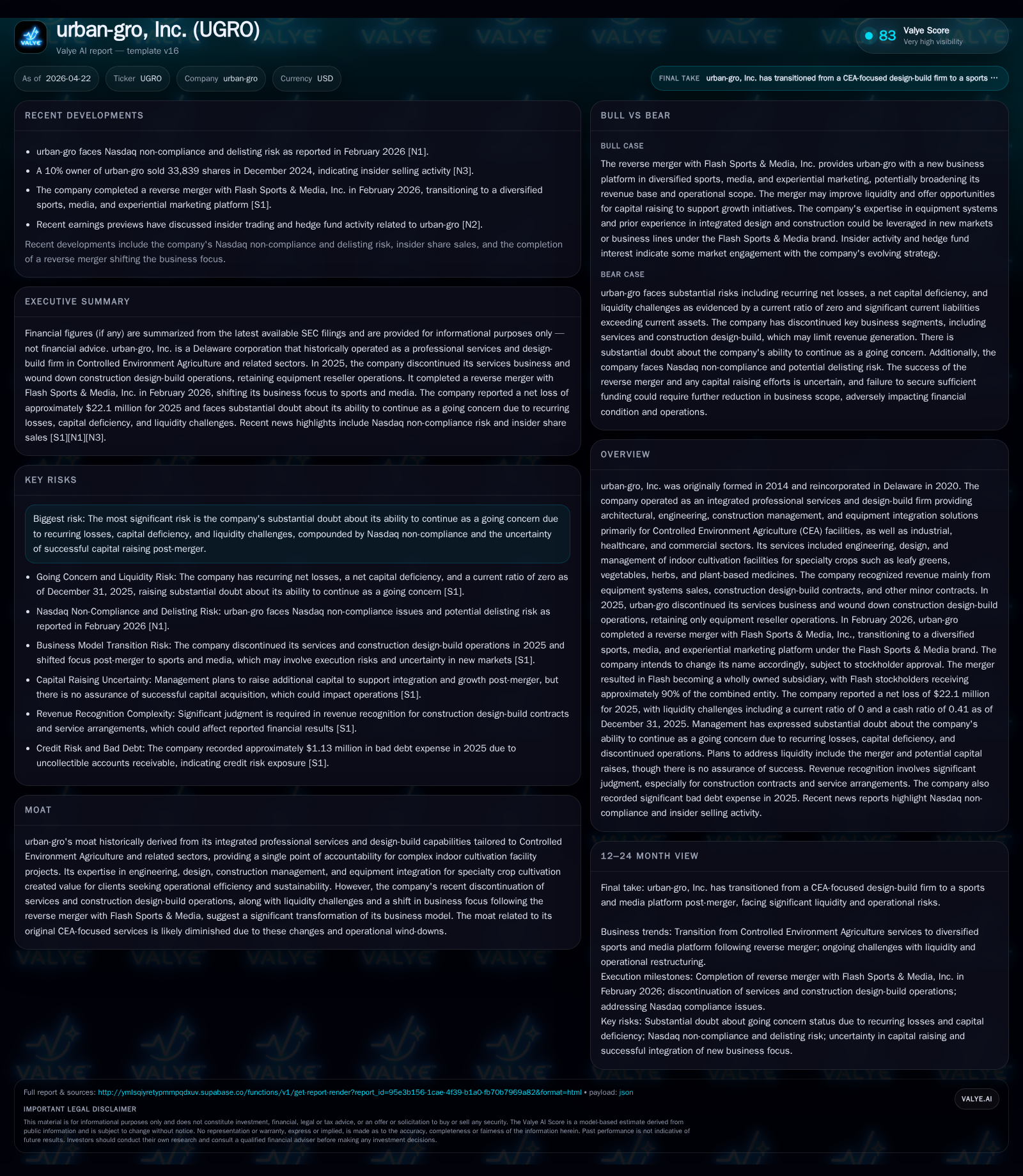
urban-gro, Inc.’s latest 10-Q filing dated February 17, 2026, reveals the completion of its exit from construction design-build and professional services, retaining solely equipment reseller operations. This marks a significant overhaul of its original Controlled Environment Agriculture (CEA)-focused business model amid liquidity challenges and a reverse merger with Flash Sports & Media. The company’s competitive moat related to integrated project delivery has eroded, leaving it exposed to heightened capital risks. Growth opportunities remain linked to the broader CEA industry’s structural trends, but near-term sustainability hinges on capital raising and operational execution under new ownership.
Latest Quarterly Filing Signals Strategic Repositioning
The most recent quarterly disclosure from urban-gro dated February 17, 2026 [S2] provides a stark update on the company's operating footprint. It confirms the cessation of all professional services and construction design-build operations by the fourth quarter of 2025. These were once urban-gro's core competencies in providing integrated engineering, architectural design, construction management, and equipment integration solutions tailored for Controlled Environment Agriculture (CEA) facilities and other commercial sectors [S1]. Post-wind down, the business now retains only its equipment reseller segment as its ongoing operation.
This structural pivot comes against a backdrop of deep liquidity constraints highlighted by substantial doubt over going concern status disclosed in the annual amended report filed April 21, 2026 [S1]. Key events include the foreclosure and Article 9 sale of accounts receivable belonging to UG Construction subsidiary in September 2025 at a distressed valuation ($450K), signaling severe financial distress [S27][S28]. The company mitigated some near-term risk through a reverse merger with Flash Sports & Media completed early 2026 which transfers majority control to new owners [S1]. However, recent SEC event filings also reveal secured promissory note financings valued up to $2.775 million closed with new investors granting liens on nearly all company assets as collateral [S3][S8][S10]. These developments reinforce that urban-gro is navigating a critical inflection point where survival depends on stabilizing revenues via equipment sales and achieving successful capital raises.
Deconstructing urban-gro’s Evolving Business Model
Historically founded as an end-to-end design-build firm for complex indoor cultivation environments focused on specialty crops including leafy greens and medicinal plants , urban-gro’s business encompassed multi-disciplinary services—engineering design, project management, construction oversight alongside equipment supply.[S1] Revenues were accordingly recognized using mixed methods: cost-to-cost over time for construction design-build contracts reflecting long-cycle projects; point-in-time recognition for equipment system shipments; and milestone or completion-based revenue for consulting services.
Post-2025 retrenchment has stripped away the higher complexity service lines primarily due to liquidity challenges and strategic decisions related to the reverse merger [S1]. This leaves urban-gro as essentially an equipment reseller relying mainly on hardware sales such as lighting systems, climate control units and hydroponic setups. The stand-alone selling price for these product sales is set by forecasting expected costs plus contract-specific margins established upfront [S14]. Revenue recognition typically occurs upon shipment or delivery under standard bill-to-ship-to arrangements providing simpler transactional dynamics than legacy projects.
This model shift entails both strategic contraction and operational inertia reflecting constrained capital resources. The original moat built around integrated CEA facility expertise—that offered customers a single accountable partner for turnkey indoor farm implementation—effectively evaporates. While equipment supply is necessary within CEA ecosystems, it operates at thinner margins and faces intense competition from specialized manufacturers and broad industrial distributors. Consequently, pricing power likely deteriorates without accompanying value-added service differentiation.
Competitive Context and Industry Trends in Controlled Environment Agriculture
Urban-gro sits within an evolving CEA market that blends agriculture tech innovation with complex infrastructure demands including controlled climate systems design, modular components integration, automated lighting regimes tailored to crop cycles, and sustainable energy use [S1]. Integrated design-build firms traditionally command premium economics through bundled engineering-construction contracts validated by past performance reliability—a key consideration when clients invest millions into custom indoor cultivations.
However, urban-gro's exit from these value-added segments undermines its ability to compete as a full-scope partner. Remaining within equipment resale exposes it to commoditized supply chains where differentiation is limited primarily to product availability or logistic efficiency rather than intellectual property or proprietary engineering know-how.
Regulatory frameworks supporting indoor cultivation remain favorable overall but demand significant capital investment from end-users requiring dependable project execution partners. Urban-gro’s receded presence reduces opportunities to secure large-scale contracts that embed longer-term relationships and higher switching costs typical in CEA facility development cycles.
Furthermore, competitors maintaining integrated approaches continue innovating in automation-enabled zones that pair environmental controls with AI-driven crop optimization—areas urban-gro currently no longer addresses directly . Thus, while demand for select pieces of cultivation hardware may grow structurally alongside expansion of specialty crops globally, urban-gro’s narrower scope places it at a competitive disadvantage.
Growth Opportunities and Operational Constraints Ahead
From a macro perspective, structural growth drivers supporting urban-gro’s addressable market remain intact: global interest in sustainable food production favors indoor controlled farming due to yield efficiencies and reduced resource footprints; consumer demand for fresh leafy greens year-round drives new facility investments; advances in LED horticultural lighting and sensor-based controls catalyze technology adoption within existing farms.
Nevertheless, urban-gro faces steep challenges constraining its ability to capitalize fully. Capital scarcity evidenced by repeated equity deficiency (-$45M FY25) limits marketing reach to potential customers seeking turn-key solutions versus component suppliers [F1][S27]. Nasdaq compliance risks add regulatory hurdles that may distract management focus or limit access to public funding channels [S13]. The loss of integrated service capabilities restricts contract pipeline prospects since clients view single-source delivery as less risky amid complex build projects.
Additionally, short-term cash flow remains pressured despite modestly positive operating cash flow of ~$841K in FY25 driven largely by reduced operational scale rather than revenue progress which declined sharply -56.5% YoY [F1]. Debt obligations continue mounting with multiple secured notes carrying high default interest clauses (up to 18% per annum), placing immediate refinancing imperatives on leadership [S10][S24].
Risk mitigants partially materialize through incremental capital injections tied to structured private placements offering warrants exercisable at fixed prices congruent with current market caps [S8]. If subsequent tranches proceed based upon fulfilling annual filing compliance milestones—and if management successfully pivots marketing efforts—the equipment reseller business could stabilize revenues at lower scale but sustainability remains uncertain absent broadening product mix or regaining niche differentiation.
Near-Term Catalysts and Key Milestones to Monitor
Looking forward into mid-2026 horizon several corporate actions will be pivotal:
- Completion or delay of the second tranche funding ($500K plus original issue discount increases) contingent on passing audited financial statement filing requirements [S8].
- Progress toward reversing Nasdaq non-compliance flags including stockholder equity floor maintenance above $2.5M threshold alongside timely periodic filings continuing post-merger [S13].
- Evidence of improving receivables collection rates offsetting $1.13M bad debt expense recorded in FY25 reflecting historical customer default risk [S4][F1].
- Contract wins under standalone equipment reseller model validating pricing power or securing repeat buyers indicative of stickiness despite absence of integrated service offerings.
- Potential earn-out or synergy realization with Flash Sports & Media operational alignment depending on merger integration cadence.
Any failure or delay across these markers would exacerbate execution risks layered atop already fragile balance sheet dynamics.
Supporting Financial Review: Liquidity, Revenue, and Capital Structure
Historical performance (annual)
| FY | Rev ($mm) | Net ($mm) | CFO ($mm) | OpInc ($mm) | Rev YoY | Net YoY |
|---|---|---|---|---|---|---|
| 2025 | 17 | -22 | 1 | -18 | -56.5% | +39.4% |
| 2024 | 40 | -36 | -3 | -36 | -95.4% | |
| 2023 | -19 | -11 | -17 | -22.3% | ||
| 2022 | -15 | -13 | -13 |
Source: SEC companyfacts cache [F1].
Capital returns and efficiency (annual)
| FY | Buybacks ($mm) | FCF ($mm) | ROE% |
|---|---|---|---|
| 2025 | 1 | 48.9 | |
| 2024 | 0 | -3 | 148.1 |
| 2023 | 0 | -12 | -93.1 |
| 2022 | 4 | -13 | -44.0 |
Source: SEC companyfacts cache [F1].
Financial statements illustrate acute revenue contraction (-56.5%) coinciding with shrinking operational scale after exit from higher-margin segments; yet operating loss narrowed nearly by half relative to prior year suggesting cost rationalization efforts.[F1] Liquidity is critically impaired with current assets barely covering short-term liabilities resulting in a near-zero current ratio at YE25,[F1] compounded by burdensome accounts payable exceeding $18 million along with contract liabilities totaling over $13 million[S21]. Caught between mounting note payables ($3.5 million current portion plus senior secured loans) and contracted future interest charges (~12% note rate plus potential default penalties), the capital structure is deeply distressed[S6][S10]. Bad debt write-offs exceeding $1 million during FY25 reflect heightened credit risk inherent within the customer base for CEA construction projects[S4]. However improvement in operating cash flow signifies some stabilization post discontinuation of services operations.[F1] Ultimately urban-gro’s financial outlook remains heavily contingent upon successful completion of anticipated private placement tranches linked directly to corporate governance compliance plus shareholder approvals triggered under Nasdaq marketplace rules[S8][S13][S24]. The potential dilutive impact of issued warrants further pressures equity holders though provides much-needed immediate working capital.
Urban-gro’s latest filings chronicle an abrupt redefinition from a comprehensive design-build specialist into a narrowly focused CEA equipment reseller navigating acute financial distress during consolidation via reverse merger transactions. Its historical moat anchored on integrated facility services has been sacrificed amid pressing liquidity constraints raising significant going concern issues—casting uncertainty over growth trajectories even as Sustainable Indoor Ag markets advance broadly.
This juncture demands close evaluation of near-term financing success plus realignment efforts towards scalable reseller models backed by improved collections efficiency to avoid further deterioration. Investors closely tracking urban-gro must weigh these unfolding realities against sector growth fundamentals that favor well-capitalized full-service providers able to capture multi-dimensional value across CEA project life cycles.
This report is based solely on publicly filed regulatory disclosures without any investment recommendations.
Disclaimer: This is research-only, informational analysis and not investment advice. It may include AI-generated interpretation and general industry context. Always verify important details using primary sources.

Comments