
JFB Construction Holdings Eyes Strategic Transition with Xtend AI Robotics Merger
A recent merger amendment marks a strategic pivot for JFB as it moves beyond its core construction business toward AI robotics integration.
JFB Construction Holdings, originally focused on specialized construction projects such as luxury estates and clubhouses, has announced an amended merger agreement with Xtend AI Robotics, setting a transformative course expected to complete mid-2026. This deal foresees a corporate rebranding and ticker change that signals a profound shift from traditional construction to technology-driven operations, introducing new opportunities but also considerable execution risks. While JFB’s core business shows moderate operational capabilities in contract execution, it faces growth challenges stemming from negative profitability and industry cyclicality. The merger’s success depends on regulatory clearances, integration feasibility, and the ability to scale new market segments—key points to watch in the coming quarters.
Recent Operating Update: Merger Amendment Refines JFB’s Strategic Path
On March 21, 2026, JFB Construction Holdings filed an amendment to its previously announced Agreement and Plan of Merger with Xtend AI Robotics, Inc., reflecting refinements to the transaction terms but maintaining the core timeline and strategic direction. The merger remains subject to customary closing conditions and regulatory approvals, with an anticipated closing timeframe around mid-2026 [S3]. Upon completion, the merged entity is set to be renamed Xtend AI Robotics, Inc. and will trade under the ticker symbol "XTND" on Nasdaq [S3].
This recent amendment filing clarifies that the previously disclosed forward stock split is independent from the merger terms and will not affect the combination structure or timing [S3]. Notably, this update shifts focus away from JFB’s quarterly operational disclosures toward this transformative corporate event that will reshape its identity and strategic orientation. The latest annual 10-K/A filing dated April 21, 2026 further contextualizes this transition by detailing the original merger agreement signed February 13, 2026, underpinning the intent to pivot away from pure construction activities toward technology-enabled robotics offerings [S1].
JFB’s Business Model: From Luxury Estates to Specialized Construction Services
Prior to announcing its technological merger strategy, JFB operated primarily as a smaller reporting construction company headquartered in Lantana, Florida. Its revenue model has revolved around winning contractual projects focused on high-margin luxury estates, exclusive clubhouses, and customized development assignments executed largely in regional markets [S1]. These bespoke contracts tend to be substantial in size but entail long project durations and complex management cycles.
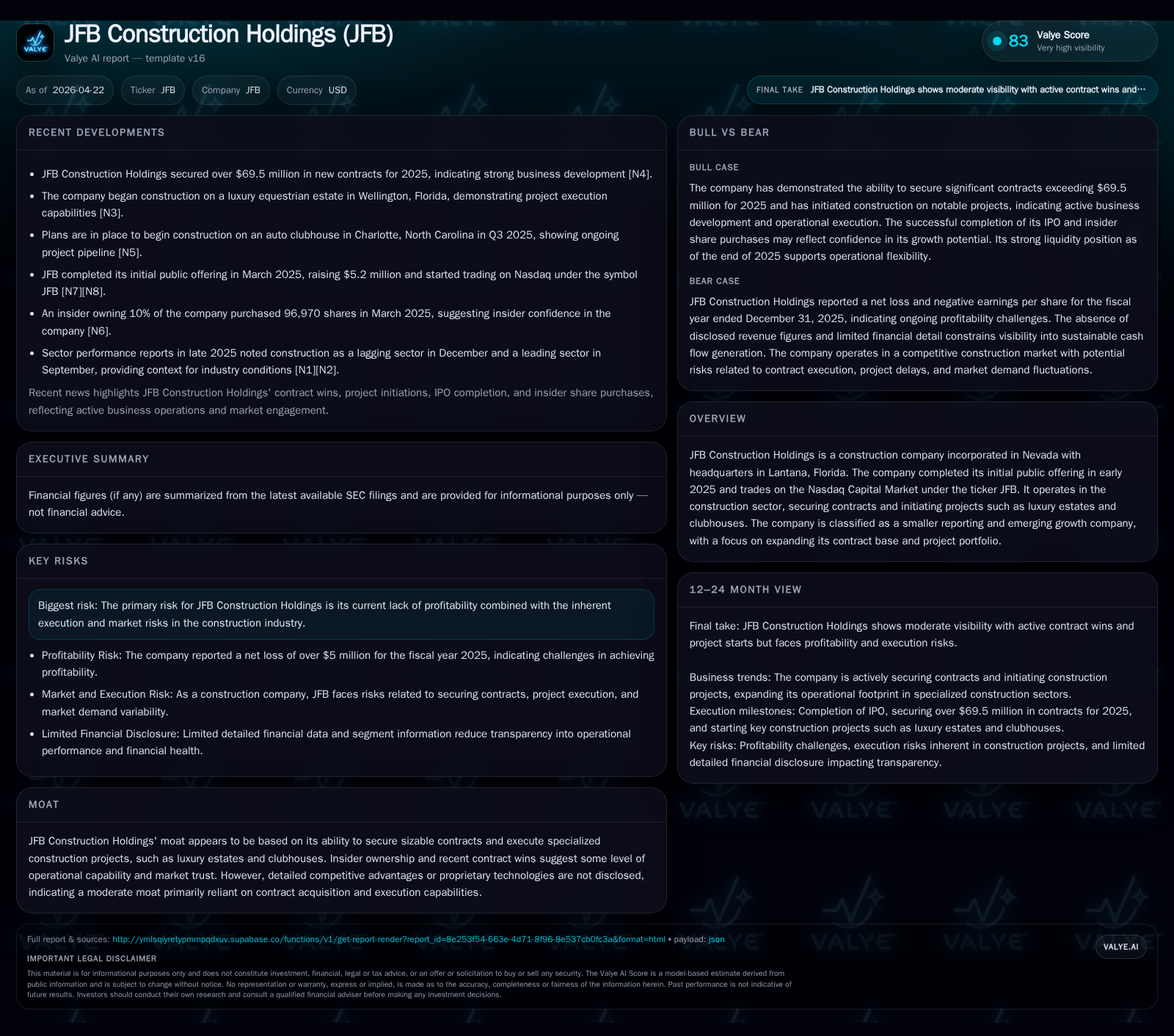
JFB distinguishes itself through demonstrated contract acquisition capability underpinning its moderate moat—there is no disclosure of proprietary building technologies or patents that might confer lasting pricing power [S1]. Instead, operational reliability and market trust are foundational elements enabling the firm to secure repeat clients or new prestigious development mandates. This niche focus on upscale developments contrasts with commodity-driven construction segments but still subjects the company to cyclical demand fluctuations inherent in real estate investment trends.
From an economic perspective, JFB’s profitability hinges on managing project costs tightly while navigating supply chain variabilities for key inputs such as specialty materials or labor skilled in luxury home finishes—a challenge given frequent volatility in construction inputs [F1][S1]. Such dynamics necessitate disciplined contract bidding strategies balancing risk exposure against margin targets.
Industry Structure: Competitive Pressures and Contract Acquisition Dynamics
Operating within a fragmented construction sector dominated by mid-size firms aiming at high-value residential and recreational developments places JFB amid intense competition centered on execution excellence rather than technological differentiation. The absence of proprietary platforms or patented processes limits barriers to entry for other capable builders within target locales [S1].
Contract awards depend heavily on established relationships with developers or private owners willing to engage smaller firms able to deliver tailored expertise. However, supply chain disruptions—including materials shortages or labor availability—and rising input costs pose continuing headwinds that constrain pricing power even for specialized builders like JFB.
Furthermore, customers’ switching costs remain relatively low as alternative bidders often present competitive proposals; this dynamic pressures margins and reinforces the importance of impeccable project delivery timelines [S1]. As such, while JFB commands some goodwill through insider ownership alignment suggested by filings, it must persistently strengthen operational efficiencies to maintain relevance.
Growth Drivers and Constraints: Contract Pipeline, Market Position, and Risk Factors
Growth prospects for JFB hinge primarily on expanding its contract book both through geographic reach extensions beyond Florida and deeper penetration within its existing luxury estates segment. The firm's strategy appears focused on scaling by increasing volume while preserving quality standards essential for brand reputation [F1][S2][S1].
However, underlying risks include continued negative profitability reported at approximately -$5.65 million in operating income for fiscal year 2025 alongside net losses near -$5.27 million—a reflection of early-stage growth pains coupled with capital-intensive nature of custom builds [F1]. Free cash flow was significantly negative at roughly -$12 million in the same period signaling ongoing cash consumption requiring access to liquidity reserves or external financing support [F1].
Additionally, contracts frequently carry execution risks related to cost overruns or delays exacerbated by volatile materials availability—a known cyclicality factor impacting demand for large-scale luxury projects. These constraints suggest that while structural market demand may remain intact during economic expansions favoring real estate development spending, downturns could disproportionately threaten a leaner operator like JFB.
Merger Impact and Transition Risks: Toward an AI-Integrated Future
The forthcoming business combination with Xtend AI Robotics signifies a material pivot for JFB from conventional construction services toward incorporation into a technology-centric robotics entity [S3][S1]. Post-merger plans include renaming the company as Xtend AI Robotics, Inc., which signals management's intention to realign corporate identity away from traditional building practices towards emerging AI-driven physical automation applications.
While speculative details about merger synergy creation remain sparse—given the distinct operational domains—this strategic move ostensibly aims to leverage technological innovation opportunities potentially complementary to industrial automation or smart infrastructure sectors [S3]. However, risks abound regarding successful integration of disparate cultures, regulatory hurdles governing transactions involving tech startups versus construction firms, and investor reception toward such transformational narratives.
At present, customary closing conditions are yet to be fulfilled including receipt of necessary regulatory approvals implying uncertainties about timing or final consummation details remain unresolved [S3]. Furthermore, it remains unclear how operational resource allocation will shift post-merger or whether capital constraints might intensify during transition phases.
Forward-Looking Indicators: Key Milestones and Execution Benchmarks
Critical near-term markers include monitoring progress against regulatory review processes typically required for sizable mergers involving different industries—such clearances will dictate whether the anticipated mid-2026 closing can be met without delays [S3][S1]. Additionally, tracking incremental contract wins following merger announcements provides indirect insight into whether the ongoing core construction offering retains momentum amidst impending rebrand.
Post-closing corporate governance adjustments alongside public communications regarding integration roadmaps will also serve as barometers for investor confidence. Should reported operating results improve meaningfully in subsequent filings—reflecting synergy gains or efficiency enhancements—it would bolster credibility of the transition thesis. Conversely, further deterioration could heighten skepticism around sustainability without fundamental business model evolution.
Financial Snapshot: Profitability Challenges and Liquidity Assessment
Financial disclosures for fiscal year ending December 31, 2025 illustrate an enterprise still firmly in growth mode but grappling with fundamental losses. Operating income stood at approximately -$5.65 million translating into a net loss near -$5.27 million likely reflecting both fixed overhead absorption challenges plus upfront expenses linked to scaling operations [F1].
Liquidity metrics provide some reassurance with current assets nearing $37.3 million against liabilities just over $2.2 million resulting in a robust current ratio close to 17x—indicating sufficient short-term solvency buffers despite cash flow deficits [F1]. Nevertheless, free cash flow was substantially negative around -$12 million underscoring continued burn necessitating external capital infusions unless growth accelerates profitably soon [F1].
As an emerging growth company newly public since early 2025 trading on Nasdaq Capital Market under ticker "JFB," these financial contours highlight an entity investing heavily ahead of expected transformational milestones but exposed simultaneously to classic startup risk profiles accentuated by cyclical construction industry characteristics [F1][S1].
Disclaimer
This analysis is for informational purposes only; it does not constitute investment advice or a recommendation regarding securities of JFB Construction Holdings or any other entity.
Disclaimer: This is research-only, informational analysis and not investment advice. It may include AI-generated interpretation and general industry context. Always verify important details using primary sources.

Comments