
Nocera Faces Nasdaq Compliance Challenges While Pivoting Away from RAS Production
Recent Nasdaq deficiency notices tighten the spotlight on Nocera’s equity and compliance status amid a shifting business model focused on fish trading and e-commerce agency.
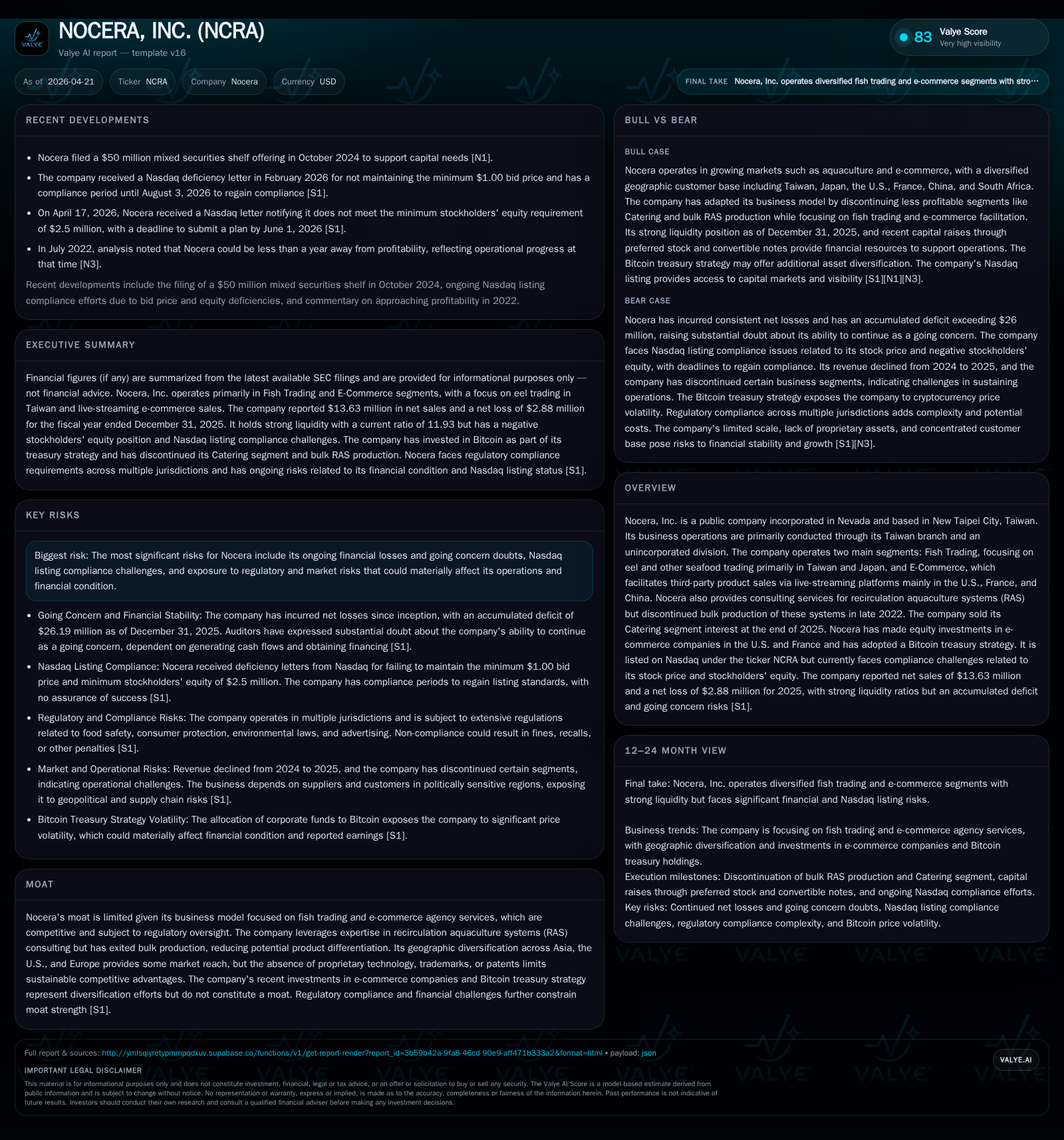
In 2026, Nocera, Inc. received a Nasdaq notification for failing to meet the minimum stockholders’ equity threshold, compelling the company to submit a recovery plan within 45 days. The firm’s pivot away from bulk production of recirculation aquaculture systems (RAS) to fish trading, live-stream e-commerce facilitation, and strategic equity investments marks a significant reshaping of its business model amidst operating losses and compliance risks. While geographic diversification offers some resilience, regulatory exposure and financial sustainability remain pressing concerns. Investors and stakeholders should watch the company’s ongoing Nasdaq compliance efforts, revenue trends in its two core segments, and success in monetizing its Bitcoin treasury strategy.
Recent Operating Update
In April 2026, Nocera Inc. received a formal letter from Nasdaq notifying it that the company has failed to meet the minimum stockholders’ equity requirement of $2.5 million as mandated by Nasdaq Listing Rule 5550(b)(1). The company reported stockholders' deficit of approximately $441,000 as of December 31, 2025 [F1], triggering this non-compliance event. Under Nasdaq rules, Nocera has until June 1, 2026 (45 calendar days) to submit a credible plan explaining how it will regain compliance. If accepted by Nasdaq, an extension of up to 180 days may be granted to demonstrate compliance. There is no immediate delisting effect nor trading suspension; shares continue trading under ticker "NCRA" on Nasdaq Capital Market during this period [S3][S26].
This development compounds earlier compliance pressure as Nocera also received a bid price deficiency notice at the beginning of this year due to its common stock price falling below $1 for an extended period but was afforded a separate compliance window through August 2026 [S20]. Both these regulatory challenges spotlight near-term financial health concerns.
Business Model
Nocera operates chiefly through two segments: Fish Trading and E-Commerce [S1][S4].
The Fish Trading segment is operated primarily via its wholly owned Taiwan branch (NTB), specializing in eel procurement and sales targeted at markets including Taiwan and Japan. This segment handles order fulfillment by coordinating harvesting, inspecting quality per customer specifications, and arranging delivery logistics. The company intends to expand into other seafood categories such as tilapia and milkfish moving forward [S1][S22].
The E-Commerce segment is administered via Xinca division which acts as an agent facilitating sales for third-party products through live-streaming commerce platforms across diverse geographies including the U.S., France, and China. This agency role means Nocera does not take inventory control but earns commissions recognized on a net basis. In line with this focus shift, the company made substantial equity investments in two foreign e-commerce companies during 2025 aimed at strengthening footholds internationally in this channel [S1][S22].
Previously integral to Nocera’s identity was its design and manufacturing of recirculation aquaculture systems (RAS), land-based controlled fish farming environments reducing environmental impact while providing high-density cultivation capabilities. However, bulk production of these systems ceased in late 2022 after which revenue generation continues only through consulting using accrued RAS expertise—signaling a strategic exit from capital-intensive manufacturing towards lower-cost service offerings [S1]. Additionally, the Catering segment was disposed of by year-end 2025 terminating that line of business altogether.
Notably diverging from operational activities is Nocera's corporate treasury strategy initiated in early 2026 involving significant investment ($2 million) into Bitcoin acquisitions executed at roughly $83k per coin aligning with broader corporate diversification initiatives beyond core seafood or e-commerce businesses [S1][S22].
Industry Structure and Competitive Position
Nocera’s market positioning lacks distinctive barriers or proprietary technology. It operates within competitive domains such as seafood trading—subject to commodity pricing dynamics—and e-commerce agency services featuring low switching costs for clients and intense rivalry among platform integrators.
The discontinuation of RAS system manufacturing diminished any potential competitive edge tied to proprietary aquaculture technology or infrastructure ownership. The absence of patents or trademarks further underscores limited intellectual property moats [S4]. Geographic diversification across Asia (Taiwan, China), North America (U.S.), Europe (France), and Africa (South Africa) does mitigate certain regional risks but introduces operational complexity given varied regulatory environments.
Moreover, customer base concentration risk is elevated; five customers accounted collectively for nearly 82% of revenue in recent periods which exposes financial performance sensitivity linked to clientele retention or demand shifts [S28]. Regulatory scrutiny is significant considering compliance obligations ranging from environmental protection policies affecting aquaculture licenses in Taiwan to consumer protection laws governing e-commerce conduct globally [S1][S7][S15].
Growth Drivers and Constraints
Growth prospects hinge primarily on expanding Fish Trading into additional seafood species beyond eel as well as scaling E-Commerce agency commissions via increased live-stream platform penetration internationally [S1][S4]. Strategic equity stakes in foreign e-commerce ventures underscore efforts towards building ecosystem synergies that could enhance distribution reach.
However, constraints are pronounced:
- The company's persistent operating losses alongside weakening stockholder equity signal capital insufficiency challenges impairing ability to invest organically or acquire growth opportunities without dilution risk or debt reliance.
- Regulatory complexity increases operational overheads especially as new or revised fishing licenses/permits are mandated amid evolving environmental mandates impacting Taiwanese fish farms.
- The competitive landscape for seafood trading remains highly fragmented with pricing subject to regional supply-demand imbalances.
- E-Commerce dependency on third-party platforms leaves limited control over customer experience or margin capture.
- Concentrated customer exposure raises vulnerability to order volume volatility.
Further hurdles relate to geopolitical risks affecting supply chains or trade tariffs particularly relevant given international sourcing/sales footprints spanning multiple jurisdictions prone to regulatory shifts or political instability [S10][S27].
What To Watch Next
Critical near-term milestones include:
- Submission and potential acceptance by Nasdaq of Nocera's plan addressing minimum stockholder equity compliance by June 1, 2026. Failure could trigger delisting or forced remedial actions such as share consolidations/reverse splits.
- Monitoring quarterly revenue traction from Fish Trading expansion into new seafood lines that could help diversify income streams beyond eel.
- Progress reports on integration success or earnings contribution from international e-commerce equity investments shaping overall segment profitability.
- Impact assessment from Bitcoin positioning—whether asset appreciates or attracts regulatory scrutiny—on balance sheet strength.
- Operational initiatives around cost containment aimed at stemming annual net losses previously exceeding $2 million alongside sustained negative operating cash flow trends.
- Any update on licensing or regulatory approvals especially relating to Taiwanese aquaculture permits which underpin fish farm customers’ operational viability.
Financial Profile Summary
Nocera’s financial profile evidences ongoing distress despite incremental top-line progress:
- Revenue increased sharply from minimal levels historically ($11 million in FY2025 vs under $50k FY2019), reflecting business pivots focused on Fish Trading and E-Commerce agency services [F1].
- Nonetheless operating income remained negative with net loss over $2.8 million for FY2025 against an accumulated deficit surpassing $26 million marking cumulative losses since inception [F1].
- Operating cash flows have been consistently negative (-$2.58 million FY2025) compounded by very low capex spend ($956 FY2024) indicating minimal reinvestment possibly constrained by liquidity stress or strategic retrenchment [F1].
- Current ratio appears strong at near 12x due largely to low short-term liabilities but this masks underlying going concern issues flagged by auditors linked directly to insufficient capitalization [F1][S1].
- Equity position turned negative at end FY2025 (-$441k) triggering direct Nasdaq listing non-compliance constraints requiring remediation efforts [F1][S3][S26].
Historical performance (annual)
| FY | Net ($mm) | CFO ($mm) | OpInc ($) | Capex ($) | Net YoY |
|---|---|---|---|---|---|
| 2025 | -3 | -3 | -22.3% | ||
| 2024 | -2 | -2 | -301071 | 956 | +45.1% |
| 2023 | -4 | -1 | 857870 | +10.9% | |
| 2022 | -5 | -2 | 0 | 0 |
Source: SEC companyfacts cache [F1].
Capital returns and efficiency (annual)
| FY | FCF ($) | ROE% |
|---|---|---|
| 2025 | 653.5 | |
| 2024 | -1575665 | -56.3 |
| 2023 | -1919721 | -134.9 |
| 2022 | -1771551 | -79.7 |
Source: SEC companyfacts cache [F1].
Conclusion
Nocera stands at a crossroads where regulatory compliance imperatives coincide with substantive strategic shifts away from legacy product lines towards more service-oriented models centered on fish trading logistics and e-commerce facilitation. Despite encouraging top-line growth driven by segment refocuses and geographical expansion attempts fueled by equity investments abroad plus adoption of cryptocurrency holding strategies on its balance sheet, persistent losses coupled with thin financial buffers introduce structural risk.
The next several months serve as critical barometers for whether management can successfully navigate Nasdaq’s remedial processes while concurrently scaling underlying operations toward sustainable profitability amid complex international regulatory environments.
Disclaimer: This is research-only, informational analysis and not investment advice. It may include AI-generated interpretation and general industry context. Always verify important details using primary sources.

Comments