
Nauticus Robotics Maneuvers Share Structure and Funding While Deepening Robotic Expertise
The company executes a reverse stock split and equity capital raises to sustain its frontier deep-sea robotics development, addressing Nasdaq compliance amid ongoing liquidity pressures.
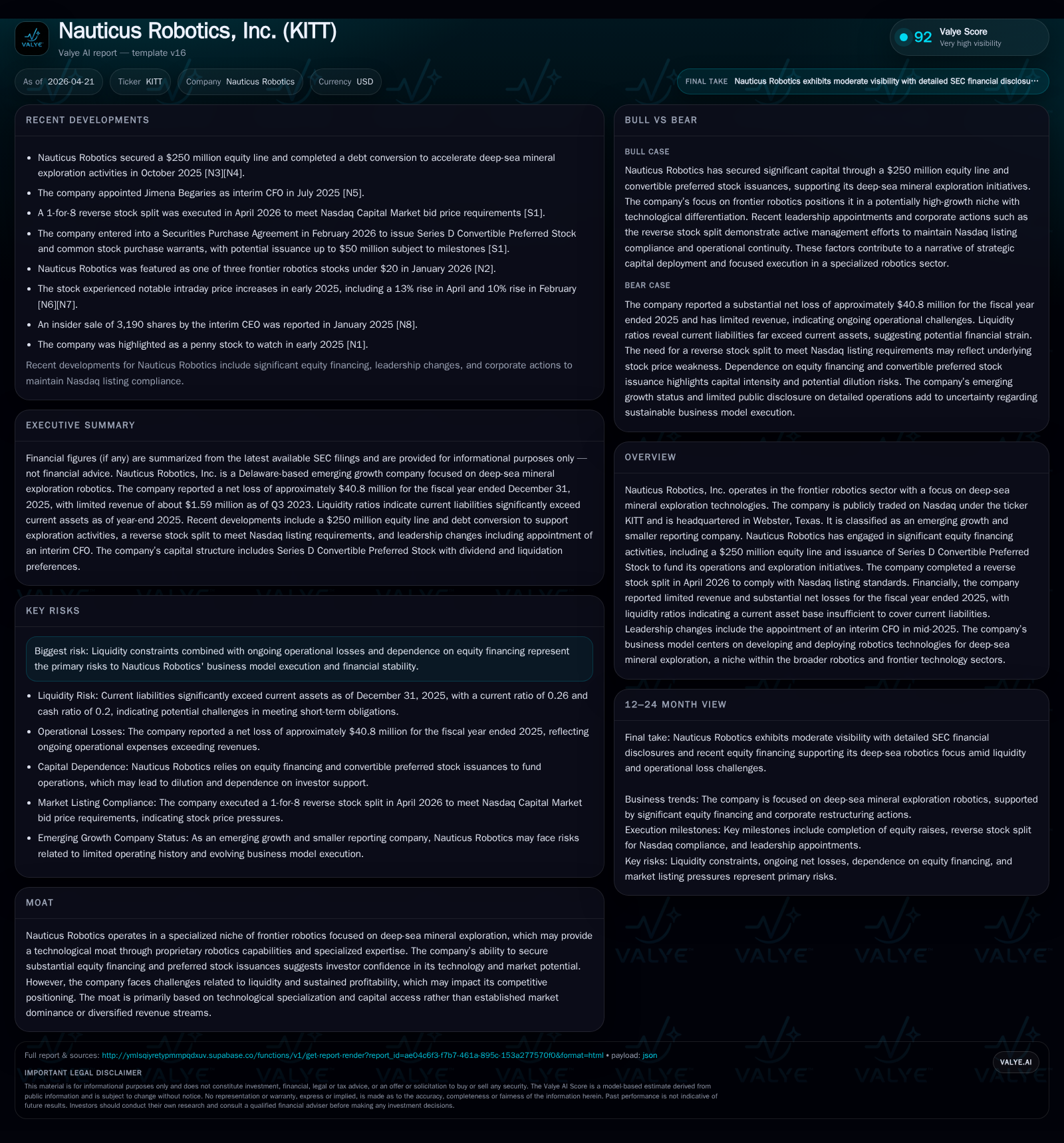
In April 2026, Nauticus Robotics filed a 1-for-8 reverse stock split to meet Nasdaq's minimum share price requirements, preserving its listing status but underscoring share price challenges. The company's innovative deep-sea autonomous underwater vehicles (AUVs) target niche mineral exploration markets, requiring extensive R&D investment and sustaining heavy cash burn. Nauticus faces limited direct competition due to specialized technology but must navigate regulatory and funding hurdles. Growth potential hinges on commercial adoption of complex robotics solutions combined with continued access to capital. Upcoming milestones will focus on financial stability and initial market traction, while the company remains deeply unprofitable with constrained liquidity.
April 2026 Reverse Stock Split: Context and Implications
On April 17, 2026, Nauticus Robotics filed a certificate of amendment effectuating a 1-for-8 reverse stock split of its common stock effective April 21 to comply with Nasdaq Capital Market minimum bid price requirements [S3][S5]. This action was pre-approved by shareholders earlier in January. While the reverse split dramatically reduces the number of shares outstanding—consolidating stakes without major dilution—the move highlights persistent share price weakness that jeopardized listing continuity. Adjustments were made proportionally across warrants and options following standard anti-dilution provisions [S5]. Post-split trading retains the 'KITT' ticker but now under a new CUSIP identifier.
From an investor relations perspective, this maneuver prioritizes maintaining Nasdaq visibility essential for capital market access amid challenging liquidity dynamics. The split itself does not directly inject capital but is preparatory for further equity raises by preserving listing compliance. It signals management’s prioritization of market presence preservation while facing share price headwinds.
Business Model Dynamics in Frontier Deep-Sea Robotics
Nauticus Robotics operates at the cutting edge of frontier robotics focusing on autonomous underwater vehicles (AUVs) tailored for deep-sea mineral exploration applications [S1]. Its commercial value proposition lies in delivering sophisticated robotic platforms capable of operating in harsh subsea environments to enable resource identification and extraction opportunities sought by mining and energy sector clients.
Revenue streams remain limited reflecting early-stage commercial deployments. The intensive R&D required translates into substantial fixed costs amortized over long development cycles; this creates an extended runway before scalable product commercialization can generate meaningful sales volumes. Recurring revenue models may ultimately hinge on service contracts or expanded fleets but are embryonic today.
Technological specialization affords Nauticus differentiation through proprietary hardware-software integration optimized for subsea autonomy—including navigation systems immune to GPS absence underwater. However, these same technical complexities delay mass adoption and inflate upfront investment commitments from both Nauticus and prospective customers.
Competitive Positioning and Industry Barriers
Nauticus occupies a narrow but defensible niche; few companies possess comparable expertise or product capabilities in deep-sea robotic mineral exploration [S1]. High entry barriers stem from rigorous engineering demands, environmental permit complexities offshore, and stringent export controls applicable to advanced marine technologies.
Customer switching costs lean heavily in favor of proven solutions due to operational risks inherent in deep ocean missions—once reliability is established, incumbents gain stickiness. That said, Nauticus must also contend with cautious potential clients given undeveloped market references and the nascence of commercial deep-sea mining ventures globally.
Regulatory uncertainty adds layers of complexity; obtaining environmental clearances involves lengthy processes influenced by geopolitical factors. These aspects constrict the pace at which Nauticus can scale operations despite technical readiness.
Capital Access and Illiquidity Risks in an Emerging Technology Niche
To sustain ongoing operations amid prolonged negative cash flows, Nauticus has undertaken multiple equity financings including a sizeable $250 million equity line agreement alongside Series D Convertible Preferred Stock issuances [S4][S6][S7][F1]. These capital raises fund working capital needs connected to product development, pilot programs, and corporate overhead.
As of fiscal year-end 2025, Nauticus reported current assets totaling approximately $9.25 million against current liabilities near $35.4 million—reflecting a severely constrained current ratio around 0.26 [F1]. This stark mismatch underlines pressing short-term liquidity challenges necessitating imminent refinancing or additional capital injections.
The consistent reliance on dilutive equity instruments spotlights execution risk: failure to timely secure funds could imperil development continuity or market position. While investor appetite remains evidenced by successful raise closures, potential dilution effects introduce shareholder concerns regarding ownership erosion.
Growth Prospects Driven by Technological Moat and Market Adoption
Assuming continued R&D progress delivering reliable AUV systems suited for commercial deployment, Nauticus could leverage its technological moat to capture growing demand linked to the strategic importance of subsea mineral resources [S1]. As global energy transitions increase interest in alternative minerals found underwater (e.g., polymetallic nodules), the addressable market should expand structurally rather than cyclically.
Margins may improve as production scales reduce unit costs and service contracts gain traction—moving beyond prototype-phase economics toward sustainable revenue generation. Additional avenues like licensing technology or forming partnerships with established marine service providers could broaden reach.
Nonetheless, capital intensity combined with regulatory lead times tempers growth velocity expectations; practical deployment will likely follow gradual phases tied closely to client validation milestones rather than rapid scaling.
Upcoming Catalysts and Execution Risks to Monitor
Critical near-term events include monitoring adherence to Nasdaq listing rules post-reverse split; any delisting risk would severely impair strategic options [S3][S5]. The success of future financing rounds—both equity sales under preferred agreements and convertible notes—will be pivotal for operational runway extension [S6][S13].
Commercial pilots or contract awards announced publicly would mark step-changes validating technology maturity and enhancing credibility. Additionally, stabilization or permanence in key management roles such as CFO could support governance strength following interim appointments noted mid-2025 [S22].
Investors should track updates on environmental permitting progress as regulatory outcomes materially influence deployment timelines. Finally, watch for any announcements relating to partnerships or collaborations enhancing go-to-market capabilities.
Financial Overview: Liquidity, Losses, and Capital Structure Snapshot
Nauticus’s fiscal year 2025 financials reveal ongoing steep losses overshadowing initial revenue efforts: net income registered at -$40.8 million while operating income stood at -$23.7 million [F1]. Operating cash flow was consistently negative (-$23 million), reflecting persistent operational cash burn exceeding capital expenditures:
Historical performance (annual)
| FY | Net ($mm) | CFO ($mm) | OpInc ($mm) | Net YoY |
|---|---|---|---|---|
| 2025 | -41 | -23 | -24 | +69.7% |
| 2024 | -135 | -24 | -23 | -166.2% |
| 2023 | -51 | -22 | -55 | -516.4% |
| 2022 | -8 | -37 | -18 |
Source: SEC companyfacts cache [F1].
Capital returns and efficiency (annual)
| FY | ROE% |
|---|---|
| 2025 | -581.7 |
| 2024 | 661.4 |
| 2023 | 121.3 |
| 2022 | -29559.4 |
Source: SEC companyfacts cache [F1].
The company's balance sheet equity turned positive ($7M) only recently after prolonged deficits thanks primarily to new financings [F1]. The precarious current ratio (~0.26) highlights immediate solvency pressure requiring careful cash management or further fundraises.
While losses have narrowed modestly compared with deeper prior years (-69% YoY improvement versus FY2024 net loss), absolute losses remain material underscoring the developmental stage business model reliant on external capital injections rather than internal cash generation.
This analysis is based solely on information extracted from the company's recent SEC filings and corroborated public data as of April 2026. It is intended for informational purposes only without offering investment advice.
Disclaimer: This is research-only, informational analysis and not investment advice. It may include AI-generated interpretation and general industry context. Always verify important details using primary sources.

Comments