
MSCI Inc. Unlocks Subscription Growth Amid Asset Management Fee Pressures
MSCI’s Q1 2026 results underscore expanding demand for sustainability analytics and recurring subscriptions despite industry-wide fee compression.
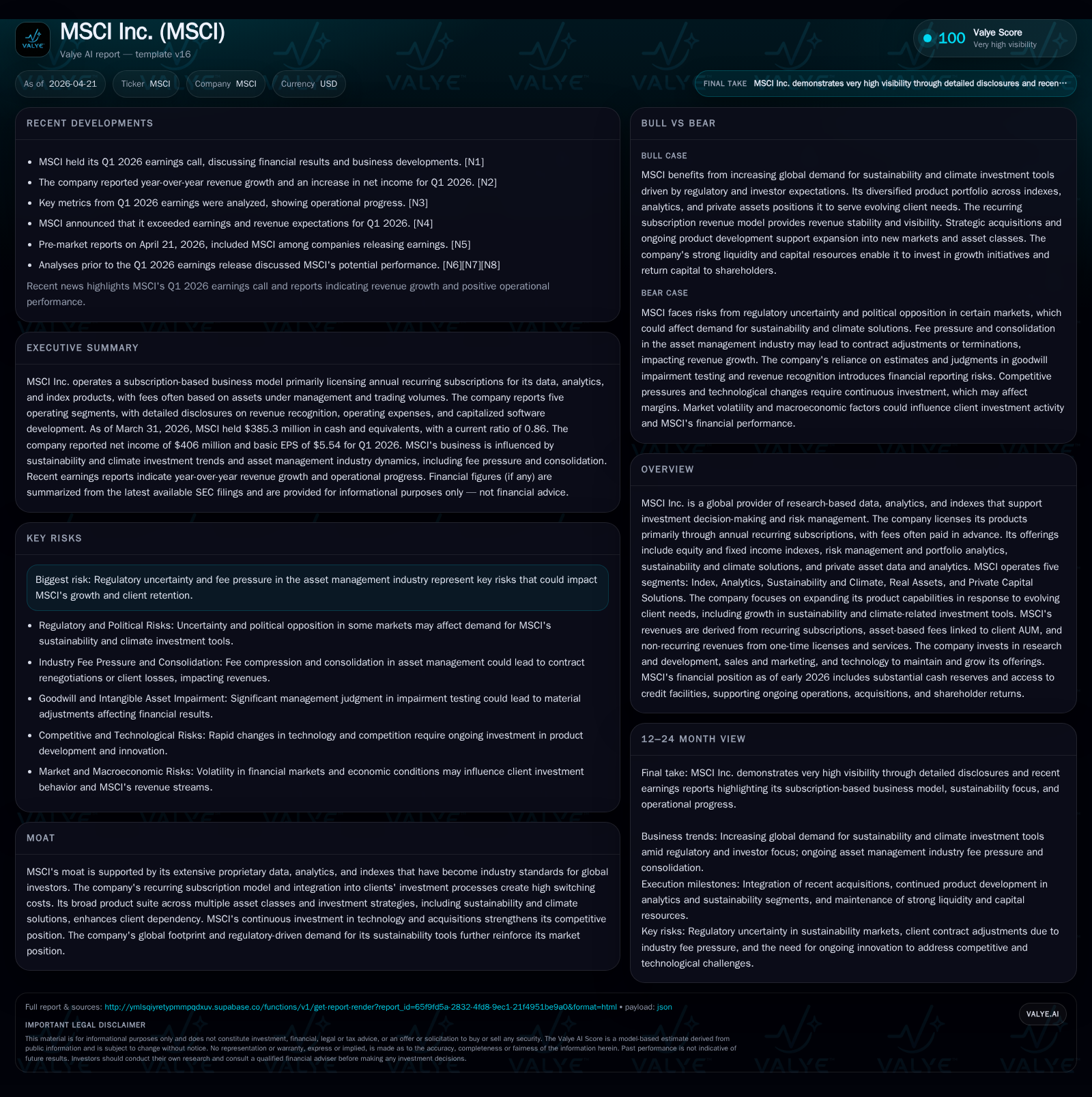
In its latest quarterly filing, MSCI Inc. reported strong subscription revenue growth driven largely by heightened adoption of sustainability and climate-related products. This momentum reflects MSCI’s strategic positioning as asset managers increasingly integrate ESG considerations amid evolving regulatory landscapes. While fee pressures in asset management pose challenges, MSCI’s diversified product suite and entrenched client relationships support resilient demand and margin expansion prospects.
Q1 2026 Operating Update: Subscription Growth and Sustainability Demand
MSCI Inc.'s first quarter ending March 31, 2026, showcased encouraging signs of both revenue growth and product engagement that resonate with its strategic focus areas. According to the latest 10-Q filing [S2], total revenues outpaced consensus estimates with a year-over-year increase driven primarily by growth in recurring subscription fees. This uptick notably correlated with enhanced client adoption of MSCI’s Sustainability and Climate solutions — a segment formally rebranded in early 2025 to better capture its extended remit beyond traditional ESG metrics [S1].
In an industry grappling with fee compression, the sequential expansion in subscription sales during Q1 holds particular significance. It suggests clients are prioritizing advanced tools for climate risk assessment as regulatory regimes—especially in Europe—intensify transparency requirements [N1][N2]. This dynamic aligns with management commentary emphasizing sustained global momentum even during pockets of regulatory uncertainty in jurisdictions such as the U.S. where political debates have cast some shadow over ESG integration [S1]. The accompanying recent event filing [S3] reiterates MSCI's commitment to doubling down on product innovation tailored to these evolving client needs.
Business Model: Recurring Revenue and Product Ecosystem Strength
MSCI's business model centers around the licensing of proprietary data sets, indexes, and analytics through annual recurring subscriptions that clients typically pay in advance [S1]. These subscriptions cover a spectrum of offerings including equity and fixed income indexes used as investment benchmarks, portfolio risk analytics, sustainability frameworks, and more recently expanded private capital market data services.
A critical element underpinning MSCI’s revenue durability is its asset-under-management (AUM) linked fee structure embedded in many index licenses. As clients’ AUM tied to MSCI benchmarks grows or fluctuates, so do the variable fees MSCI collects — creating a direct alignment between client success metrics and company revenue streams [S1]. This dual-source revenue approach—combining predictable subscription billing with scalable AUM-linked fees—forms a sticky revenue base supported by high switching costs; investment teams typically integrate MSCI products deeply into their workflow leading to entrenched user dependency.
The company groups its operations into five segments: Index, Analytics, Sustainability and Climate, Real Assets, and Private Capital Solutions. Each segment offers complementary capabilities that allow MSCI to cross-sell within institutional clients aiming to cover multiple asset classes or risk dimensions concurrently.
Industry Dynamics: Competitive Advantages in Data, Indexes, and Analytics
MSCI sustains a competitive moat stemming from its extensive proprietary data assets coupled with the broad industry adoption of its indexes as de facto standards for passive investment vehicles globally [S1]. The firm's indexes underpin trillions in assets worldwide across ETFs, mutual funds, derivatives instruments, and structured products — reinforcing entrenched vendor status.
This ecosystem effect raises switching costs significantly, as replacing index providers or migrating analytics platforms implies operational risks and resources costs for institutional investors. Beyond scale advantages, MSCI leverages continuous technology investments—both organic R&D and targeted acquisitions—to deepen product sophistication especially related to ESG scoring models and climate scenario analytics where increasing regulatory scrutiny heightens demand [S1].
Industry consolidation among asset managers can pressure vendor costs but also concentrates buying power. MSCI balances this tension by expanding its product breadth to meet multi-use cases spanning traditional portfolio construction to alternative assets analysis—a trend corroborated by rising adoption of Private Capital Solutions . Regulatory-driven demand for transparency notably enhances barriers to entry for competitors lacking comprehensive data integration.
Growth Drivers: Sustainability Solutions and Asset-Based Fee Expansion
Regulatory trends constitute a principal long-term driver for MSCI's growth trajectory. European directives mandating detailed ESG disclosures push asset managers worldwide toward robust sustainability tools capable of meeting compliance while facilitating investment decision-making grounded in climate risk factors [S1]. Demand for climate-aligned indexes has surged accordingly.
Further growth stems from expanding private assets coverage—notably real estate, infrastructure, private equity—which historically lacked standardized data analytics comparable to public markets. MSCI’s development of specialized analytics products here addresses a major market gap amid institutional investors seeking diversified exposure beyond liquid instruments [N4].
On the fee front, while overall asset management fee compression continues due to competition and passive investing trends, MSCI benefits indirectly because AUM linked to its benchmarks continues growing thanks to broader market appreciation plus incremental flow into ESG-themed strategies [S1][N3]. Thus asset-based fees provide an expanding revenue stream complementing subscription licensing.
Constraints: Fee Pressure Headwinds and Regulatory Uncertainties
Despite positive momentum, MSCI faces headwinds primarily from structural fee erosion prevalent throughout the asset management landscape. Clients under margin pressure may seek contract renegotiations or reduce service scope potentially impacting renewal cadence or pricing leverage [S2][S1]. Additionally vendor consolidation among large institutional clients could intensify procurement demands.
Another constraint pertains to political uncertainty around ESG investing in the United States. Legislative pushback or altered regulatory stances could dampen adoption rates for sustainability products domestically or create temporary customer hesitation—a risk acknowledged explicitly by management in filings [S1]. Such dynamics introduce near-term volatility despite favorable global secular tailwinds.
Key Indicators to Watch: Client Retention, New Subscriptions, and Margins
Investors should closely monitor subscription renewal rates including upsell conversion into emerging Sustainability offerings as forward indicators of durable demand [S2][N1]. Growth in AUM linked fees remains sensitive both to capital market conditions affecting benchmark assets under management but also penetration within new strategy verticals such as private assets.
Margin trends will also reflect how effectively MSCI balances enhanced investment into R&D against operating leverage gains resulting from scale expansion. Evidence so far indicates well-managed expenditure given reported operating income improvements alongside topline growth [S2]. Clarity on client contract terms amid ongoing fee pressure will be crucial for medium-term earnings visibility.
Supporting Financial Analysis: Robust Cash Flow and Profitability Metrics
Recent financial performance validates the qualitative themes around business stability. Fiscal 2025 revenue grew approximately 14.3% year-over-year while operating income expanded about 12.1%, signifying operational efficiency alongside top-line strength. Net income advanced by roughly 8.4% during the same period reflecting moderate leverage on expenses [F1].
Operating cash flow remains robust at nearly $1.59 billion in FY2025 growing over previous years; capital expenditure rose modestly supporting ongoing technology investments without overly diluting free cash flow which exceeded $1.54 billion after capex subtraction [F1]. Balance sheet liquidity stays solid with cash reserves above $380 million reported at Q1-end 2026 alongside manageable current liabilities leading to current ratio below unity but consistent with industry norms given receivables/billing cycles [F1][S2].
Historical performance (annual)
| FY | Net ($mm) | CFO ($mm) | OpInc ($mm) | Capex ($mm) | Net YoY |
|---|---|---|---|---|---|
| 2025 | 1202 | 1588 | 1714 | 39 | +8.4% |
| 2024 | 1109 | 1502 | 1529 | 34 | -3.4% |
| 2023 | 1149 | 1236 | 1385 | 23 | +31.9% |
| 2022 | 871 | 1095 | 1208 | 14 |
Source: SEC companyfacts cache [F1].
Capital returns and efficiency (annual)
| FY | Buybacks ($bn) | FCF ($mm) | ROE% |
|---|---|---|---|
| 2025 | 2.5 | 1549 | -45.3 |
| 2024 | 0.9 | 1468 | -118.0 |
| 2023 | 0.5 | 1213 | -155.3 |
| 2022 | 1.4 | 1082 | -86.4 |
Source: SEC companyfacts cache [F1].
Overall these financial markers bolster confidence that MSCI's approach balancing recurring subscription backbone with scalable AUM-linked fees continues driving profitable growth despite macro pressure on end-markets.
This analysis synthesizes current regulatory landscapes shaping ESG dynamics alongside detailed product strategy insights derived from most recent SEC disclosures combined with industry context reflective of institutional investor behavior patterns affecting data provider selection and usage intensity.
Disclaimer: This report is for informational purposes only based on publicly available information as of April 21, 2026. It does not constitute investment advice or recommendations concerning securities or other financial instruments.
Disclaimer: This is research-only, informational analysis and not investment advice. It may include AI-generated interpretation and general industry context. Always verify important details using primary sources.

Comments