
DDC Enterprise Advances Asian Market Focus with Bitcoin Treasury Integration
DDC's latest capital raise and strategic lock-up signal a renewed financial footing amid its Asia-centric pivot and Bitcoin treasury deployment.
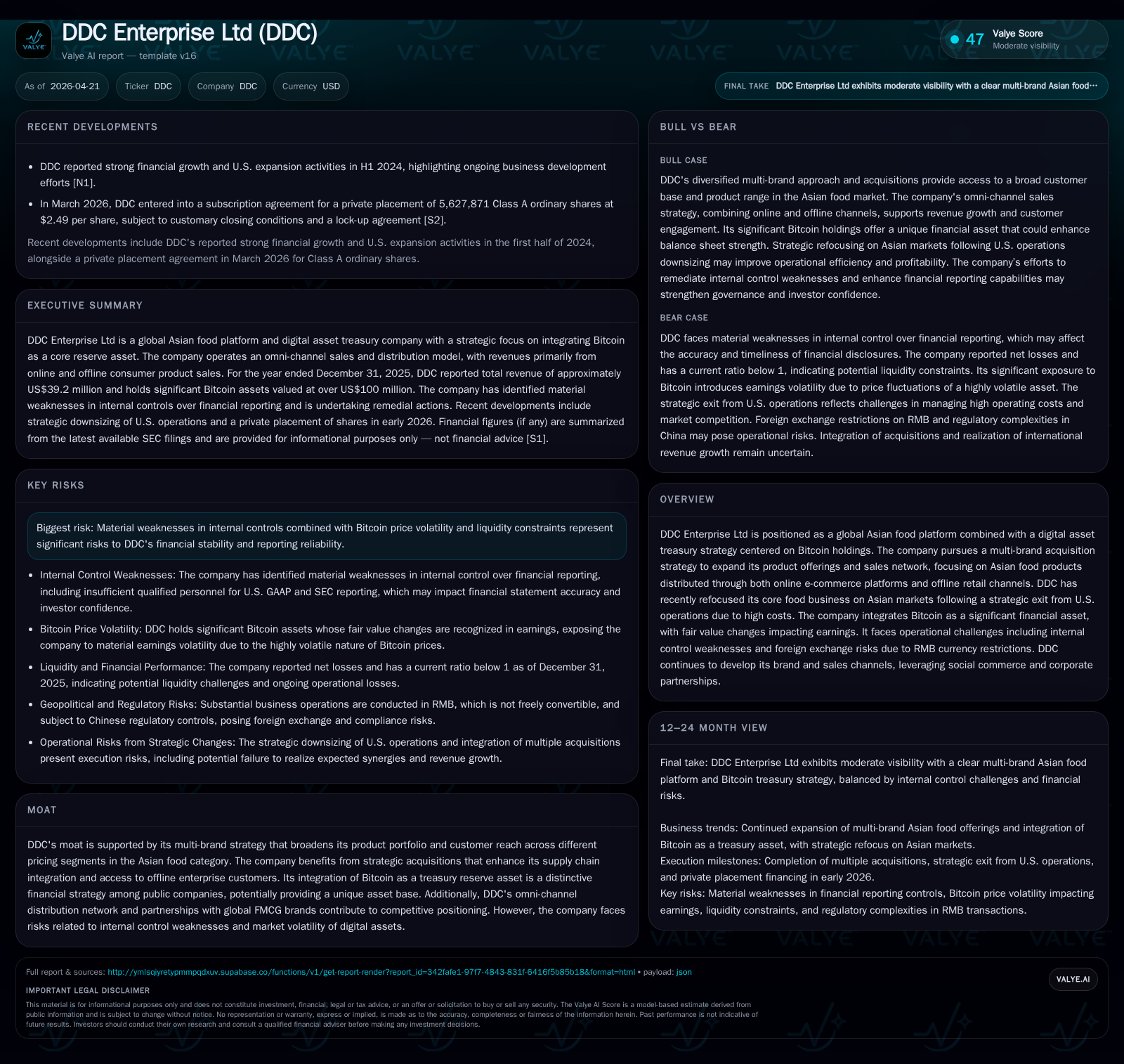
In Q1 2026, DDC Enterprise secured capital through a private placement coupled with a stringent lock-up agreement, underpinning near-term liquidity and investor confidence despite prior operational challenges. The company has decisively exited its high-cost U.S. operations, reallocating resources to expand its omni-channel Asian food platform, emphasizing offline distributor growth in secondary Chinese cities. Concurrently, DDC’s pioneering integration of Bitcoin as a treasury reserve asset, holding over 1,180 BTC as of end-2025, introduces both distinctive asset diversification and notable earnings volatility risks. Balancing growth opportunities from rising Chinese consumer demand against governance and digital asset risks will define DDC’s trajectory.
Recent Quarter Highlights: Capital Raise and Strategic Lock-Up
DDC Enterprise’s March 19, 2026 private placement with Bristol Point Investment Limited marks a pivotal near-term liquidity event [S2]. The transaction involved issuing approximately 5.63 million Class A shares at $2.49 each under an exemption from SEC registration rules. Crucially, the accompanying Lock-Up Letter Agreement restricts the investor from selling or transferring these shares for a full year except for limited exceptions such as transfers to affiliates or immediate family members. This lock-up denotes a strong measure of strategic share stability aimed at consolidating investor confidence amidst operational restructuring. The infusion of fresh capital should enhance DDC's financial flexibility to fund its Asia-focused expansion plans.
Pivot to Asia: Refocusing Business Model and Product Portfolio
The latest annual report confirms DDC’s deliberate retreat from the costly U.S. market in 2025 [S1][S3]. This contraction led to a significant reduction in sales and marketing expenses by over 63% (from RMB20.9 million to RMB7.7 million), primarily due to zero marketing spend in the U.S. operations which were fully exited. Conversely, the company posted an almost 10% increase in revenue from its core Asian markets year-over-year (RMB249.7 million to RMB274 million). This geographic refocus aligns costs more closely with profitable growth areas, particularly within China where expanding the product range of easy-to-prepare Asian foods caters well to evolving consumer preferences for convenience without compromising safety or quality [S23].
Revenue mix adjustments highlight a shift toward strengthening offline retail partnerships and deepening penetration into lower tier cities (tier-2 and tier-3), where domestic demand is accelerating due to rising disposable incomes and urbanization.
Omni-Channel Approach and Multi-Brand Expansion in the Asian Food Market
DDC is leveraging a sophisticated omni-channel distribution strategy combining online e-commerce platforms with offline wholesale Point-of-Sale (POS) distributors [S1][S23]. The company's multi-brand acquisition strategy enhances its product portfolio breadth across different price tiers in Asian cuisines. Brands acquired since early 2022 have strengthened DDC’s upstream supply chain integration—most notably through manufacturing footholds such as Lin’s Group—and broadened access to corporate gifting and FMCG partnerships including global names like PepsiCo’s Lays brand [S9][S10].
Additionally, social commerce engagement via curated video content serves as a key customer retention driver aiming to lift average order values (AOV) while attracting new users [S1]. This layered ecosystem supports differentiated product offerings blending convenience with verified safety standards—critical consumer concerns in the competitive food marketplace.
Competitive Landscape: Supply Chain Integration and Customer Engagement
DDC faces intense competition marked by aggressive price rivalry among online platforms, which partly motivated its U.S. withdrawal due to unfavorable margin pressure [S1][S23]. Its defensive response has been to pivot toward proprietary supply chain control stemming from multi-brand acquisitions combined with strong offline distributor relationships that command higher switching costs.
This enables more stable margins relative to pure-play e-commerce rivals who suffer from price commoditization dynamics. However, balancing optimal pricing without ceding volume remains challenging given diverse consumer price sensitivity across different Asian market segments.
Bitcoin Treasury Strategy: Risk and Opportunity in Financial Architecture
Distinctly among public companies with retail-themed operations, DDC has integrated Bitcoin into its treasury reserves starting May 2025 [S1][S12]. By December 31, 2025, DDC held approximately 1,181 bitcoins valued at RMB730 million ($104 million). Adopting ASU 2023-08 accounting standards effective January 2025 requires recognizing changes in fair value immediately in earnings.
This led to recording an unrealized loss of RMB38.7 million ($5.5 million) during the year on the digital asset portfolio ultimately contributing considerable volatility to reported results alongside traditional business operating outcomes.
Management views this approach as a unique asset diversification strategy potentially enhancing capital structure resilience long term but acknowledges high price fluctuation risk inherent in Bitcoin exposure—reflecting a tradeoff between innovation-driven treasury management versus earnings predictability.
Growth Opportunities and Risks from Market Shifts and Internal Controls
Macro tailwinds include China’s robust economic growth trajectory resulting in elevated consumer disposable incomes alongside government-led social reforms promoting healthier convenience foods [S1]. These factors structurally support demand for DDC’s curated easy-meal products distributed via both online and growing offline channels targeted at emerging city markets.
Conversely, DDC grapples with material weaknesses in internal controls linked predominantly to implementing U.S. GAAP financial reporting frameworks addressing complex areas such as digital assets valuation [S12][S21]. Foreign exchange exposures also loom due to RMB currency non-convertibility constraints complicating cross-border capital flows [S8]. The volatile nature of Bitcoin holdings further compounds liquidity and reporting risks.
Thus operational risk mitigation through strengthened financial governance remains vital alongside strategic execution.
Monitoring Indicators: Next Milestones and Operating Metrics to Watch
Key upcoming milestones include:
- Closing and deployment of proceeds from the March 19 private placement for organic expansion initiatives [S2].
- Execution momentum on social commerce strategies aimed at increasing average order value (AOV) through content marketing enhancements.
- Expansion metrics tracking new offline distributor collaborations especially focused on second/third-tier cities which represent primary avenues for sustainable growth [S1].
- Progress reports on internal control remedial actions addressing previously identified material weaknesses.
- Bitcoin portfolio management updates covering additional accumulation or liquidation activity alongside valuation changes affecting quarterly earnings volatility.
These indicators will collectively reveal whether DDC can capitalize on its repositioning efforts while managing emerging operational challenges.
Supporting Evidence: Financial Performance Summary
Historical performance (annual)
| FY | Rev ($mm) | CFO ($mm) | OpInc ($mm) | Capex ($) | Rev YoY |
|---|---|---|---|---|---|
| 2025 | 39 | -40 | -35 | 4575 | +4.6% |
| 2024 | 37 | -15 | -19 | 52155 | +29.4% |
| 2023 | 29 | -13 | -21 | 28409 |
Source: SEC companyfacts cache [F1].
Capital returns and efficiency (annual)
| FY | FCF ($mm) |
|---|---|
| 2025 | -40 |
| 2024 | -16 |
| 2023 | -13 |
Source: SEC companyfacts cache [F1].
Values sourced from most recent annual filings [F1], presented here as background context.
The modest top-line growth (+4.6% YoY) contrasts sharply against widening operating losses driven by substantial share-based compensation expense spikes (~RMB218 million in 2025). Cash flow continues negative territory with operating outflows intensifying (-156%), reflecting aggressive investment into team capabilities especially digital asset expertise.
the tight current ratio below one highlights ongoing liquidity management challenges despite recent equity infusion initiatives described above.
This analysis is based exclusively on factual disclosures from DDC Enterprise Ltd.'s SEC filings as of April 21, 2026 ([S1],[S2],[S3]) complemented by structured financial data ([F1]). No speculative projection beyond confirmed forward pointers has been included herein.
Disclaimer: This is research-only, informational analysis and not investment advice. It may include AI-generated interpretation and general industry context. Always verify important details using primary sources.

Comments