
Black Hawk Acquisition Cellars Value in Vesicor Tie-up; Investor Focus Shifts to Close
BKHA’s latest quarterly report highlights the transition from capital raise to business combination execution, underscoring key liquidity and integration considerations.
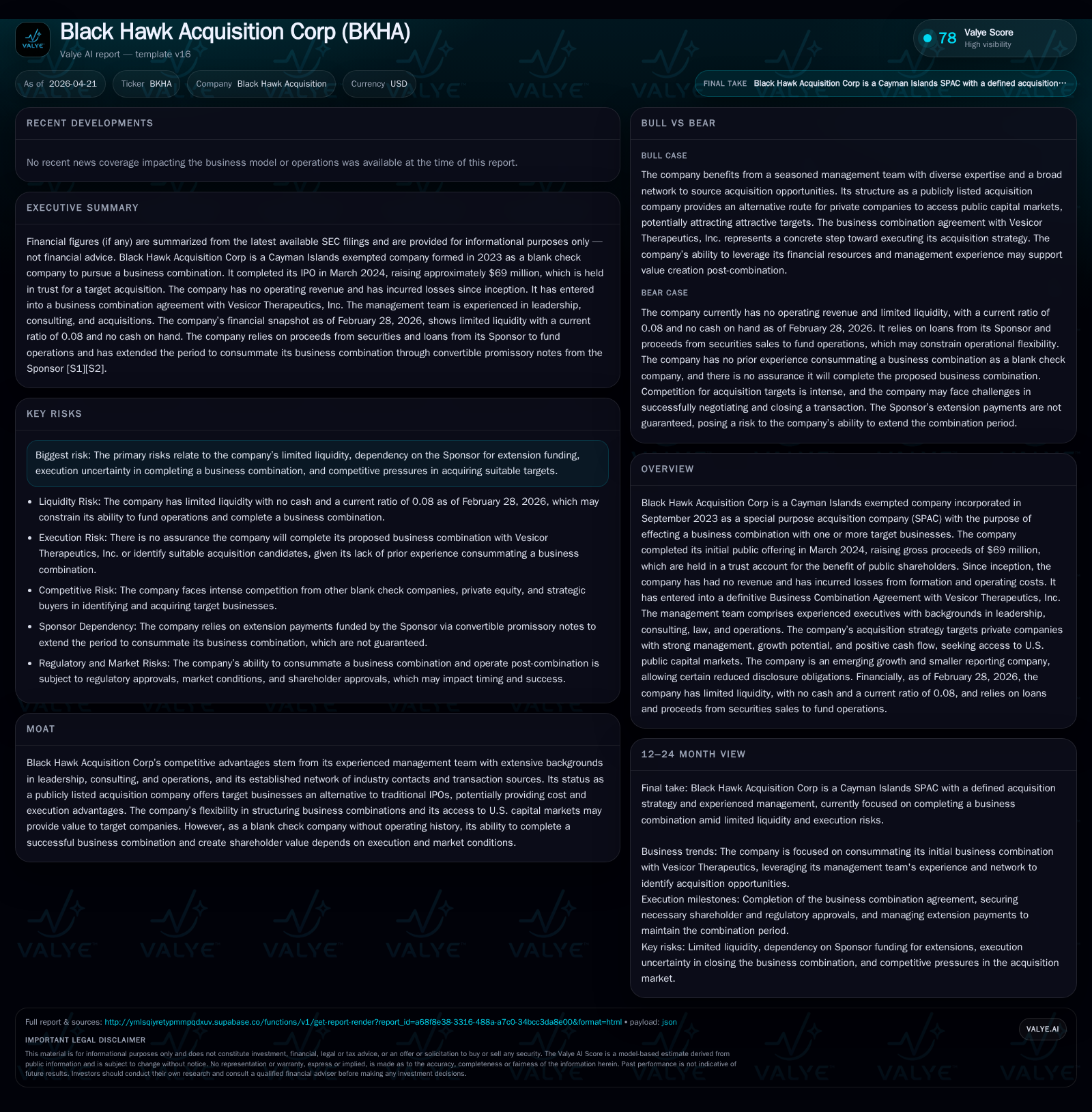
Black Hawk Acquisition Corp remains at a pivotal stage as it advances toward closing its business combination with Vesicor Therapeutics. The Q1 2026 filing reveals critical liquidity constraints coinciding with an impending merger that aims to unlock value by leveraging BKHA’s public vehicle to bring a cash-flowing private target public. The SPAC’s business model centers on its ability to find and structure deals that satisfy shareholder and regulatory hurdles amid competitive pressures and inherent execution risks. Going forward, the market will focus on deal closure milestones, redemption behavior, and sponsor support as primary indicators of success.
Q1 2026 Operating Overview: Funds Deployment and Business Combination Progress
Black Hawk Acquisition Corp’s most recent quarterly filing dated April 21, 2026 [S2] illustrates the company's transition from formation phase into the critical execution stage of completing its planned business combination with Vesicor Therapeutics, Inc. The filing confirms that BKHA currently holds no cash or equivalents outside of its trust account intended for the benefit of public shareholders—a signal that operational cash reserves are fully allocated toward merger activities or otherwise expended. The trust account itself, established during BKHA's IPO in March 2024 with gross proceeds of $69 million [S1], continues to anchor shareholder value pending consummation of the Vesicor transaction.
Trading of BKHA securities on the Nasdaq Global Market has continued uninterrupted following an April 1, 2026 company update [S3], despite regulatory notices that might hint at delisting risks typically associated with blank check companies advancing toward deal closures. This implies management's commitment to maintaining public liquidity through the transaction period.
This inflection point represents a fundamental shift for BKHA: moving away from capital raising as a pure shell entity into operational complexity involving integration risk with Vesicor. Execution timelines are pressing given the previously extended deadline of December 22, 2026 under their SPAC charter [S12]. Failure to close would trigger mandatory liquidation proceedings consuming residual trust funds after costs.
Business Model Roots: SPAC Structure, Capital Flow, and Acquisition Strategy
BKHA is structured as a Cayman Islands exempted company formed specifically as a Special Purpose Acquisition Company (SPAC) in September 2023 [S1]. The Cayman domicile offers tax neutrality favorable for international transactions and administrative flexibility absent burdensome regulatory codes common in other jurisdictions.
The SPAC model relies on raising capital via an IPO without underlying operations—in BKHA’s case, $69 million were raised through unit sales which bundled ordinary shares with warrants structured to incentivize sponsor alignment [S1]. These IPO proceeds reside in a segregated U.S.-based trust account, shielded from operational expenditures until released upon successful business combination.
BKHA targets private companies demonstrating strong management teams capable of revenue growth and free cash flow generation—criteria designed to mitigate execution risk as these companies seek alternatives to traditional IPOs [S9]. BKHA offers favorable deal structuring flexibility whereby consideration can be composed of cash from trust accounts, equity issuance, debt financing, or combinations thereof depending on target requirements [S4].
Management’s backgrounds span leadership consulting (notably Kent Louis Kaufman’s extensive experience advising tech and industrial firms), legal expertise, and operations oversight—a mix intended to enhance deal sourcing quality and post-merger execution capability even though BKHA itself lacks prior combined operating history [S7].
Industry Context: Competitive Nature of SPACs in Public Market Access for Private Targets
The blank check company arena remains intensely competitive with many vehicles vying for acquisition targets eager for efficient pathways to public markets beyond traditional IPOs or direct listings [S1]. Regulatory pressures have increased post-2022 reforms emphasizing transparency around shareholder approvals, redemption rights, and valuation disclosures—which heightens execution risk for all SPAC sponsors.
BKHA must convince target stakeholders that their proposed tie-up offers superior capital access alongside cost savings relative to standalone IPO underwriting fees typically incurred by emerging companies [S10]. Yet challenges persist from overlapping fiduciary obligations when directors or officers have existing ties presenting potential conflicts in acquisition opportunity allocation [S23]. Furthermore, lack of operating subsidiaries means BKHA derives no revenues until business combination closes; investor patience is therefore measured strictly by close timing reliability.
Continuous liquidity is another sector-wide concern evidenced by BKHA’s low current ratio around 0.08 as of February 28, 2026—a reality that reflects funds mostly locked inside escrow rather than held as liquid working capital [F1]. This financial profile is characteristic but underscores vulnerability should deal completion stall or market conditions deteriorate.
Growth Engines: Value Creation through Target Selection, Flexible Deal Structuring, and Market Access
At its core, BKHA’s growth thesis pivots on consummating its definitive Business Combination Agreement signed April 26, 2025 with Vesicor Therapeutics—a private company poised for expansion through enhanced access to U.S. capital markets via BKHA’s public platform [S1]. Successful closing would convert BKHA from a shell entity into an operating public company leveraging Vesicor’s revenue-generating profile.
The combined entity can expect synergistic efficiencies stemming from management experience cross-leverage plus increased operational scale supported by access to broad institutional funding sources previously unavailable to Vesicor alone [S8]. Deal structuring flexibility allows tailoring equity dilution or debt assumptions responsive to market conditions while preserving enough cash to fuel growth initiatives post-close [S4].
BKHA underscores acquiring targets that have clear paths not only to revenue growth but also stable free cash flow streams with manageable capital expenditure needs—attributes aimed at sustainable profitability enhancement after public listing transitions [S9]. The pathway from capital infusion through scaling operations characterizes SPAC-originated value creation models distinct from conventional fresh-start IPOs.
Constraints: Liquidity Challenges, Execution Uncertainty, and Sponsor Dependencies
Several binding constraints merit attention around deal execution risks now that BKHA's operating cash reserves stand at zero outside the protected trust account [F1]. Without incremental financing or timely closing proceeds release triggered by the Vesicor merger completion, ongoing liabilities such as administrative expenses pose solvency pressures given reported current liabilities surpassing $2.28 million relative to current assets near $180K ([F1]).
Further complicating this dynamic are redemption rights exercised by shareholders that reduce net funds available in the trust account—reported post-extension approvals at roughly $22.7 million remaining before deduction of fees related directly to shareholder redemptions [S12][S13]. Such redemptions shrink deal consideration capacity unless offset by sponsor-funded extensions which incur convertible promissory notes payable subject to conversion at favorable founder share prices but also represent additional financial complexity [S22].
Sponsor support remains pivotal: extension payments totaling $150K per month have been funded albeit sometimes after deadlines reflecting sponsor discretion linked clearly to belief in deal viability [S12][S22]. Should sentiment sour or unforeseen delays emerge, lack of sponsor funding could precipitate forced liquidation scenarios detrimental to shareholder value.
Investor Watchlist: Key Upcoming Deal Closures, Regulatory Milestones, and Pricing Signals
Investors eyeing BKHA should center focus tightly on several proximate milestones emanating from SEC filings:
- Finalization schedules tied explicitly to satisfaction of customary closing conditions stipulated in the Business Combination Agreement with Vesicor (including shareholder votes where required) [S1][S3]
- Redemption election volumes since these directly impact trust account balances determining per-share redemption prices post-combination and influence balance sheet strength post-close [S13]
- Maintenance of Nasdaq listing symbols “BKHA”, “BKHAU”, “BKHAR” without delisting actions which serve as barometers of regulatory compliance adherence supporting continuity claims [S3]
- Any announcements regarding additional third-party financing arrangements supplementing merger consideration or addressing working capital shortfalls pre-closing would be material signals altering risk/reward calculus Monitoring proxy statement filings providing transparency on ownership shifts from open market share purchases by insiders or sponsors should redemption rates threaten net tangible asset thresholds required under Nasdaq rules is also prudent given potential voting influence dynamics around deal approval mechanisms [S11][S15][S21].
Financial Health Synopsis: Balance Sheet Stance and Operational Outcomes
A brief financial overview underpinning this narrative reflects typical pre-business combination characteristics detailed in companyfacts data through FY2025 ended November 30:
Historical performance (annual)
| FY | Net ($) | CFO ($) | OpInc ($) | Net YoY |
|---|---|---|---|---|
| 2025 | 1329557 | -650321 | -915510 | -30.6% |
| 2024 | 1915703 | -553665 | -576076 |
Source: SEC companyfacts cache [F1].
Capital returns and efficiency (annual)
| FY | ROE% |
|---|---|
| 2025 | -34.6 |
| 2024 | -88.2 |
Source: SEC companyfacts cache [F1].
[F1]
Operating losses widened substantially year-over-year mainly reflecting increasing costs associated with finalizing organizational activities supporting the merger process. Despite negative operating income trends the net income figure remains positive driven primarily by non-operating accounting entries typical in SPAC structures where certain gains or fair value adjustments may be recorded periodically.
Equity position remains deeply negative owing largely to upfront formation costs exceeding reported assets outside the trust accounts. The critically low current ratio signals precarious short-term liquidity if not for reliance on locked trust funds which remain protected but unusable for immediate liabilities apart from transaction closure events.
These metrics collectively illustrate an enterprise awaiting catalytic events enabling transition into revenue-generating entity status while highlighting interim fragility — normal among SPAC peers advancing toward final transactions but still worth monitoring given unknown timing uncertainties.
This analysis leverages exclusively SEC-filed disclosures up through April 21st, 2026 combining numerical evidence from statutory filings with qualitative context surrounding Black Hawk Acquisition Corp’s role as a nascent SPAC progressing toward a definitive business combination marked by considerable operational focus shifts coupled with classic sector-specific risks related predominantly to timing execution and funding dependencies experienced industry-wide within this evolving acquisition vehicle class.
This document does not constitute investment advice or recommendations but endeavors to contextualize operational dynamics critical for stakeholders evaluating BKHA within the contemporary special purpose acquisition framework.
Disclaimer: This is research-only, informational analysis and not investment advice. It may include AI-generated interpretation and general industry context. Always verify important details using primary sources.

Comments