
GE Aerospace Bolsters Commercial Engine Profitability While Managing Market Pressures
The latest quarterly report reveals GE Aerospace’s strategic prioritization of commercial engine margins amidst competitive dynamics and production ramp challenges.
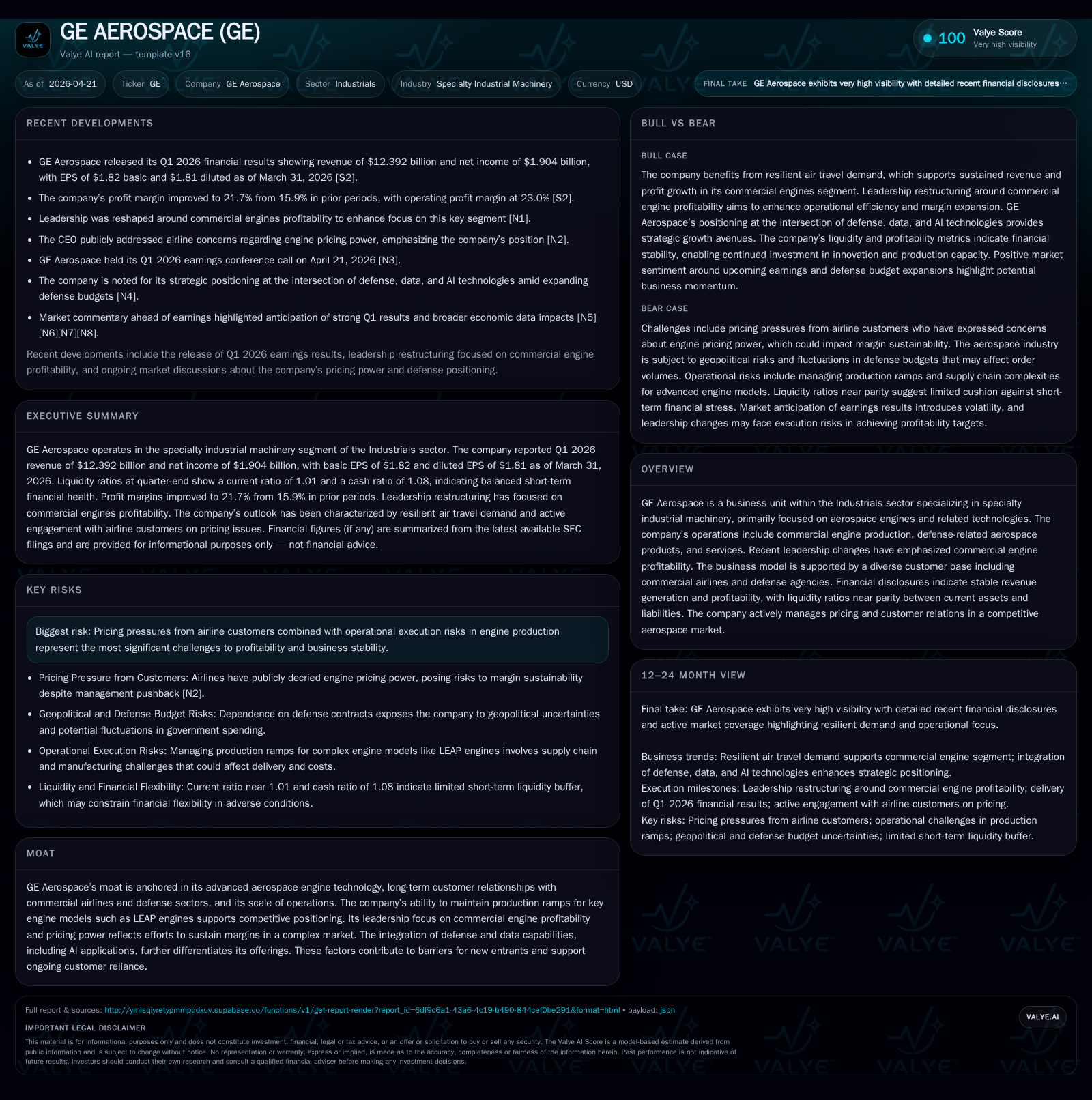
GE Aerospace’s Q1 2026 10-Q filing underscores a disciplined focus on commercial engine profitability, reflected in stable segment margins despite pricing pressures from airline customers. The company continues to ramp production of key models like the LEAP engine while leveraging its defense aerospace integration and data analytics capabilities to reinforce competitive differentiation. Balancing execution execution risks and customer negotiation leverage remains central to sustaining growth momentum within a complex aerospace ecosystem.
Latest Quarterly Operational Highlights Signal Focused Profitability Efforts
GE Aerospace’s most recent quarterly disclosure on April 21, 2026, foregrounds a strategic shift towards enhancing commercial engine profitability. The Q1 2026 10-Q [S2] reports stable segment margins in the face of ongoing unit economics pressures driven by airline customers' intense pricing negotiations. Production volumes for flagship models like the LEAP engine continue rising as planned, but management is signaling a cautious stance prioritizing margin improvement over aggressive volume increases. An accompanying 8-K event filing [S3] reiterates this focus as part of leadership’s broader value management initiative.
The earnings conference call commentary [N1] further corroborates these themes: executives emphasize managing cost structures and optimizing pricing power even as demand recovers unevenly amid macroeconomic variables affecting global airlines. These developments imply that GE Aerospace is executing a deliberate recalibration—ramping up production without sacrificing disciplined profit control—in a market where cost inflation and customer bargaining exacerbate margin volatility.
Business Model Essentials: Engine Innovation, Customer Base, and Service Revenue
At its core, GE Aerospace operates through producing advanced aerospace engines predominantly for commercial airlines alongside a substantive defense aerospace segment. The business model integrates hardware manufacturing — notably the LEAP family and other commercial engines — with an increasingly important aftermarket service component that delivers higher-margin revenue streams through maintenance, repair, overhaul (MRO), and digital analytics offerings [S1].
The customer base remains diversified but weighted toward major carriers requiring state-of-the-art fuel-efficient engines; defense contracts complement this through specialized propulsion systems and integrated data solutions supporting fleet readiness. The scale of production for high-volume engines underpins favorable unit economics via spread fixed costs and learning curve benefits while innovation advances sustain the firm’s technological moat .
Service revenues anchored by installed base support enhance recurring income stability and play a pivotal role in customer retention given the long-life cycle and critical nature of aerospace engines.
Industry Dynamics: Competition, Pricing Leverage, and Regulatory Environment
Within specialty industrial machinery focused on aerospace propulsion, GE Aerospace contends principally with peers such as Rolls-Royce and Pratt & Whitney. Advanced engineering capabilities create substantial entry barriers; however, competition is relentless on price given airlines' significant negotiating power as they consolidate fleets or pursue cost-saving initiatives [S1,S4].
The company’s pricing leverage thus faces ceiling effects dictated by customer consolidation trends coupled with global economic headwinds impacting travel volumes. Regulatory oversight concerning emissions standards imposes technical compliance demands but also incentivizes development of more efficient engines—an area where GE Aerospace has invested heavily.
Supply chain resilience remains a latent constraint especially given the precision materials needed for turbine production; any disruption poses risk to timely delivery—a critical factor given contractual penalties prevalent in aerospace manufacturing.
Growth Drivers: Production Ramps, Defense Contracts, and Data Integration
A primary growth driver for GE Aerospace resides in scaling production ramps for key models such as the LEAP engine. This ramp supports capture of market share gains as airlines renew fleets with next-generation technology [S15]. Enhanced operational efficiency initiatives aim to smooth throughput increases while controlling unit costs.
Simultaneously, the defense segment is expanding notably through synergistic integration of AI-enabled data capabilities atop traditional hardware offerings [N8]. This hybrid approach positions GE Aerospace advantageously against competitors less advanced in digital transformations.
Aftermarket services form another cornerstone growth pillar; sophisticated digital analytics improve predictive maintenance effectiveness generating stickier customer relationships and improved margins beyond pure hardware sales.
Operational Risks and Constraints: Pricing Pressure and Execution Challenges
Despite the positive trajectory in ramping production and defense integration, significant risks linger. Key among them is sustained pricing pressure exerted by airline customers who wield considerable bargaining power due to fleet concentration trends . This constrains margin expansion even as input costs fluctuate.
Execution complexity in manufacturing cutting-edge high-thrust engines introduces potential delays or quality issues with outsized impact considering contractual delivery schedules. Any slip-ups could erode customer trust or incur financial penalties.
Raw material cost volatility or supply shortages constitute additional constraints that may compress margins or necessitate price renegotiations.
Forward Indicators: Backlog Trends, Guidance Evolution, and Technology Deployment
Looking forward, critical indicators for tracking GE Aerospace's operational health include shifts in order backlogs which offer forward visibility into demand strength especially within commercial airlines [S15]. Management’s forthcoming guidance updates will be insightful regarding anticipated pricing strategy adjustments or expected cadence for production volumes.
Technology deployment milestones such as new AI-driven maintenance platforms or next-gen engine certifications warrant close attention—they carry potential to materially disrupt competitive positioning if successfully scaled.
In sum, continued progress on balancing production efficiency gains with maintaining pricing discipline will likely dictate the firm’s near-term growth trajectory amidst an evolving aerospace market landscape.
Disclaimer: This is research-only, informational analysis and not investment advice. It may include AI-generated interpretation and general industry context. Always verify important details using primary sources.

Comments