
Aircastle LTD Reinforces Global Aircraft Leasing Position with Strategic Fleet Expansion
The latest quarterly filing reveals Aircastle’s fleet growth and operational resilience amid ongoing industry constraints.
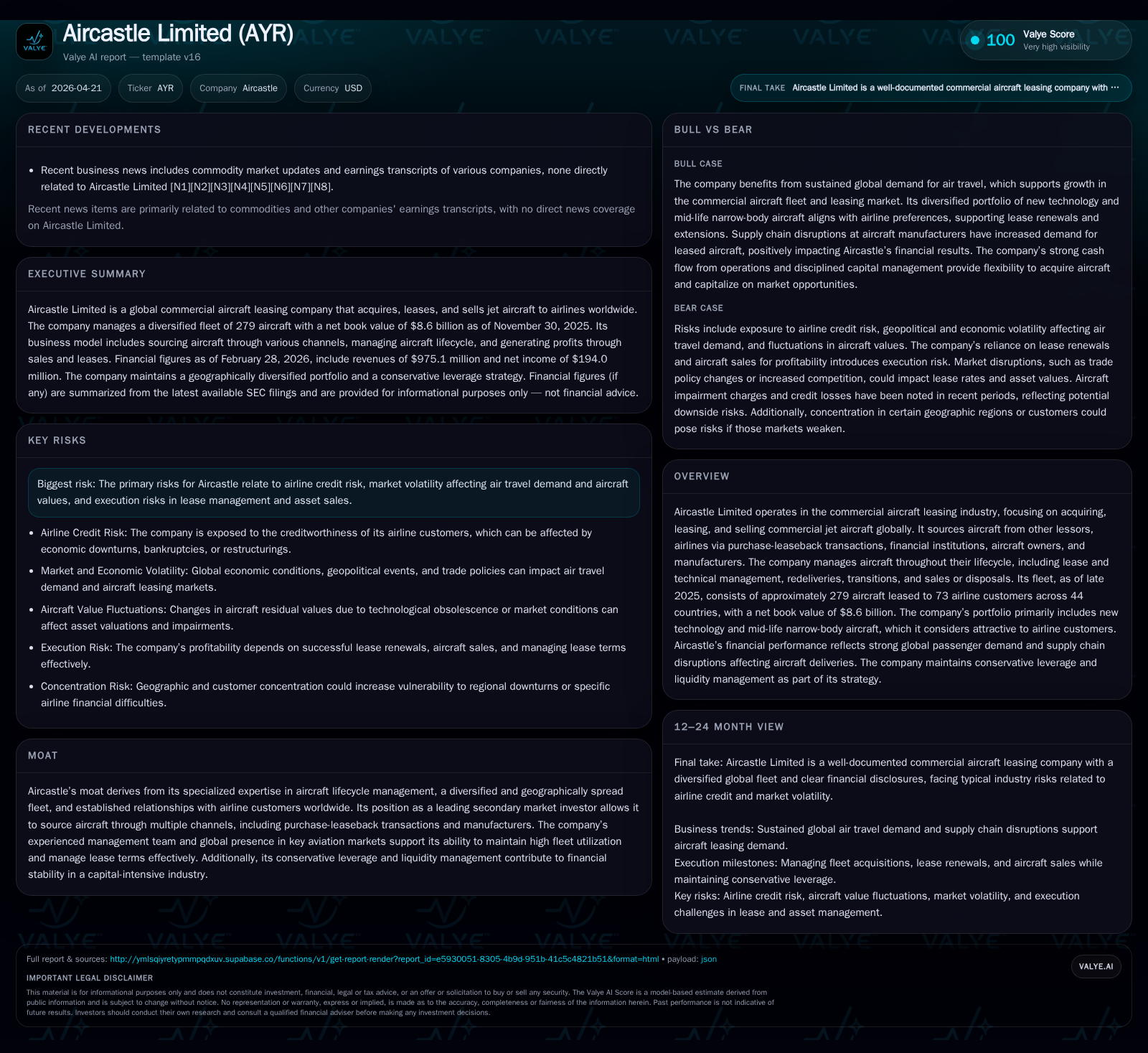
Aircastle's January 2026 10-Q highlights an increase in fleet size and high utilization rates, reinforcing its robust position in the aircraft leasing market. The company’s strategy of diversified secondary sourcing and lifecycle management underpins asset value preservation amid supply chain disruptions. Strong lease extension activity and a growing portfolio of new-technology narrow-body jets support revenue growth, while conservative leverage maintains financial stability. Upcoming delivery commitments and lease portfolio performance remain key milestones to watch.
Latest Quarterly Developments Highlighting Fleet Growth and Utilization
In its most recent quarterly filing dated January 13, 2026 ([S2]), Aircastle Limited reported continued strengthening of its operational footprint through fleet expansion and sustained high utilization. As of the end of the nine months ended November 30, 2025, the company owned and managed approximately 279 commercial aircraft with a net book value (NBV) of $8.6 billion, marking an increase from prior periods. The fleet utilization rate remained exceptionally strong at over 99%, underscoring effective lease management even amid global aviation sector challenges.
The quarterly disclosures also detailed related party transactions involving service agreements with shareholders totaling $1.9 million in fees for the quarter, consistent with similar historical patterns, reflecting integrated administrative support arrangements without material impact on operations or costs ([S2]). Income taxes were accounted for on a multinational basis based on jurisdictional rules where leases are executed ([S2]).
These developments reinforce Aircastle's robust positioning despite broader supply chain disruptions impacting Original Equipment Manufacturers (OEMs), which have constrained new aircraft production globally. The company’s ability to maintain high utilization alongside fleet growth indicates resilient demand for leased assets within its portfolio.
Dynamics of Aircastle’s Acquisition, Leasing, and Lifecycle Management Model
Aircastle predominantly sources its fleet through multiple secondary-market channels: acquiring aircraft from other lessors, airlines via purchase-leaseback transactions—a structure that provides airlines liquidity while retaining operational control—and direct purchases from manufacturers ([S1][S2]). This diversified sourcing mitigates supply risk inherent in a cyclical industry reliant on OEM deliveries hampered by ongoing production delays.
A strategic emphasis is placed on acquiring newer technology narrow-body jets characterized by enhanced fuel efficiency and lower emissions profiles. For the fiscal year ending February 28, 2026, approximately 63% of incremental NBV additions were such next-generation aircraft ([S1]). This selection aligns with increasing airline preferences driven by ESG (Environmental, Social, Governance) investing pressures and regulatory incentives encouraging cleaner fleets. Meanwhile, mid-life narrow-bodies remain attractive due to extended lifecycle utility supported by regulatory airworthiness directives that occasionally delay mandatory upgrades or replacements ([S1]).
Key lifecycle management activities span proactive lease negotiation renewing or extending leases at favorable terms, technical oversight ensuring compliance with maintenance standards during redeliveries or transitions between lessees, and strategic disposition including sales or part-outs aimed at maximizing residual values ([S1][S2]). This end-to-end expertise underpins asset value retention across varying economic cycles.
Competitive Positioning Within the Secondary Commercial Aircraft Leasing Market
Aircastle operates as a leading midsize player globally within an industry where scale confers advantages in sourcing flexibility, geographic reach, and customer diversification ([S1][S2][S3]). Managing a portfolio leased to 73 airline customers spread over 44 countries softens regional concentration risk while expanding pricing power derived from long-term relationships.
The company distinguishes itself through specialized lifecycle management capabilities combined with strong presence in key aviation hubs including the United States, Europe, and Asia Pacific. These competencies enable efficient handling of complex maintenance redeliveries and regulatory compliance which pose barriers to entry for smaller entrants lacking technical depth.
Competitive resilience is further sustained by Aircastle's extensive use of purchase-leasebacks—a popular financing mechanism among airlines seeking liquidity amid sector volatility—allowing expedited deployment of assets into revenue-generating leases ([S1]). Recent board changes announced in April 2026 ([S3]) suggest potential strategic realignments intended to maintain governance strength amid evolving market dynamics.
Industry Constraints such as OEM Output and Regulatory Factors Influencing Demand
A defining external constraint remains the disparity between OEM output and global demand for commercial aircraft. Persistent delivery delays have elevated reliance on secondary markets where Aircastle actively participates ([S1]). This bottleneck induces upward pricing pressure on existing leased fleets as airlines defer capital investment in new build orders.
On the regulatory front, certain airworthiness directives pose temporary service restrictions on newer engine models; however, paradoxically these challenges can extend commercial service lives of current technology aircraft still favored in leasing portfolios due to proven reliability ([S1]). These factors compound the structural demand for mid-life aircraft leasing addressed by Aircastle’s core offerings.
Combined industry dynamics effectively create a captured market niche where well-capitalized lessors with lifecycle management sophistication can exercise meaningful pricing discipline and negotiate extended lease durations.
Key Growth Catalysts and Potential Headwinds in Fleet Composition and Lease Economics
Growth prospects hinge on several intertwined drivers:
- Expanding share of new technology narrow-body aircraft which command premium lease rates due to operating cost advantages;
- Robust access to capital markets enabling disciplined acquisition funding amidst competitive bidding;
- Realization of gains on strategically timed disposals supported by favorable residual values energized by airline demand trends;
- Sustained high fleet utilization reinforced by extended lease term renewals indicative of customer satisfaction.
Conversely, margins face potential pressure from credit risks tied to airline lessees’ financial health sensitive to macroeconomic cycles affecting global travel volumes. Additionally, technical complexities in maintaining evolving fleets could escalate maintenance costs or disrupt redeployment timing if not expertly managed ([S1][S2]).
Overall, structural tailwinds induced by constrained primary supply and enforced regulatory frameworks augment Aircastle's growth runway albeit moderated by cyclical headwinds inherent to the aviation sector.
Upcoming Milestones and Indicators to Monitor for Execution
Key forthcoming execution milestones include delivery of committed aircraft valued at approximately $829 million through November 2028 as disclosed in the latest filings ([S1][S2]). Successful integration of these additions will be critical in sustaining fleet modernization momentum.
Operational performance indicators such as annual weighted average utilization rates near current lofty levels will serve as barometers for leasing pipeline robustness. Additionally, tracking gains realized on aircraft sales relative to cost basis will elucidate asset disposition effectiveness.
Monitoring shifts in lease extension frequency or terms amidst evolving airline credit outlooks remains prudent given their direct impact on recurring revenue streams. Lastly, any further executive or board developments—as noted with recent governance changes—could signal strategic recalibrations worth attention ([S3]).
Financial Performance Review Supporting Operational Insights
Fiscal Year 2025 results reported following year-end close (February 28, 2026) reflect marked top-line expansion with total revenues reaching $975.1 million—an increase of approximately 18.8% compared to $821 million the prior year ([F1], [S1]). Net income surged by roughly 57% to $194 million supported by higher lease rental income combined with significant gains on sale transactions underpinning margin enhancement.
Operating cash flow remained robust at $483 million with only modest growth year-over-year indicating effective working capital management despite modest capex contraction relative to historical norms ([F1]).
The company maintains a conservative leverage profile anchored by diversified unsecured senior notes maturing between 2026–2031 carrying fixed coupon rates averaging low-to-mid single digits ([S4]-[S14]). Revolving credit lines totaling up to nearly $2 billion provide further flexible liquidity support essential for fleet acquisition plans.
Below is a summary table consolidating key financial metrics:
Historical performance (annual)
| FY | Rev ($mm) | Net ($mm) | CFO ($mm) | Rev YoY | Net YoY |
|---|---|---|---|---|---|
| 2025 | 975 | 194 | 483 | +18.8% | +57.0% |
| 2024 | 821 | 124 | 464 | -4.0% | +48.4% |
| 2023 | 855 | 83 | 370 | +7.5% | +32.8% |
| 2022 | 796 | 63 | 438 |
Source: SEC companyfacts cache [F1].
Capital returns and efficiency (annual)
| FY | ROE% |
|---|---|
| 2025 | 7.3 |
| 2024 | 4.9 |
| 2023 | 3.9 |
| 2022 | 3.4 |
Source: SEC companyfacts cache [F1].
This solid financial footing complements Aircastle’s demonstrated operational execution reflected throughout its latest filings confirming resilient performance amid complex aviation industry conditions.
This analysis is based solely on publicly filed documents including SEC filings up to April 21, 2026. It serves informational purposes without providing investment advice or recommendations.
Disclaimer: This is research-only, informational analysis and not investment advice. It may include AI-generated interpretation and general industry context. Always verify important details using primary sources.

Comments