
Genuine Parts Co Faces Strategic Pivot with Separation Plan Amid Margin and Demand Pressures
Q1 2026 results highlight operational challenges offset by strategic restructurings and a transformative separation plan.
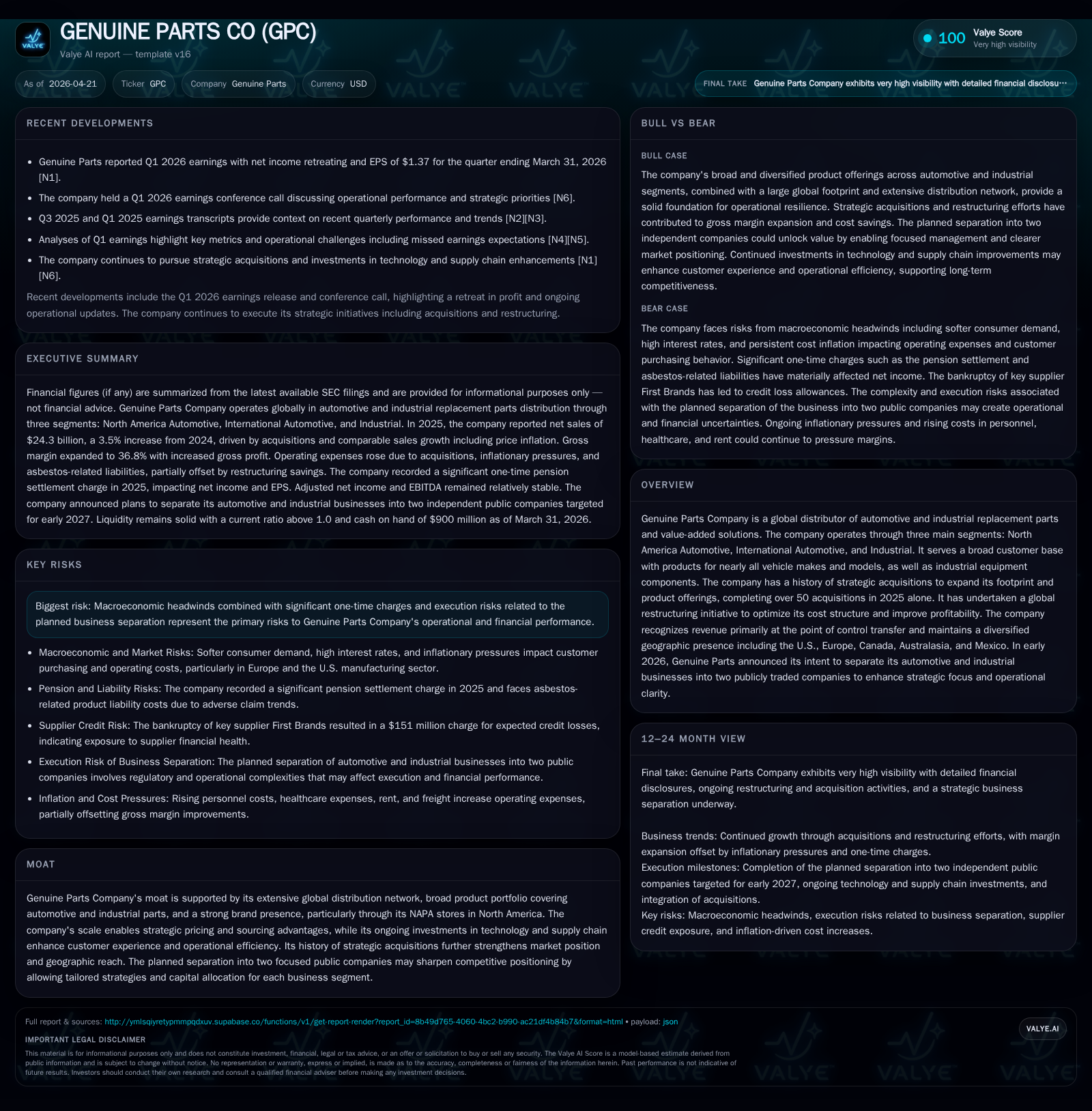
Genuine Parts Company’s latest quarterly filing shows top-line resilience albeit with margin compression driven by inflationary pressures and one-time charges. The company’s business model, anchored in automotive and industrial parts distribution, is navigating softer demand conditions particularly in Europe and industrial sectors. Its competitive moat stems from a vast global distribution network and strategic acquisitions. Growth is constrained by macroeconomic headwinds and execution risks related to its planned separation into two public companies. Close attention should be paid to progress on the split, cost control initiatives, and acquisitions as drivers of future performance.
Recent Operating Update: Q1 2026 Earnings Review
Genuine Parts Company’s first-quarter 10-Q filing dated April 21, 2026 marks an inflection point characterized by muted top-line growth alongside margin pressures [S2]. Revenue growth was modestly positive yet offset by persistent cost inflation notably in wages, freight, and rent expenses. The company reported net income of $65.9 million for full-year 2025—a sharp decline of approximately 93% year-over-year—primarily attributable to non-recurring charges including a substantial $742 million pension settlement charge (recognized late 2025), bankruptcy-related credit loss reserves from First Brands Group suppliers, and heightened asbestos-related liability costs [S1]. While adjusted EBITDA remained largely flat between 2024 and 2025 at roughly $2 billion reflecting operational resilience post-adjustment [S25], underlying operating expenses expanded by nearly 9.4%, signaling cost structure under pressure even with benefits from global restructuring cost savings [S10].
This quarterly update underscores the company’s efforts to navigate a period marked by macroeconomic softness—especially in European markets—and a contractionary manufacturing environment in the U.S. industrial sector [S1]. The company reiterated its full-year outlook cautiously optimistic on modest revenue growth aided by margins expansion from pricing actions but contingent on effective cost controls and favorable capital allocation during these headwinds [S3]. The addition of more than 250 new locations globally through over 50 acquisitions in calendar year 2025 reveals Genuine Parts’ commitment to scale-based growth despite volatile end markets [S1]. Additionally, no new equity repurchase plans were announced during Q1 though limited share purchases took place primarily through employee tax withholding mechanics [S2].
Business Model: Diversified Distributor with Strategic Expansion
Genuine Parts derives revenue principally from wholesale distribution of replacement automotive parts across most vehicle makes within North America (largely through its iconic NAPA brand), supplemented by international automotive parts sales primarily in Europe, Canada, Australasia, and Mexico, as well as an industrial parts segment supplying machinery components like bearings, hydraulics, and power transmission equipment [S4]. The business model hinges on leveraging an expansive distribution network paired with a comprehensive product portfolio that serves both retail outlets (NAPA Auto Parts stores) and wholesale customers.
Revenue recognition occurs predominantly at the point of product transfer under customary terms generally not extending beyond one year [S14]. The company supplements product sales with ancillary services such as marketing support and training programs though these represent minor revenue contributions.
Strategic acquisitions are integral to Genuine Parts’ growth framework—increasing geographic reach and product assortment while reinforcing its competitive barriers via customer intimacy fostered through localized inventory availability [S1]. The recent acquisition of Benson Auto Parts broadens Canadian penetration particularly in Ontario/Quebec markets where diversified product offerings improve service levels [S1]. Historical data points to steady reinvestment into capital expenditures (~$470 million in 2025) directed at supply chain automation enhancements which bolster fulfillment efficiencies critical for competitive differentiation [S18].
Global restructuring initiatives launched in early 2024 aim to rationalize physical assets including consolidation of distribution centers and optimization of store footprints to reduce fixed costs while investing in technology platforms to modernize digital commerce capabilities—key for retail customer experience improvements [S10]. Nonetheless, these efforts contend with inflationary wage pressures, rising healthcare costs, lease renewals pushing rent higher, all inflating SG&A expenses as a percentage of sales [S10][S8].
Industry Structure & Competitive Positioning
The automotive aftermarket industry exhibits moderate fragmentation but rewards scale economies associated with volume purchasing power, extensive warehouse networks capable of rapid delivery turnaround times, brand recognition among retailers/consumers (particularly notable through Genuine Parts’ NAPA presence), plus technological investments supporting e-commerce ordering platforms.
Genuine Parts competes against broad lines of distributors such as AutoZone and Advance Auto Parts domestically alongside regional players internationally; industrial distribution rivals span from Grainger-type conglomerates to specialty local suppliers. Its competitive moat rests on decades-long brand equity coupled with its role as aggregator of independents which creates significant switching costs for smaller operators reliant on Genuine Parts’ credit facilities or supply guarantees . Furthermore, procurement synergies achieved through scale afford it advantageous vendor terms enabling favorable pricing strategies.[S8]
Acquisition velocity remains a key defensible contributor differentiating Genuine Parts—amply demonstrated by its executed transactions adding hundreds of new points of service across mature markets—thereby enhancing customer proximity—an important factor given customers’ preference for immediacy in auto part availability to minimize vehicle downtime.
However, the industry also faces structural challenges; OEM vehicle complexity evolution sometimes elongates repair cycles reducing frequency of smaller part replacements while new vehicle technologies can shift aftermarket dynamics potentially compressing legacy part demand over longer terms (not directly quantified here). Additionally, trade tariffs affecting imported automotive goods impose input cost volatility confirmed by mention of tariff-driven price inflation effects comprising roughly ~2% of comparable sales gains [S1].
Growth Drivers & Constraints
Key growth drivers include continued acquisition integration expanding footprint especially within independent repair shops aligned with NAPA access; gradual recovery or stabilization in core automotive replacement part demand influenced by miles driven trends; ongoing investments in supply chain automation improving delivery reliability; capped by potential expansion into adjacent industrial product categories benefiting from cross-selling opportunities across segments.
Contrastingly macroeconomic restraints loom large: persistent inflation hampers disposable income thereby curtailing consumer maintenance spend; high interest rates elevate financing costs for both Genuine Parts (increased interest expense) and its customer base (retailers relying on credit); economic softness in Europe impacts international automotive part sales as observed; manufacturing sector contraction depresses industrial segment revenues due to reduced equipment utilization or deferment of maintenance capital expenditure cycles [S1][N1].
Additionally notable are discrete legacy-cost risks including asbestos-related liabilities which increased reserve requirements by over $100 million in recent years representing a non-operating drag separate from core business fundamentals [S7][S16]. Supplier bankruptcy events such as First Brands filing Chapter 11 disrupt supply chains causing write-downs impacting cost of goods sold materially ($151 million charge recorded) signaling vendor concentration vulnerability requiring vigilant supplier diversification strategies going forward[S16][S25].
The forthcoming strategic separation planned for early 2027 further layers execution complexity. While management anticipates unlocking shareholder value through focused operating models tailored respectively toward global automotive versus industrial parts businesses ecosystems—which differ markedly regarding customer profiles, regulatory considerations, capital needs—it also introduces transitional costs alongside uncertainty around synergies or standalone operational efficiency gains initially [S15].
What To Watch Next
Investors and analysts should closely monitor quarterly reports for evidence that margin expansion efforts via cost controls outpace continuing inflationary pressures especially wage-related SG&A line items. Progress made against stated restructuring targets providing durable annualized savings will be key confirming the sustainability of cost transformation programs started in 2024.
The pace and effective integration of bolt-on acquisitions remain vital indicators shaping organic versus inorganic growth dynamics. Execution discipline surrounding the impending corporate split—targeting completion Q1 calendar year 2027—will be critical given associated risks around duplicated infrastructure overheads or potential disruptions to vendor & customer relationships.
Macroeconomic indicators particularly consumer confidence indices influencing automotive maintenance patterns plus PMI trends signaling industrial activity levels should be assessed to gauge revenue sector sensitivities impacting comparable store sales evolution across operating segments.
Shifts in pension obligation landscape post-settlement (eliminating U.S.-qualified defined benefit plan liabilities) warrant surveillance concerning future pension-related income volatility or cash flow implications.
Finally any developments relating to supplier concentration risks including additional distress within major vendors would be material given prior impact seen from First Brands’ bankruptcy resulting in credit losses.
Financial Profile & Performance Summary
Financially Genuine Parts reflects mixed performance shaped by extraordinary items:
- Net sales grew moderately by 3.5% in fiscal year 2025 driven primarily through acquisitions contributing about two-thirds of this lift while comparable sales increments remained subdued attributed partly to price inflation including tariffs accounting for ~2% increases[S1][S21].
- Gross margin improved slightly (+50bps YoY) reflecting strategic pricing tactics yet offset partially by increased inventory write-downs previously recorded[S10].
- Operating expenses escalated substantially mainly due to inflationary wage pressure (
7.6% rise YoY), asbestos claims increments ($103 million more accrued), acquisition-related spending increases (~$225 million), partly balanced by ~$175 million liquidity-enhancing global restructuring savings[S10].[F1] - EBITDA contracted sharply on GAAP basis (-55%) primarily reflecting $742 million pension settlement charge booked during Q4’25 materially distorting underlying earnings comparability whereas adjusted EBITDA held steady at ~$2 billion indicating normalized operating profitability[S25].[F1]
- Interest expense almost doubled ($164 million vs $97 million prior year) due to increased borrowings including commercial paper draws offsetting matured lower-interest debt[S9].[F1]
- Cash flow generated from operations declined ~29% YoY ($891 million vs $1.25 billion prior year) influenced by lower net earnings plus working capital timing variances albeit free cash flow remained positive near $421 million after capex outlays[S13][F1].
- Capital expenditures remained sizable at approximately $470 million driven towards supply chain & technology investment continuation yet down roughly -17% versus prior year's elevated base[F1][S18].
- Dividend payments rose slightly (~3%) maintaining company’s reputation for consistent shareholder returns with over six decades of consecutive dividend increases confirming strategic emphasis on capital return discipline[S13][F1].
- Share repurchases were paused amid current uncertain environment following aggressive buyback pursuance earlier years highlighting conservative capital stewardship[S27][F1].
- Total debt outstanding exceeded $4.8 billion as of Dec ’25 featuring diverse unsecured senior notes combined with commercial paper borrowings balanced against readily available revolving credit lines ensuring liquidity adequacy amid financial covenant compliance[S9][S23][F1].
- Debt maturity profile appears manageable though attention warranted on near-term amounts due within twelve months exceeding $1.29 billion necessitating refinancing sensitivity analysis during volatile market periods[S26].
Historical performance (annual)
| FY | Net ($mm) | CFO ($mm) | Capex ($mm) | Net YoY |
|---|---|---|---|---|
| 2025 | 66 | 891 | 470 | -92.7% |
| 2024 | 904 | 1251 | 567 | -31.3% |
| 2023 | 1317 | 1436 | 513 | +11.3% |
| 2022 | 1183 | 340 |
Source: SEC companyfacts cache [F1].
Capital returns and efficiency (annual)
| FY | Div ($mm) | Buybacks ($mm) | FCF ($mm) |
|---|---|---|---|
| 2025 | 564 | 0 | 421 |
| 2024 | 555 | 150 | 684 |
| 2023 | 527 | 261 | 923 |
| 2022 | 496 | 223 |
Source: SEC companyfacts cache [F1].
Despite near-term headwinds weighing on profitability metrics under GAAP measures attributable to non-operating or one-time items—the firm's operational fundamentals evidenced through stable adjusted EBITDA performance together with disciplined capital allocation merit attention as foundational elements shaping Genuine Parts’ path forward.[F1]
Disclaimer: This report provides an analytical overview based solely on publicly available SEC filings ([S#]), company transcripts ([N#]), and companyfacts data ([F1]). It does not constitute investment advice or recommendations regarding any securities offered by Genuine Parts Company or any other entity.
Disclaimer: This is research-only, informational analysis and not investment advice. It may include AI-generated interpretation and general industry context. Always verify important details using primary sources.

Comments