
PreAxia Advances Digital Health Payment Ecosystem with Ambitious AI-Driven Financial Tools
PreAxia's latest quarterly filing illuminates its efforts to blend health spending account management with AI-powered fintech innovation amid capital and execution challenges.
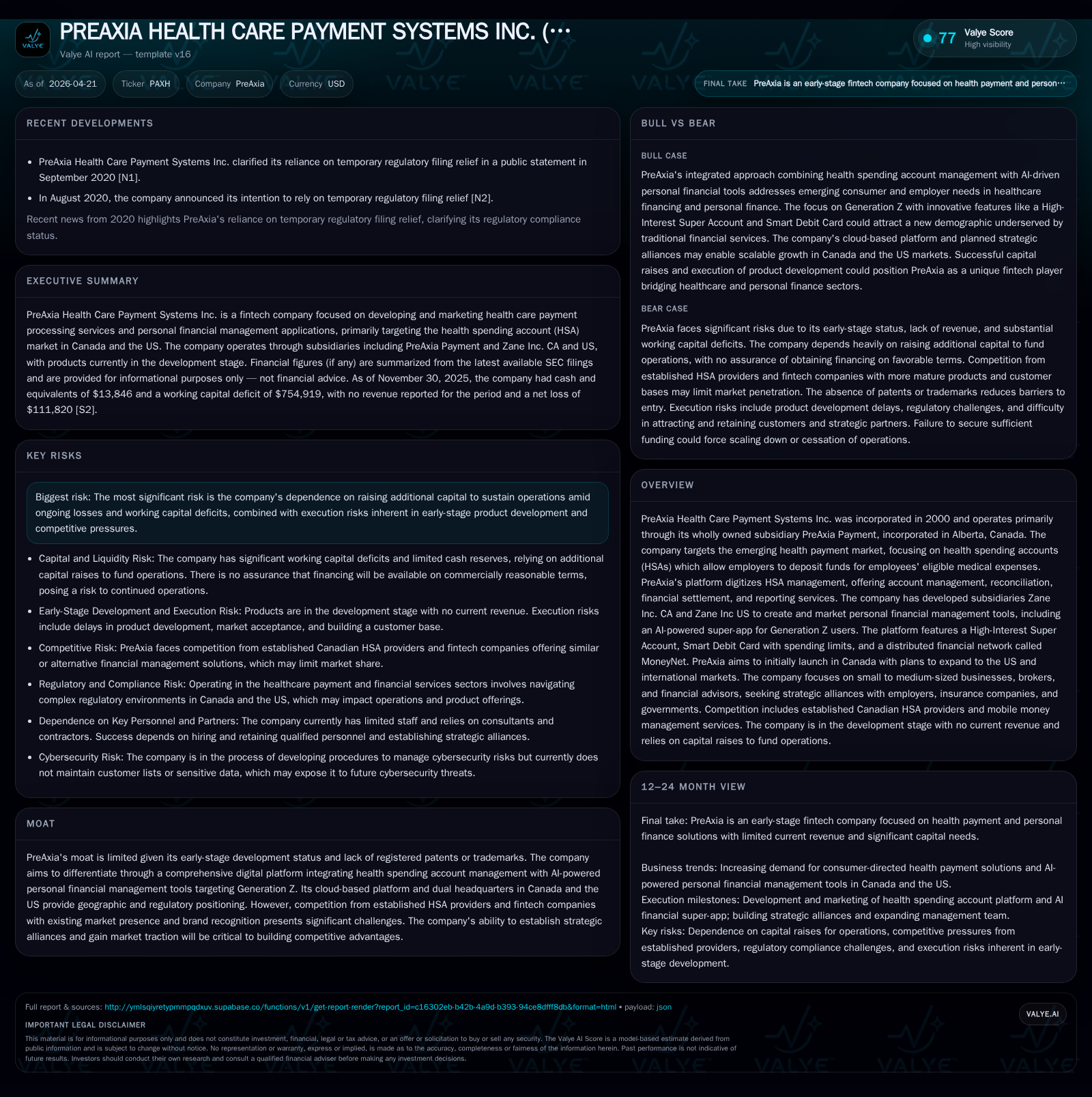
The April 2026 10-Q reveals PreAxia’s strategic momentum in deploying a digital platform for health spending accounts (HSAs) alongside AI-driven personal finance tools targeting Generation Z. Despite operating losses and persistent working capital deficits, the company is advancing its dual-market approach with subsidiaries in Canada and the US while focusing on strategic alliances in healthcare and finance. Competitive pressures and regulatory complexities impose significant execution risks, making capital raising and partnership formations critical near-term milestones. The company’s growth hinges on capturing expanding HSA demand driven by healthcare cost inflation and consumer preferences for self-directed health payments.
Latest Quarterly Developments Reveal Strategic Momentum and Persistent Capital Needs
PreAxia’s latest quarterly filing dated April 21, 2026 ([S2]) reaffirms the company’s mission to capitalize on the rapid shift towards self-directed health spending accounts (HSAs), which are gaining traction as a preferred vehicle for managing escalating healthcare expenses. This quarter’s MD&A emphasizes broad trends reshaping the boundaries between healthcare and financial services, highlighting that insurance and benefit firms are betting heavily on HSAs becoming a major growth conduit. The filing underscores that these market shifts align well with PreAxia's digital-first platform ambitions.
Notably, PreAxia reported a modest increase in liquidity since May 2025—from effectively zero cash to $13,846 as of November 30, 2025 ([S4]). Meanwhile, its working capital deficit shrank significantly from ($2.34 million) to approximately ($755k), primarily due to debt conversions and stock issuances ([S8]). However, this still reflects a precarious positioning with limited operational runway absent additional funding. The company projects needing roughly $1 million over the coming twelve months to cover creditor obligations (~$300k) plus product development expenditures ([S4]).
An important governance milestone appeared via a Form 8-K filed concurrently ([S3]), disclosing discovery of material errors related to prior stock award valuations requiring restatements—a sign of organizational maturing despite early-stage operational risks.
These filings collectively signal that PreAxia is progressing methodically towards deploying its core platform but remains dependent on successive capital raises to fund momentum. The marketplace opportunity is robust but timing and execution are critical.
PreAxia’s Business Model: Digitizing Health Spending Accounts with Integrated AI Finance
PreAxia operates primarily through its wholly owned Alberta-incorporated subsidiary, PreAxia Payment ([S1],[S11]). Its core offering consists of a cloud-based technology platform that digitizes management of HSAs—employer-funded accounts dedicated exclusively to paying eligible medical expenses for employees. The platform handles key functions including cardholder account management, transaction reconciliation, financial settlement processes, and comprehensive reporting.
On the innovation front, PreAxia has spun off Zane Inc units in Canada and the US targeting the burgeoning Generation Z cohort with an AI-powered personal finance super-app ([S11]). This app offers three flagship innovations: a High-Interest Super Account (HISA) delivering ~10% APY returns while maintaining liquidity; a Smart Debit Card imposing predictive budget-based daily spending caps; and MoneyNet — a distributed financial network monitoring multiple institutions' accounts to orchestrate fund flows optimally.
This dual B2B/B2C model attempts to address both ends of the health payment ecosystem: employers seeking efficient benefit delivery solutions via HSAs, and young consumers demanding seamless AI-assisted wallet management. Integration of these tools represents an ambitious strategy to transcend traditional segmented solutions such as standalone budgeting or simplistic debit cards.
Moreover, PreAxia emphasizes channel strategies encompassing brokers, financial advisors, small-to-medium enterprises (SMEs), insurers, and governments — all aimed at scaling transaction volume necessary for achieving profitable economics ([S22],[S23]).
Competitive Terrain: Early-Stage Niche Amid Fintech, Insurance, and Healthcare Convergence
The competitive environment for PreAxia is multifaceted: it faces established health spending account providers like Benecaid and Olympia Benefits in Canada known for broker-supported distribution models and cost-plus pricing structures ([S23]). Additionally, fintech entrants offer overlapping personal finance tools though often lacking integrated healthcare payment capabilities.
The company concedes that its moat remains limited due to lack of registered patents or exclusive trademarks (). In an industry converging insurance underwriting complexity with real-time fintech agility under stringent regulations, differentiation hinges more on execution efficiency and strategic partnerships than technological barriers.
Regulatory nuances spanning US-Canada cross-border operations introduce compliance challenges complicating scale-up. PreAxia aims to build competitive advantage through deep integration between health payment processing infrastructure and AI-driven personal finance tools combined with targeted channel partnerships rather than pursuing mass-market commoditized HSA offerings (,[S23]).
In this evolving landscape, the ability to forge alliances with banks, insurers, governments—and vertically integrate services—is paramount. Execution missteps or failure to secure critical partners could result in rapid margin erosion given entrenched competitors’ scale advantage.
Growth Prospects: Capitalizing on HSA Market Expansion and Digital Consumer Engagement
Growth drivers for PreAxia rest largely on structural trends reshaping healthcare financing. In the US alone, HSAs held assets totaling approximately $123 billion by 2023 representing an annual growth rate exceeding 18% ([S1],). This mirrors burgeoning adoption in Canada’s group insurance market seeking innovative benefit designs enabling employers enhanced cost control paired with employee empowerment.
Simultaneously, digital-native demographics require compelling AI-enabled financial guidance platforms rather than legacy budgeting apps—creating an opening for Zane’s super-app aimed particularly at Generation Z consumers ([S11]).
Yet actualizing these opportunities is contingent upon timely expansion into Canadian markets initially with subsequent US rollout planned following platform maturation ([S1],[S11]). Moreover, scaling requires overcoming capital constraints that could throttle deployment velocity.
If successfully executed, embedding AI advisors that automate budgeting coupled with novel product features such as high-yield super accounts promise meaningful user engagement improvements translating into deeper network effects.
Risks and Constraints: Execution Challenges, Capital Requirement, and Market Adoption
PreAxia’s filings conspicuously highlight substantial risks reflecting its nascent stage. Foremost is reliance on external financing given ongoing monthly operating losses (~$150k annually) coupled with working capital deficits placing sustainability in question without fresh funds ([F1],[S2],[S4]). Management candidly admits substantial uncertainty around raising equity or loan proceeds on commercially reasonable terms ([S1],[S4]).
The complexity of developing fully integrated platforms spanning regulated healthcare payments plus fintech services introduces significant execution risk including timely product completion plus rigorous compliance adherence (,[S2],[S26]). Equally critical is attracting qualified senior leadership talent across sales, engineering and regulatory affairs domains outlined as pressing priorities ([S1],[S11],[S25]).
Market acceptance challenges stem from intense competition from incumbents holding entrenched employer relationships plus growing consumer expectation volatility where superior user experience may be table stakes but brand trust remains critical.
Investors must weigh potential dilution effects from anticipated equity raises alongside scalability uncertainty until meaningful revenue generation commences.
Upcoming Catalysts: Product Launches, Strategic Partnerships, and Funding Milestones
Key execution milestones maintain high investor focus:
- Initiation of commercial launch in Canadian markets leveraging broker networks targeting SMEs expected within FY2026 horizon ([S1],[S11]);
- Expansion into United States markets via Zane Inc US following testing phase completion to capture broader Generation Z wallet share ( [S11]);
- Formation of strategic alliances encompassing banking institutions for deposit placement products alongside insurance companies for integrated benefit offerings ([S1],[S25]);
- Recruiting senior leadership hires across sales administration engineering designed to accelerate adoption curves alongside regulatory navigation capacity ([S25]);
- Undertaking private placements or debt draws projecting capital needs around $1 million+ over next twelve months essential for sustaining operations without disruption or downsizing ([S4],[S25]).
Successful attainment of these milestones will be bellwethers validating operational scalability versus potential execution hurdles delaying growth trajectories.
Financial Snapshot: Liquidity Drilldown Highlights Operational Burn and Capital Gaps
PreAxia’s financial profile remains emblematic of an early-stage fintech developing complex software-intensive products without yet generating revenue internally ([F1]). Its fiscal year ending May 31, 2025 shows:
- Revenue: $0;
- Operating income: -$152k;
- Net income: -$82k;
- Operating cash flow: -$41k;
- Cash & equivalents at Nov 30 2025: approximately $14k;
- Current liabilities strikingly outweigh current assets leading to a razor-thin current ratio near 0.02 reflecting liquidity constraints ([F1],[S4],[S8]).
The consistent operating losses coupled with sizeable negative equity positions (~$2.34 million working capital deficit May 2025) underscore urgent need for sustained financing inflows geared primarily towards technology development costs heavily skewed toward software capitalization among other administrative overheads ([F1],[S9],[S16]).
Capital structure remains focused on equity issuance augmented by loans from related parties; margins remain deeply negative reflective of a start-up burn model heavily weighted on R&D investment activating future revenue potential but emphasizing significant going concern risks absent new funding sources ([F1],[S24]).
Historical performance (annual)
| FY | Rev | Net ($) | CFO ($) | OpInc ($) | Rev YoY | Net YoY |
|---|---|---|---|---|---|---|
| 2026 | ||||||
| 2025 | 0 | -82010 | -41516 | -152124 | +17.5% | |
| 2024 | 0 | -99449 | -30888 | -99449 | +36.4% | |
| 2023 | 0 | -156266 | -37617 | -156266 | -100.0% | +13.5% |
Source: SEC companyfacts cache [F1].
Capital returns and efficiency (annual)
| FY | ROE% |
|---|---|
| 2026 | |
| 2025 | 3.5 |
| 2024 | 4.2 |
| 2023 | 6.8 |
Source: SEC companyfacts cache [F1].
While losses are expected during product ramp-up periods common in fintech-healthcare intersections, the magnitude mandates attentive monitoring of financing progress relative to scaling plans.
This analysis aims to provide an informed perspective based strictly on reported data without offering investment advice or recommendations. The early-stage nature of PreAxia's operations involves material uncertainties typical of emerging fintech companies bridging regulated healthcare payments with innovative AI-driven personal finance technologies.
Disclaimer: This is research-only, informational analysis and not investment advice. It may include AI-generated interpretation and general industry context. Always verify important details using primary sources.

Comments