
Cleveland-Cliffs Inc. Confronts Margins and Market Volatility in Q1 2026
Q1 2026 results reveal continued margin pressure despite volume gains, highlighting cyclical demand challenges in steel markets.
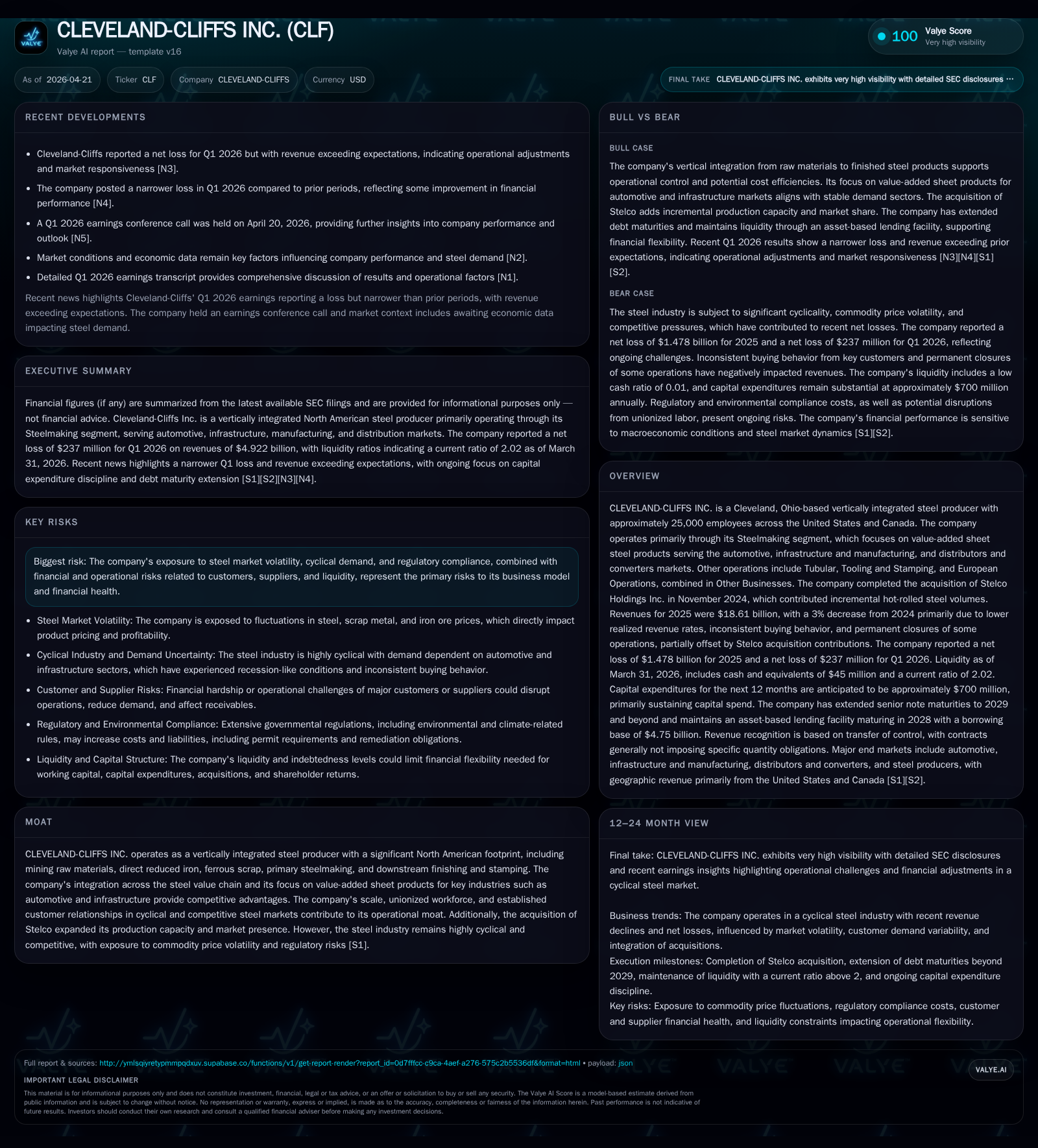
Cleveland-Cliffs reported a Q1 2026 operating loss amid declining realized pricing despite incremental volume contributions from its Stelco acquisition. The vertically integrated producer’s business model centers on value-added sheet steel for automotive and infrastructure sectors, underpinned by tariff protections and multi-year contracts with OEMs. While capacity expansions and government trade policies support growth, persistent demand cyclicality, pricing volatility, and regulatory risks constrain profitability. Financial metrics show narrowing losses but sustained negative operating cash flows, emphasizing the importance of execution on cost controls and demand recovery signals going forward.
Q1 2026 Operating Update: Margin Pressures Persist Despite Volume Growth
In the first quarter of 2026, Cleveland-Cliffs’ operating results reflected the steel industry’s enduring cyclicality and margin compression pressures. The company reported higher shipment volumes partly attributable to the added hot-rolled coil (HRC) capacity brought by the Stelco acquisition closing late in 2024. However, despite these volume gains, revenue increase was primarily offset by lower realized selling prices across key steel products leading to significant margin erosion [S2], [N2]. The quarter ended with continued net losses as the company grappled with inconsistent end-user buying patterns amid recession-like conditions noted in major end markets such as automotive manufacturing [N1], [S3]. Permanent idling of some plants aimed at footprint optimization also tempered output gains.
Notably, domestic HRC prices softened from their recent highs due to subdued demand even as tariffs maintained protections from import competition [S2], [N2]. This dynamic led to shrinking spreads between unit costs and selling prices, compressing EBITDA margins which had already been pressured in prior periods [F1]. Management commentary emphasized tight focus on cost discipline alongside targeted operational improvements including commissioning of a new bright anneal line at its Coshocton facility intended to enhance downstream product quality and competitiveness [S3], [S1].
Business Model and Vertical Integration: Steelmaking Focus and Value-Added Products
Cleveland-Cliffs operates as one of North America's largest vertically integrated steel producers with an extensive value chain encompassing raw material mining (iron ore), direct reduced iron (DRI) production, scrap processing, primary steelmaking via electric arc furnaces (EAF), and downstream processing including finishing, tooling, stamping, and tubular products [S1]. This integration theoretically supports cost efficiencies, inventory control benefits, and input price risk mitigation through internal sourcing.
The company’s Steelmaking segment dominates operations contributing over $17 billion in revenues annually with products chiefly comprising value-added sheet steel types such as hot-rolled, cold-rolled coated steels tailored for automotive OEMs, infrastructure projects, manufacturing suppliers, distributors and converters [S10], [S20]. Other Businesses encompass tubular products, tooling & stamping divisions that provide carbon & stainless tubing alongside complex steel components.
By focusing on value-added sheet steels rather than commodity-grade coils or plates alone, Cleveland-Cliffs aligns its product mix with relatively higher-margin applications requiring technical precision — notably automotive body panels where strict surface finish and dimensional tolerances command premium pricing [S20], [S22]. Its upstream-to-downstream control allows strategic collaborations such as the recent production trial stamping automotive-grade exposed parts leveraging existing aluminum forming equipment — a proof point of product quality advancement designed to deepen OEM ties [S1].
Competitive Positioning within North American Steel Industry
Post-Stelco acquisition expansion has solidified Cleveland-Cliffs’ scale advantages particularly by boosting Canadian market exposure where tariffs on dumped imports have started improving margins for domestic players like Stelco [S1], [N2]. The vertical integration combined with multi-year fixed price contracts lock in substantial volumes with major auto manufacturers mitigating spot market volatility risks in some measure.
Tariffs imposed since early 2025—50% on imported steel from several countries—have been instrumental in limiting downward pressure from unfairly priced foreign producers typically subsidized or subject to lax environmental standards abroad [S1]. This trade protection has allowed domestic producers like Cleveland-Cliffs greater pricing power than many global competitors facing excess capacity.
However, unionized labor forces representing over 90% of hourly workers at Cleveland-Cliffs contribute to higher fixed labor costs reducing operational flexibility during downturns relative to non-union rivals overseas or mini-mills employing predominantly non-union workers [S24]. The company balances this constraint against strong customer retention stemming from trusted delivery schedules and established quality reputations.
Growth Drivers: Tariffs, Capacity Expansion, and Automotive Partnerships
Governmental tariffs remain a critical growth enabler by restricting low-cost imports thus supporting domestic steel prices crucial for Cleveland-Cliffs’ profitability trajectory. Recent commissioning of advanced process lines such as the Coshocton bright anneal line enhances product differentiation through superior surface finishes that appeal strongly to automotive clients seeking high-quality exposed body parts capable of substituting aluminum without costly retooling [S1].
Partnership discussions embodied by a Memorandum of Understanding signed with POSCO signal potential for knowledge exchange or joint ventures leveraging Cliffs’ North American footprint combined with POSCO’s global scale advantages [S1]. Such alliances could accelerate innovation deployment or introduce new markets.
The company's multi-year fixed-price contracts bolster revenue visibility amidst cyclical demand swings while embedding long-term relationships within automotive supply chains—a sector historically representing ~30%+ of Cliffs’ Steelmaking sales—thereby anchoring demand stability during uneven macroeconomic cycles [S10], [N1].
Manufacturing on-shoring trends incentivized by recent U.S. legislation further augur incremental base-layer growth opportunities if realized fully given Cliffs’ centrality to both automotive metals supply and broader infrastructure programs highlighted by governmental spending plans [S1].
Constraints: Cyclicality, Pricing Volatility, and Regulatory Risks
Despite positive frameworks supporting pricing integrity like tariffs and supply agreements, Cleveland-Cliffs remains inherently exposed to cyclical swings characteristic of global steel demand especially manifested through light vehicle production declines affecting direct automotive sales volumes negatively year-on-year recently [S1], [N2].
Raw material cost volatility notably in natural gas (used heavily in DRI processes), electricity rates impacting EAF operations coupled with fluctuating iron ore prices impose recurrent margin pressures propagating cost unpredictability downstream into finished product pricing dynamics challenging contract renegotiations or spot market sales expositions [S9], [S18].
Environmental regulations continue adding incremental CAPEX obligations related to emissions controls potentially reducing return on invested capital while unionized labor agreements limit immediate workforce adaptability curbing cost-cutting speed during downturn phases relative to more flexible competitors globally [S14], [S18].
Furthermore, expiring slab supply contracts post-2025 present uncertainty risks mandating successful renegotiation or alternative sourcing strategies to maintain steady semi-finished input availability necessary for downstream finishing operations especially outside core sheet markets requiring specialized metallurgical attributes.
Looking Ahead: Milestones, Demand Signals, and Execution Risks
Upcoming quarterly earnings reports will be key monitoring points for signs of margin recovery or stabilization following Q1’s disappointing breadth underscoring how well operating efficiencies such as footprint rationalizations and new annealing lines mitigate raw material inflation against soft selling prices [S2], [N3]. The absence so far of renewed slab supply contracts after December 2025 requires watchful scrutiny given its downstream impact.
End-market signals like recovering North American light vehicle production volumes beyond current sub-par levels (~15.3 million units in 2025 vs. historical pre-COVID average near 17 million units) will be pivotal for revenue growth trajectories given automotive OEM reliance on Cliffs’ finished goods bundles [S1], [N1]. Domestic infrastructure project commencements signaling increased public-sector steel consumption can also offset volatility inherent in private sector cyclical trends.
Progress executing strategic partnerships (e.g., initial outcomes from POSCO alliance), further tariff policy developments influencing import dynamics amid evolving geopolitical landscape as well as environmental regulatory compliance costs will collectively shape near-to-medium term fundamental sustainability.
Financial Overview: Profitability Challenges and Liquidity Status
Historical performance (annual)
| FY | Rev ($bn) | Net ($mm) | CFO ($bn) | OpInc ($mm) | Rev YoY | Net YoY |
|---|---|---|---|---|---|---|
| 2025 | 18.6 | -1478 | -0.5 | -1579 | -3.0% | -96.0% |
| 2024 | 19.2 | -754 | 0.1 | -756 | -12.8% | -289.0% |
| 2023 | 22.0 | 399 | 2.3 | 677 | -4.3% | -70.1% |
| 2022 | 23.0 | 1335 | 2.4 | 1939 |
Source: SEC companyfacts cache [F1].
Capital returns and efficiency (annual)
| FY | Buybacks ($mm) | FCF ($mm) | ROE% |
|---|---|---|---|
| 2025 | 0 | -1023 | -24.2 |
| 2024 | 733 | -590 | -11.3 |
| 2023 | 152 | 1621 | 5.1 |
| 2022 | 240 | 1480 | 17.1 |
Source: SEC companyfacts cache [F1].
Cleveland-Cliffs reported $18.61 billion in revenue for fiscal 2025—a decline of approximately 3% year-over-year—from $19.19 billion in 2024 largely due to lower realized pricing compounded by permanent operational closures partially offset by incremental contribution from Stelco acquisition volume additions [F1]. Operating income deepened its loss position from -$756 million in 2024 to -$1.58 billion in 2025 reflecting margin deterioration under demand softness.
Net income followed suit moving into a $1.48 billion loss territory mirrored by negative operating cash flows totaling -$462 million evidencing ongoing profitability challenges exacerbated by working capital dynamics amid volatile sales patterns constrained capital expenditures fell nearly 20% YoY to $561 million indicating disciplined investment focused on sustaining capital rather than growth projects currently [F1].
Liquidity remains adequate with current assets exceeding liabilities yielding a current ratio above 2x sustaining short-term solvency buffers; access to credit facilities totaling billions provides financial flexibility though elevated debt levels circa $7+ billion necessitate prudent capital management aligned with cyclical earnings volatility inherent in steel markets [F1], [S26].
This financial profile underlines the imperative for Cleveland-Cliffs to successfully execute costs controls while capturing nascent volume recoveries driven by tariff-supported pricing structures plus enhanced industrial partnerships if it aims at returning toward sustainable profitability margins amid continuing macroeconomic uncertainties.
This analysis is based solely on publicly available information as of April 21, 2026 and does not constitute investment advice or recommendation.
Disclaimer: This is research-only, informational analysis and not investment advice. It may include AI-generated interpretation and general industry context. Always verify important details using primary sources.

Comments