
International General Insurance Holdings Boosts Capital Returns as Loss Ratios Tighten
IGIC’s March 2026 quarter reveals rising catastrophe losses have pressured underwriting margins even as the company doubled down on capital returns with an extraordinary dividend.
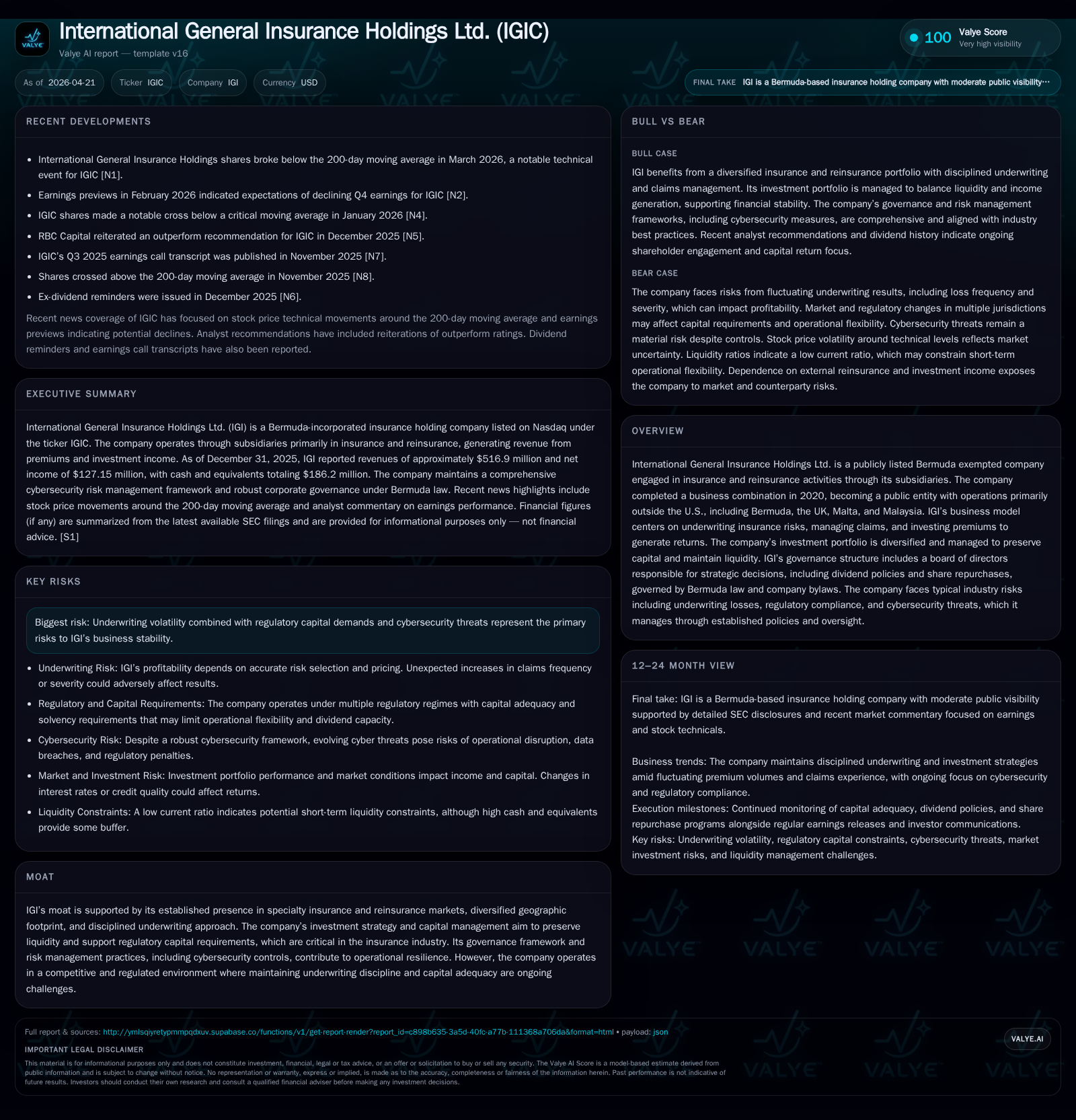
International General Insurance Holdings Ltd. (IGIC) reported a noticeable uptick in its loss ratio for 2025 primarily driven by elevated catastrophe losses from events such as Taiwan earthquakes and California wildfires, as detailed in its latest 20-F and quarterly disclosures. Despite underwriting margin pressures, IGIC declared an extraordinary $1.15 per share dividend in early 2026, signaling confidence in capital adequacy and disciplined deployment. The company’s specialty underwriting focus combined with a geographically diversified footprint across Bermuda, UK, Malta, and Malaysia underpins its competitive moat amid regulatory complexity. Key risks around catastrophe volatility and regulatory solvency remain, while growth hinges on expanding specialty segments and maintaining underwriting discipline.
Latest Quarterly Results Spotlight Loss Ratio Pressure and Capital Actions
IGIC’s most recent quarterly filings dated March 18, 2026 [S2] confirm ongoing elevated catastrophe losses contributing to a loss ratio increase to 47.6% for full-year 2025 from 44.7% for 2024 per its annual 20-F [S1]. Notable events driving these losses included the Taiwan earthquakes ($9.9M net incurred), Hurricane Melissa ($8.9M), California wildfires ($8.5M), and other weather-related catastrophes totaling over $59 million net incurred in 2025 alone. These episodic events heightened current accident year losses, partially offset by less favorable prior year reserve development compared to prior periods.
Despite these headwinds on underwriting profitability, IGIC surprised markets by declaring an extraordinary $1.15 per share cash dividend in February 2026 [S3]. This bold capital return underscores management’s confidence in maintaining capital adequacy amidst loss ratio pressure by balancing prudent risk selection with active capital deployment initiatives including ongoing share repurchases (see later section).
Business Model: Specialty Underwriting and Investment Income Synergies
International General Insurance Holdings operates primarily through subsidiaries issuing specialty insurance and reinsurance products outside the U.S., focusing on risk niches where expertise allows disciplined underwriting profitability [S1]. Core revenue arises from premiums earned on these specialized lines combined with investment income generated from a well-diversified fixed income-heavy portfolio designed to preserve liquidity and support regulatory capital requirements [S6],[S23].
IGIC employs tight underwriting controls evident via stable loss reserve practices, privileging quality over volume growth to sustain double-digit return targets despite volatile catastrophe exposures [S1]. This strategy creates a durable moat by limiting exposure to commoditized mass-market risks while leveraging detailed local market knowledge across Bermuda, the UK, Malta, and Malaysia.
Competitive Context: Geographic Diversification and Regulatory Complexity
IGIC’s operational footprint spans several key insurance hubs — Bermuda (its jurisdiction of incorporation), the UK (under FCA/PRA supervision), Malta (regulated by MFSA), and Malaysia — delivering geographic diversification that mitigates region-specific concentration risk [S1],. However, this multi-jurisdictional presence imposes complex regulatory capital requirements tightly monitored under frameworks such as Solvency II equivalent regimes with Solvency Capital Ratios (SCR) comfortably above minimums (e.g., IGI Europe exceeded SCR requirements by over 80% in 2025) [S23].
This environment limits overly aggressive underwriting as regulatory bodies demand robust capital buffers against adverse loss scenarios including catastrophe peaks — shaping product pricing power but restraining leverage for growth or margin expansion [S1],. Cybersecurity compliance is another emerging governance area impacting operational resilience given rising risks from sophisticated threats [S12],[S13],[S24].
Growth Drivers: Expanding Specialty Segments and Disciplined Risk Selection
Specialty lines continue to grow structurally given their relevance to complex commercial risks often underserved by commoditized insurers. IGIC’s niche expertise positions it well to gain market share in these segments where pricing improvement cycles can be harnessed through stringent risk selection ,[S1].
Furthermore, IGIC pursues selective geographic expansion within existing regulated jurisdictions leveraging its established distribution networks. The company’s adherence to underwriting discipline—demonstrated by conservative reserving and avoidance of rate-cutting—bolsters earnings quality over time even amid fluctuating loss environments [S1].
Constraints: Catastrophe Volatility and Regulatory Capital Demands
Catastrophe loss volatility remains a primary constraint causing periodic surges in loss ratios as observed over recent years given unpredictable natural disaster frequency/severity (Taiwan earthquakes, California wildfires) [S1]. Such shocks force reserve additions which compress near-term earnings despite eventual recoveries.
Additionally, escalating regulatory capital demands require maintaining strong solvency margins which limit operating leverage or excessive capital return without risking compliance breaches [S23]. These pressures curtail the scope for aggressive premium growth or loosening of underwriting standards that might boost top-line but endanger longer-term financial stability.
Capital Allocation Focus: Dividend Strategies and Share Repurchase Trends
IGIC has demonstrated an increasingly shareholder-friendly capital return policy combining regular dividends with opportunistic buybacks [S4],[S5],[F1]. Dividend payments have increased steadily from minimal distributions pre-2023 to a peak payout of $0.875/share declared in March 2025 followed by several small quarterly dividends reflecting growing free cash flow generation.
The February 2026 announcement of a substantial $1.15/share extraordinary dividend [S3] highlights management’s intent to deploy excess capital aggressively even amid margin uncertainty — signaling confidence backed by solid equity base of over $710 million at end-2025 [F1]. Share repurchases have also accelerated in volume throughout 2025 reaching nearly $62 million spent on buybacks that year alone [F1], further enhancing per-share metrics.
Governance aligns to maintain balance between rewarding shareholders and preserving statutory solvency buffers mandated across multiple jurisdictions [S17],[S18]. Buyback flexibility is supported under Bermuda law allowing treasury shares or cancellations without affecting authorized capital stock levels.
What to Watch Next: Loss Development, Capital Adequacy, and Market Signals
Key near-term indicators warrant monitoring include:
- Development of loss reserves: whether prior accident years’ reserves see further favorable or adverse adjustments impacting earnings stability beyond reported increases in catastrophe claims [S1].
- Regulatory solvency ratios especially following stress testing exercises or updated Basel/Solvency II guidance influencing permissible leverage or dividend capacity.
- Renewal pricing trends in specialty lines signaling shifts in competitive dynamics or broader market conditions influencing underwriting margins.
- Execution on growth strategies within existing geographies or possible expansions into complementary territories.
- Market technical cues such as stock price break below the important 200-day moving average recently noted on Nasdaq which may reflect changing investor sentiment toward risk profiles for specialty insurers like IGIC [N1].
Supporting Financial Overview: Earnings Quality, Cash Flow, and Returns
Historical performance (annual)
| FY | Rev ($mm) | Net ($mm) | CFO ($mm) | Rev YoY | Net YoY |
|---|---|---|---|---|---|
| 2025 | 517 | 127 | 108 | -4.1% | -5.9% |
| 2024 | 539 | 135 | 209 | +14.2% | +14.3% |
| 2023 | 472 | 118 | 197 |
Source: SEC companyfacts cache [F1].
Capital returns and efficiency (annual)
| FY | Div ($mm) | Buybacks ($mm) | ROE% |
|---|---|---|---|
| 2025 | 46 | 62 | 17.9 |
| 2024 | 27 | 23 | 20.6 |
| 2023 | 2 | 31 | 21.9 |
Source: SEC companyfacts cache [F1]. *ROE calculated using net income/average equity approx.
Despite a modest revenue decline (-4.1% YoY), net income remained relatively stable reflecting prudent expense management though operating cash flow softened significantly (-48% YoY) likely impacted by elevated claim payments timing differences or reserve build changes [F1]. Nonetheless free cash flow remains sufficient to support enhanced dividends and buybacks without compromising liquidity which totaled approximately $186 million at year-end along with high-quality fixed income portfolio exceeding $1 billion ensuring robust capital base consistent with stated strategic goals [F1],[S6],[S23].
This analysis synthesizes data as of April 21, 2026 from International General Insurance Holdings Ltd.’s recent SEC filings including the March quarterly Form 6-K reports (Feb & Mar filings), latest annual Form 20-F filings, accompanying press releases, plus related financial statement data from Companyfacts caches without speculative projections or investment advice.
Disclaimer: This is research-only, informational analysis and not investment advice. It may include AI-generated interpretation and general industry context. Always verify important details using primary sources.

Comments