
Guardforce AI Expands AI Revenue Through MGAI Acquisition Amid Stable Secured Logistics Foundation
Guardforce AI reported modest revenue growth in 2025 driven by secured logistics and early-stage AI & Robotics commercialization, highlighting strategic diversification efforts.
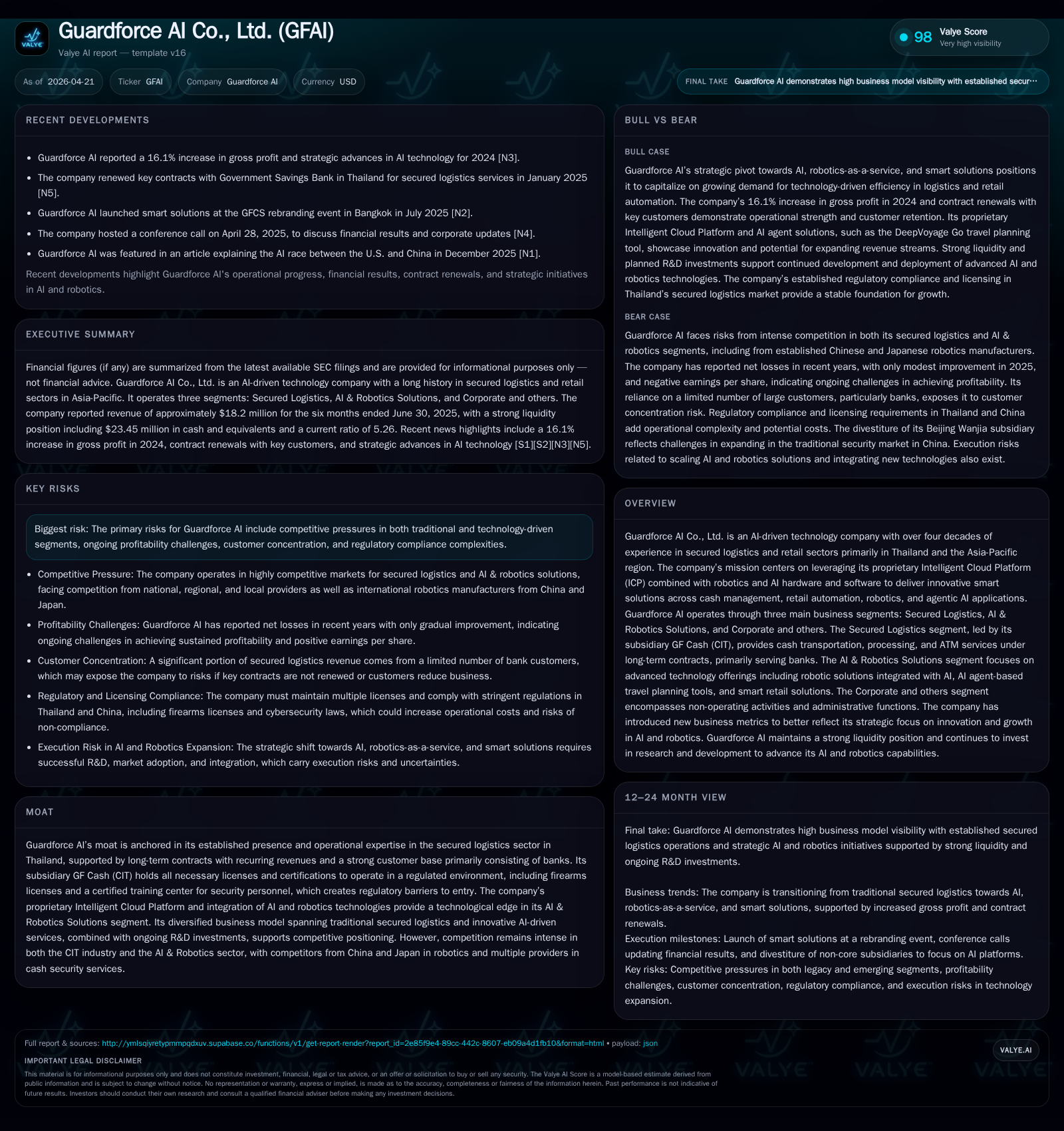
In its latest quarter ending December 31, 2025, Guardforce AI Co., Ltd. demonstrated steady operational performance anchored by its secured logistics segment. The company marked a 7.5% increase in gross profit and a 42.1% revenue jump in its AI & Robotics solutions business compared to 2024, reflecting progress in its diversification strategy. A major development was the March 2026 acquisition of MGAI Limited, which expands Guardforce’s footprint into AI agent platform verticals for Asian markets. Despite competition and regulatory challenges, the company’s blend of long-term cash-in-transit contracts and evolving AI-powered offerings positions it for measured growth. Financially, Guardforce maintains a strong liquidity position, although profitability remains constrained by increasing administrative expenses.
Recent Operating Update
Guardforce AI Co., Ltd.'s fiscal year ended December 31, 2025, saw a continuation of its strategic focus on its core secured logistics operations complemented by emerging growth in its AI & Robotics segment [S2]. The company reported revenues of approximately $35.2 million with a stabilizing gross profit margin near 15%. Notably, the AI & Robotics sector recorded a significant 42.1% year-over-year increase to nearly $283,000—a promising sign as the business crosses initial commercialization thresholds.
A material highlight in early 2026 was the completion of a strategic acquisition: MGAI Limited [S3]. This Hong Kong-based entity brings proprietary agentic AI platforms targeting enhanced vertical integration across Asian markets. The deal includes issuance of restricted shares alongside cash payment totaling about $300,000 upfront—signaling Guardforce’s commitment to expand beyond its traditional cash-in-transit roots.
Business Model
Guardforce's revenue generation hinges primarily on three segments:
Secured Logistics: Delivered through its main subsidiary GF Cash (CIT) operating extensively in Thailand’s cash handling ecosystem. This segment provides cash transportation, processing, ATM servicing under three-year contracts typically renewable annually [S11]. These agreements afford predictable and recurring revenues—97.7% recurring as of FY2025—with banks accounting for about 55% of income at this core business unit [S9]. The segment benefits from regulatory protections including specialized firearms licenses and a certified training center fostering operational stability [S1].
AI & Robotics Solutions: A newer venture focusing on integrating advanced robotic hardware with proprietary Intelligent Cloud Platform capabilities alongside AI agents specializing in trip planning (DeepVoyage Go), retail automation solutions, and smart robotics (Wishnote). Though modest in overall revenue contribution currently (~0.8% of total revenue), it demonstrated robust growth stemming from post-pandemic demand shifts and technological innovation investments [S11][S16].
Corporate and Others: Encompasses headquarter functions and administrative overheads including public company costs.
Industry Structure and Competitive Position
The secured logistics space remains intensely competitive within Thailand's regulated environment where barriers such as firearm possession licenses enforce operational exclusivity [S1][S15]. Guardforce leverages deep-rooted client relationships—especially within banking—and regulatory compliance to maintain an entrenched position.
Simultaneously, the AI & Robotics domain is fragmented without a clear market leader but marked by aggressive pursuits from Chinese and Japanese manufacturers [S15]. Guardforce differentiates via:
- Embedded Intelligent Cloud Platform integration ensuring scalable AI service delivery.
- A hybrid approach mixing legacy client base leverage with cutting-edge robotics development.
- Strategic partnerships across industry verticals accelerating market access.
However, elevated competition combined with rapid advances in generative AI technologies suggests continuous investment will be required to sustain differentiation.
Growth Drivers and Constraints
Drivers:
- Growing retail sector demand for smart cash solutions catalyzes revenue in secured logistics beyond traditional banking clients.
- Accelerated adoption of AI agents and robotic automation bolsters new product introductions like DVGO Beta enhancements [S1][S16].
- Regulatory licenses engender robust entry barriers securing contract renewals; e.g., Government Savings Bank renewal through mid-2028 [S1].
- Recent MGAI acquisition expands addressable markets within agentic AI segments offering cross-selling potential.
Constraints:
- Labor intensiveness subjects margins to inflation-driven wage pressures despite cost control initiatives; workforce unionization adds negotiation complexity [S15].
- Regulatory scrutiny requiring continued compliance expenses including firearm management.
- Customer concentration risk centered on banking clients could amplify revenue volatility if contract losses or payment difficulties emerge.
- Listing compliance issues highlighted by Nasdaq minimum bid price warning may pressure equity valuation [S1].
What to Watch Next
Key milestones include:
- Integration progress post-MGAI acquisition impacting early traction for advanced agentic AI products.
- Quarterly updates on AI & Robotics segment scaling trajectory potentially signaling sustainable diversification beyond low-base revenues.
- Contract renewal outcomes for key clients past May 2028 horizon that may affect core steady cash flows.
- Capital allocation developments given ongoing ATM offering capacity plus any additional fundraises directed at supporting R&D investments.
- Management commentary addressing Nasdaq compliance status before June 10, 2026 deadline.
Financial Profile
Guardforce demonstrates a solid liquidity profile with cash and equivalents totaling approximately $23.5 million as of mid-2025—with current assets well exceeding liabilities yielding a current ratio of approx. 5.26 [F1]. Despite this strength, profitability remains an area of challenge as the firm reported non-IFRS adjusted EBITDA losses narrowed to around $0.94 million in FY2025 from greater losses previously [S7]. Rising operating expenses linked primarily to personnel additions and public company overhead continue to weigh on net income despite improved gross margins reflecting disciplined cost management especially around labor efficiencies [S13][S21].
Given these factors, the financial trajectory reflects an enterprise balancing mature cash-in-transit cash flows while investing heavily into longer-term innovation-based growth areas within robotics and AI services requiring patience from stakeholders.
This analysis is based solely on publicly available filings as of April 21, 2026. It does not constitute investment advice or recommendations.
Disclaimer: This is research-only, informational analysis and not investment advice. It may include AI-generated interpretation and general industry context. Always verify important details using primary sources.

Comments