
Pacific Sports Exchange's Niche Strategy Faces Critical Operating Inflection
PSPX’s latest quarterly report exposes urgent liquidity pressures and operational challenges that threaten its niche international resale model built on platform dependence and selective inventory sourcing.
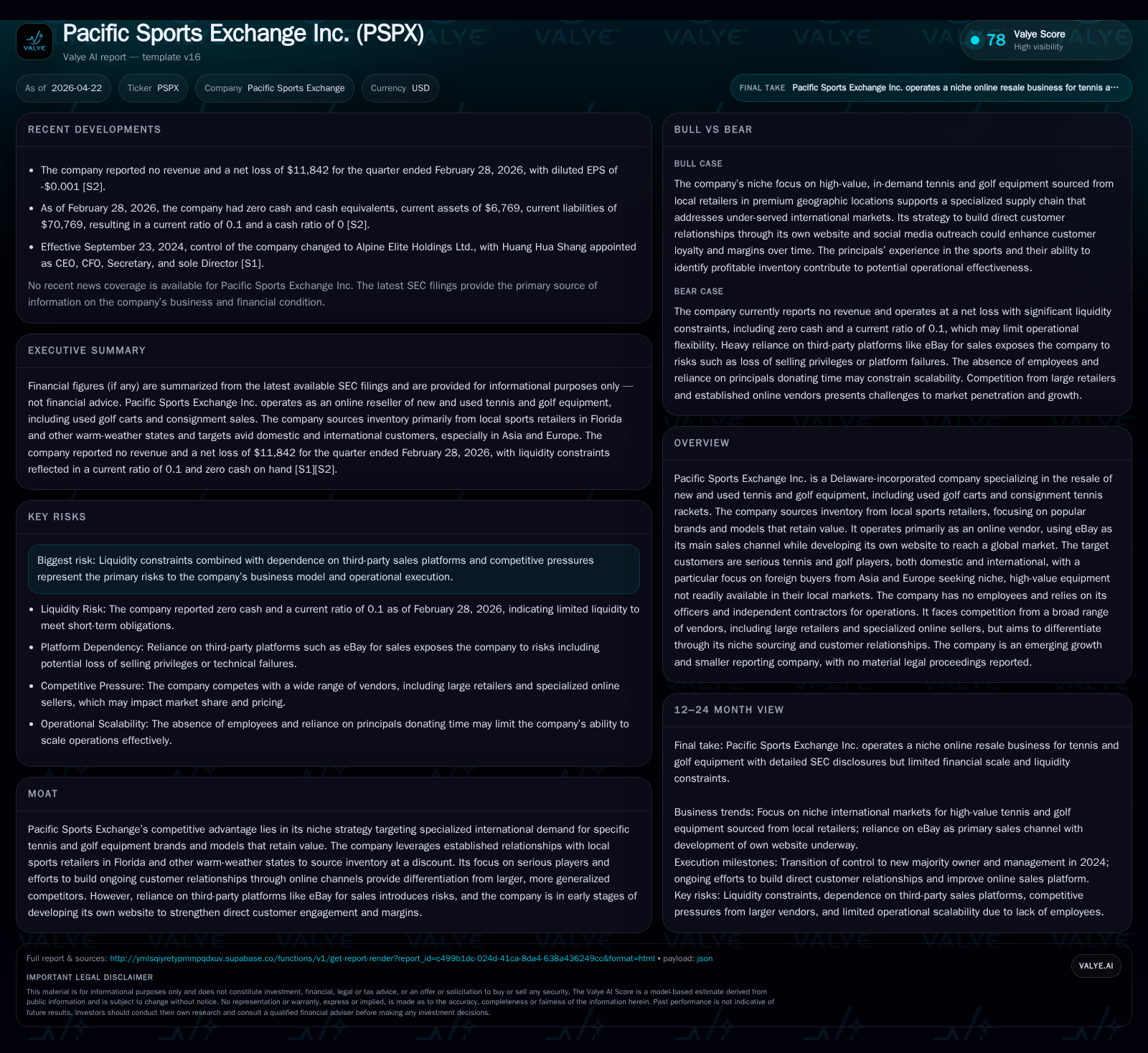
In its April 2026 quarterly filing, Pacific Sports Exchange disclosed zero cash balance and a severely impaired current ratio, underscoring acute near-term liquidity risks that strain its niche tennis and golf equipment resale business. The company’s strategic focus on sourcing high-value used equipment from local Florida shops for dedicated domestic and international players differentiates it in a crowded market dominated by large retailers and specialized online vendors. However, heavy reliance on eBay sales channels limits margins and exacerbates platform risk. The firm aims to mitigate these vulnerabilities by developing its own website to foster direct customer relationships and improve margin capture. Key growth vectors include expanding geographic sourcing beyond Southwest Florida and deepening engagement with niche international buyers in Asia and Europe, but legacy financial constraints impede scaling efforts.
Latest Quarterly Operating Highlights Reveal Liquidity Concerns
Pacific Sports Exchange's April 2026 10-Q [S2] starkly underscores the company’s precarious near-term financial position. As of February 28, 2026, PSPX reported zero cash on hand coupled with current assets totaling just $6,769 against current liabilities of $70,769, yielding a dangerously low current ratio of roughly 0.1 [F1]. This signals an acute liquidity deficit that threatens the firm's ability to sustain day-to-day operations without immediate capital infusion or drastic cost containment.
The operating income further deteriorated over the latest fiscal year ending August 31, 2025, with losses expanding by approximately 18% year-over-year to -$36,745 [F1]. Despite the company’s efforts to generate revenue from its niche product lines, top-line figures declined roughly 15% from $5,400 in FY2024 to $4,600 in FY2025 [F1], reflecting scale challenges in market penetration or inventory turnover efficiency. Operating cash flow remains negative but shows some improvement year-over-year [F1], hinting at possible early signs of operational stabilization albeit insufficient to offset severe balance sheet strains.
This combination of deteriorating liquidity paired with sustained operating losses forms a critical inflection point for PSPX’s business model viability absent corrective measures.
Business Model: Targeting High-Value Tennis and Golf Equipment Resale
Pacific Sports Exchange operates as an online reseller specializing in new and used tennis and golf equipment with an expanded offering including used golf carts and recently initiated consignment sales of tennis rackets [S1][S4]. The firm’s distinctive approach lies in sourcing inventory primarily from local sports retailers concentrated in Southwest Florida — shops embedded deeply within their communities that receive steady trade-in equipment flows seasonally [S4][S6]. These retailers willingly sell their surplus or gently-used items at discounts that create margin potential for PSPX.
The company focuses on brand-name equipment identified through principals’ domain expertise as retaining value across markets typically underserved internationally [S4][S8]. Their target customers consist predominantly of serious domestic and foreign golfers and tennis players who prioritize precise specifications — leveraging the company's insight into sought-after models rather than casual recreational buyers. This strategy supports relatively high margins per transaction despite PSPX’s modest scale.
Distribution channels rely heavily on eBay as the primary sales platform providing instant global reach at relatively low shipping flat rates domestically [S4]. However, eBay also imposes significant platform dependence risks. To diversify revenue channels while improving unit economics, PSPX is developing its own e-commerce site enhanced through keyword optimization targeting tennis- and golf-related search terms globally [S4]. This next step aims to cultivate direct long-term customer relationships enabling higher margin capture through repeat business.
Competitive Position: Niche Focus Versus Large-Scale Retailers and Online Sellers
The competitive environment includes dominant generalist sporting goods retailers such as Dick's Sporting Goods and Amazon alongside specialized online vendors like Tennis Warehouse or Holabird Sports [S5]. While these incumbents benefit from broader assortment breadth and established distribution networks, they generally cater to mass-market demand lacking fine-tuned customer segmentation.
PSPX's defensible positioning stems from its hyper-focused strategy targeting niche international demand for specific high-value brands/models that are scarce or unavailable locally abroad [S4][S6]. Its network-sourced inventory creates supply-side barriers difficult for larger operators who do not maintain deep local retailer relationships or pursue limited-target product selections.
Nevertheless, reliance on eBay substantially caps pricing power due to competitive market dynamics on the platform plus fees reducing effective margins [S4]. This reliance introduces vulnerability should marketplace policies change or selling privileges be revoked — a non-trivial risk given historical precedents affecting smaller third-party sellers. The proprietary website development marks a strategic pivot toward mitigating this platform risk while enhancing brand presence.
Growth Opportunities: Leveraging Product Sourcing and Global Customer Segments
PSPX identifies clear vectors for expanding its niche resale business organically. First is geographic replication of its Southwest Florida sourcing network into East Coast Florida as well as warm-weather states such as California or Arizona where similar local sports retail ecosystems exist with steady trade-in inventories [S4][S6]. Building supplier diversification reduces concentration risk while potentially increasing inventory volumes aligned with client demand.
Second is accelerating direct-to-customer sales through improved digital marketing campaigns powered by SEO optimization aiming to rank for relevant tennis- and golf-related searches worldwide [S4]. Such efforts could deepen penetration particularly among Asian and European consumers who demonstrate affinity for specialized equipment often inaccessible locally [S5][S7]. This aligns with management’s longer-term objective to build a loyal customer database facilitating repeat purchases beyond one-off transactions.
Lastly, expanding product breadth via consignment arrangements (recently added tennis racket consignment) allows asset-light growth potentially increasing inventory variety without commensurate working capital increase.
Constraints: Platform Dependence, Liquidity Risks, and Competitive Pressures
The company's dependency on eBay constrains both pricing power and margin stability given marketplace fees plus algorithm-driven visibility risks [S4]. Should selling privileges be lost or if technical disruptions occur on third-party platforms, revenue streams would be immediately jeopardized.
Liquidity constraints highlighted by zero cash levels hamper necessary investments into website development or comprehensive marketing campaigns crucial for shifting sales mix away from third-party marketplaces toward owned digital assets [F1][S4][S9]. Without sufficient funding sources or retained earnings reinvestment capability — both limited given ongoing operating losses — scaling initiatives remain vulnerable.
Additionally, broad industry competition from well-funded retail chains or niche online specialists can pressure pricing through deeper discounting or more aggressive customer acquisition spending. PSPX must balance growth ambitions against operational cash flow realities amidst this competitive tension.
Key Milestones Ahead: Website Development, Market Penetration, and Operational Scaling
Investors should track sequential updates regarding the proprietary website’s launch timetable alongside metrics demonstrating organic traffic growth supported by SEO keyword rankings [S1][S4]. Effectiveness in transitioning sales volume off eBay will be telling for margin recovery prospects.
Parallel progress in expanding geographic supplier networks beyond Florida will serve as a bellwether for inventory scalability essential to meeting diversified demand pockets internationally [S6][S7].
Management’s success in improving working capital ratios either through internal cost controls or external capital raises will be critical given present liquidity stress documented in the latest quarter’s balance sheet snapshot.
Monitoring customer retention depth via repeat purchase frequency would gauge how well niche serious player segments respond over time beyond initial merchandising efforts.
Financial Snapshot: Revenue Trends, Profitability Challenges, and Balance Sheet Strain
Historical performance (annual)
| FY | Rev ($) | Net ($) | CFO ($) | OpInc ($) | Rev YoY | Net YoY |
|---|---|---|---|---|---|---|
| 2025 | 4600 | -36745 | -519 | -36745 | -14.8% | -470.1% |
| 2024 | 5400 | 9928 | -1156 | -31029 | -71.3% | +138.1% |
| 2023 | 18794 | -26033 | -9448 | -26033 | -58.4% | -94.3% |
| 2022 | 45169 | -13399 | -16308 | -13399 |
Source: SEC companyfacts cache [F1].
Capital returns and efficiency (annual)
| FY | ROE% |
|---|---|
| 2025 | 87.3 |
| 2024 | -12.5 |
| 2023 | 29.2 |
| 2022 | 21.3 |
Source: SEC companyfacts cache [F1].
Data show a persistent decline in top-line revenue over recent years accompanied by widening negative operating income culminating at a loss of $36.7k in FY2025 representing an approximate YoY worsening of over 18% [F1]. Net income swings deeper negative reflecting both continued operational inefficiencies and absence of sustainable profitability.
Cash depletion is most alarming — zero cash reported at quarter end February 2026 leaves negligible margin for operational exigencies absent fresh inflows [F1]. Current liabilities exceed current assets sevenfold further indicating intense short-term solvency risk.
Operating cash flow improved marginally relative to prior years yet remains negative indicating limited intrinsic cash generation capacity needed for growth investment or debt servicing).
Financial Table Source: [F1]
_ This report leverages detailed SEC filings up through Pacific Sports Exchange's latest April 2026 quarter (10-Q) combined with annual disclosures (10-K) from December 2025 to provide a granular look into the company’s operating trajectory and structural dynamics absent any investment advice._
Disclaimer: This is research-only, informational analysis and not investment advice. It may include AI-generated interpretation and general industry context. Always verify important details using primary sources.

Comments