
Range Resources Corp's Quarterly Surge Reflects Resilience in Appalachian Gas Market
The latest quarterly results reveal operational strength and disciplined risk management amid natural gas price headwinds.
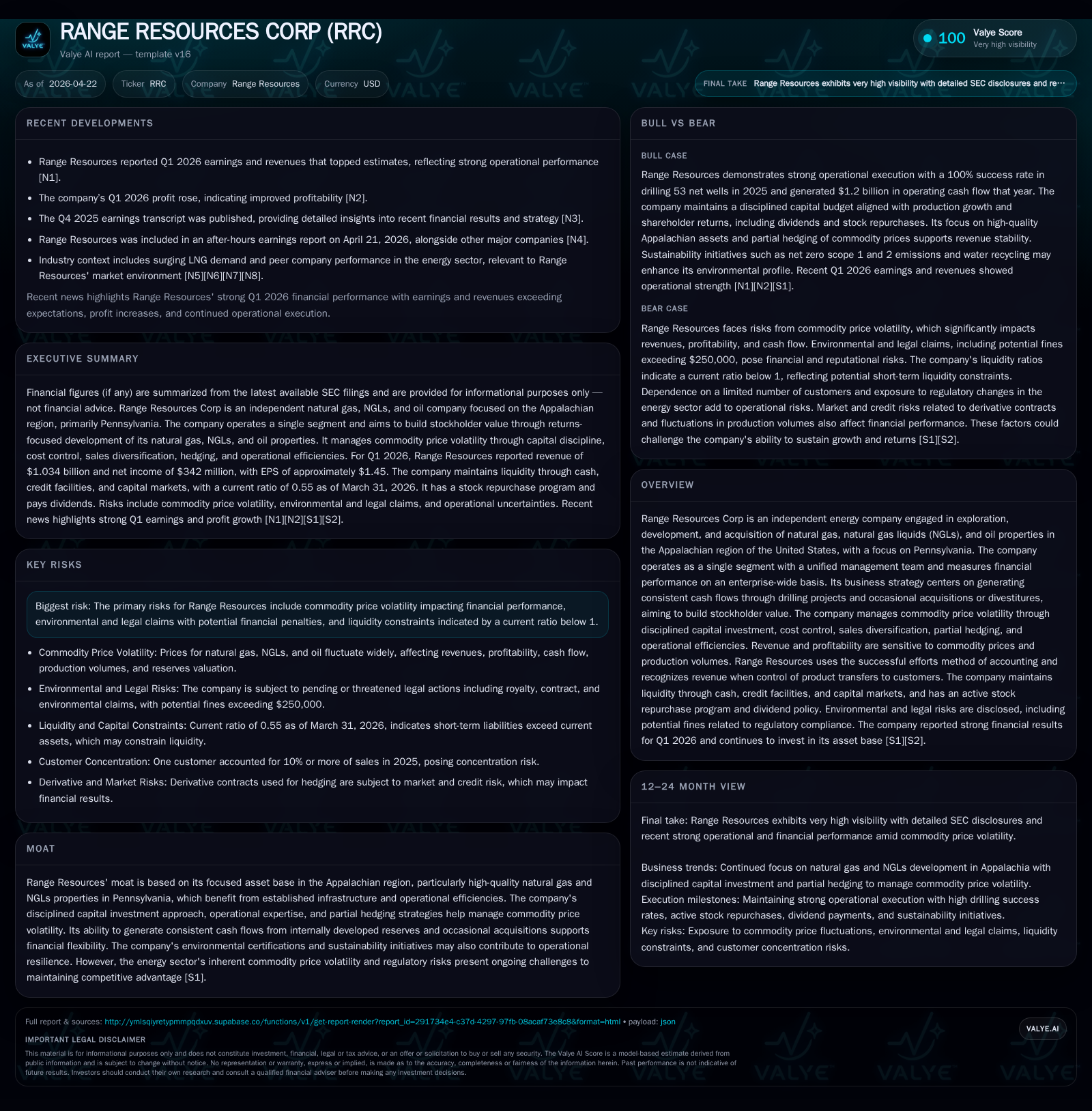
Range Resources Corp reported a strong first quarter for 2026 with earnings and revenues surpassing estimates, underscoring operational resilience in its Appalachian-focused natural gas portfolio. Despite a marked $33.4 million loss on derivatives disclosed in its recent 8-K filing, the company maintains disciplined capital investment, prudent cost controls, and partial hedging to mitigate commodity price volatility. Its business model centers on leveraging established infrastructure in Pennsylvania to generate stable cash flows from natural gas and NGL production while strategically managing regulatory and liquidity challenges. Key milestones to watch include the spring borrowing base re-determination and execution of its $650–700 million 2026 capital budget.
Latest Quarter Highlights and Derivative Loss Impact
Range Resources Corp's (RRC) most recent quarterly report filed on April 21, 2026 ([S2]) reveals earnings and revenues that surpassed market expectations according to multiple Nasdaq sources ([N1], [N8]). This performance highlights the company's ongoing operational resilience despite persistent natural gas price challenges. However, an event filing dated April 14, 2026 ([S3]) disclosed a significant $33.4 million total loss on derivatives for Q1 2026, marking the impact of commodities market volatility on the firm’s hedging instruments. Importantly, the filing also noted net cash settlements received during the quarter that alleviate some of the liquidity effects of these mark-to-market losses.
This derivative loss is a non-cash accounting adjustment affecting reported earnings but does not necessarily impair operating cash flow. The company’s use of partial hedging limits downside price risk while preserving upside exposure, reflecting a balanced risk management approach in a volatile energy environment. The ability to generate positive cash flow alongside such losses indicates operational stability anchored by solid production volumes.
Business Model: Appalachian Gas Focus and Revenue Drivers
Range Resources operates as an independent energy company centered exclusively on exploration, development, and acquisition of natural gas, natural gas liquids (NGLs), and oil assets primarily located in Pennsylvania within the Appalachian basin ([S1]). This single-segment approach enables focused management and unified financial reporting.
Revenue generation flows primarily from drilling projects that develop internally sourced reserves complemented by occasional strategic acquisitions or asset divestitures. Operational efficiency benefits greatly from the mature infrastructure network pervasive throughout Appalachia facilitating cost-effective production and transportation ([S1], [S15]).
Partial hedging reduces commodity price risk while sales diversification across multiple product lines — natural gas, NGLs, and oil — enhances revenue stability amidst shifting market demand. The company's financial results are sensitive to commodity prices and production levels but are buffered by disciplined capital expenditures and cost control measures outlined in their strategy ([S1]).
Competitive Position and Industry Economics in Appalachia
Range’s competitive moat derives largely from its concentrated asset base in Appalachia — particularly high-quality properties serviced by well-established midstream pipelines and processing facilities ([S1], [S29]). This geographic focus affords advantages including lower transportation costs relative to more remote shale plays and faster response times for operational optimizations.
Environmental certifications and sustainability programs documented in [S1] support regulatory compliance which is increasingly critical given evolving environmental scrutiny of unconventional hydrocarbon developments. Regulatory risks remain notable but managed through proactive governance.
In the broader Appalachia market context, Range competes with peers like EQT; however, its scale benefits enable operating leverage amid rising input costs, safeguarding margins when pricing pressures intensify ([N10]). Natural gas pricing remains below $2.70/MMBtu as analyzed in [N9], constraining sector profitability but also spurring select operators like Range toward efficiency gains.
Growth Catalysts and Operational Leverage
The approved capital budget of $650–700 million for 2026 ([S27]) signals ongoing investments into drilling activities designed to maintain or modestly expand production capacity within core areas. Operational improvements lowering breakeven costs represent critical levers to enhance returns given cyclical pricing.
Strategic acquisitions or divestitures remain tools to optimize asset quality or generate liquidity as part of disciplined portfolio management. Market commentary acknowledges Range's strong momentum underpinned by this methodical growth approach ([N11], [N14]).
However, growth faces constraints chiefly around regulatory approvals for new wells or expansions in conservation-sensitive zones; these hurdles may lengthen development timelines or restrict capital deployment flexibility.
Risks: Commodity Volatility, Litigation, and Liquidity Constraints
Commodity price swings directly impact Range’s revenues and profitability due to unchanged exposure despite partial hedging ([S1]). The recent marked-to-market derivative loss exemplifies this sensitivity.
The company is subject to ongoing legal actions including royalty disputes, contractual claims, and environmental proceedings carrying uncertainty; potential fines could exceed $250k individually or cumulatively though management deems no material adverse financial impact is presently likely ([S1]).
Liquidity pressure is evident with a current ratio around 0.55 calculated from reported current assets ($375.77m) versus liabilities ($678.66m) as of March 31, 2026 ([F1]), falling below the credit facility covenant minimum of 1.0x described in [S7]. Maintaining liquidity will require careful working capital management coupled with available borrowing capacity.
Upcoming Milestones and Market Signals to Monitor
Key near-term events include the spring 2026 borrowing base re-determination scheduled as part of bank credit facility covenants ([S7]). This assessment will influence available credit capacity potentially affecting liquidity and financing costs.
Dividend declarations remain at board discretion contingent on earnings trends and covenant compliance with prior dividends at $0.09/share announced for late 2025 ([S6]). Execution against the planned capital budget will serve as an operational health indicator.
Market reactions to natural gas price movements—currently subdued under $2.70/MMBtu—will critically influence profit metrics going forward ([N9]). Monitoring derivative portfolio mark-to-market fluctuations provides insight into embedded price risk exposure.
Supporting Financial Profile and Capital Structure
Annual financial data per [F1] confirms a strong top-line rebound with revenue growing nearly 29% year-over-year to approximately $3.12 billion in FY2025 reflecting higher volume realization combined with improved market conditions compared to FY2024 ($2.42 billion).
Net income surged by approximately 147% year-over-year reaching ~$658 million in FY2025 from $266 million prior year evidencing bottom-line recovery supported by operational efficiencies.
Operating cash flow totaled over $1.17 billion enabling free cash flow around $1.17 billion after significantly reduced capital expenditures (~$39 million estimated from historical context) indicating exceptional cash generation capability amidst conservative capex discipline.
Range maintains a manageable debt profile with approximately $1.2 billion net long-term debt after redeeming prior notes in early 2026 using bank credit facility borrowings ([S8], [F1]). The bank credit facility features substantial borrowing base secured against reserves with lender commitments around $2 billion providing liquidity buffer ([S4], [S7]).
The share repurchase program remains active with roughly $785 million authorized balance supporting shareholder return initiatives while dividend dependency remains secondary per board discretion policy ([S5], [S10]).
Historical performance (annual)
| FY | Rev ($bn) | Net ($mm) | CFO ($mm) | Rev YoY | Net YoY |
|---|---|---|---|---|---|
| 2025 | 3.1 | 658 | 1171 | +28.9% | +147.1% |
| 2024 | 2.4 | 266 | 945 | -28.4% | -69.4% |
| 2023 | 3.4 | 871 | 978 | -18.6% | -26.4% |
| 2022 | 4.1 | 1183 | 1865 |
Source: SEC companyfacts cache [F1].
Capital returns and efficiency (annual)
| FY | ROE% |
|---|---|
| 2025 | 15.2 |
| 2024 | 6.8 |
| 2023 | 23.1 |
| 2022 | 41.1 |
Source: SEC companyfacts cache [F1]. *Capex projected for full year per guidance [S27].
Debt maturity schedule reflects elimination of near-term maturities via January 2026 redemption of $600 million senior notes due 2029 simplifying upcoming debt service obligations ([S9]). Interest expense is managed through a blend of fixed-rate senior notes (90%) versus recently increased floating rate borrowings (10–50% post-redemption) exposing future interest costs to SOFR fluctuations moderately ([S12], [F1]).
Overall financial posture supports continued investment while managing commodity-driven margin volatility with sufficient liquidity albeit tight working capital coverage necessitating ongoing monitoring.
Disclaimer: This analysis does not constitute investment advice or recommendations. It is based solely on publicly available documents cited herein without assumptions beyond disclosed facts or industry-standard analytical frameworks.
Disclaimer: This is research-only, informational analysis and not investment advice. It may include AI-generated interpretation and general industry context. Always verify important details using primary sources.

Comments