
Fly-E Group Advances E-Bike Integration While Tackling Nasdaq Compliance
Recent filings highlight Fly-E Group's operational progress through municipal e-bike programs alongside pressing Nasdaq compliance challenges.
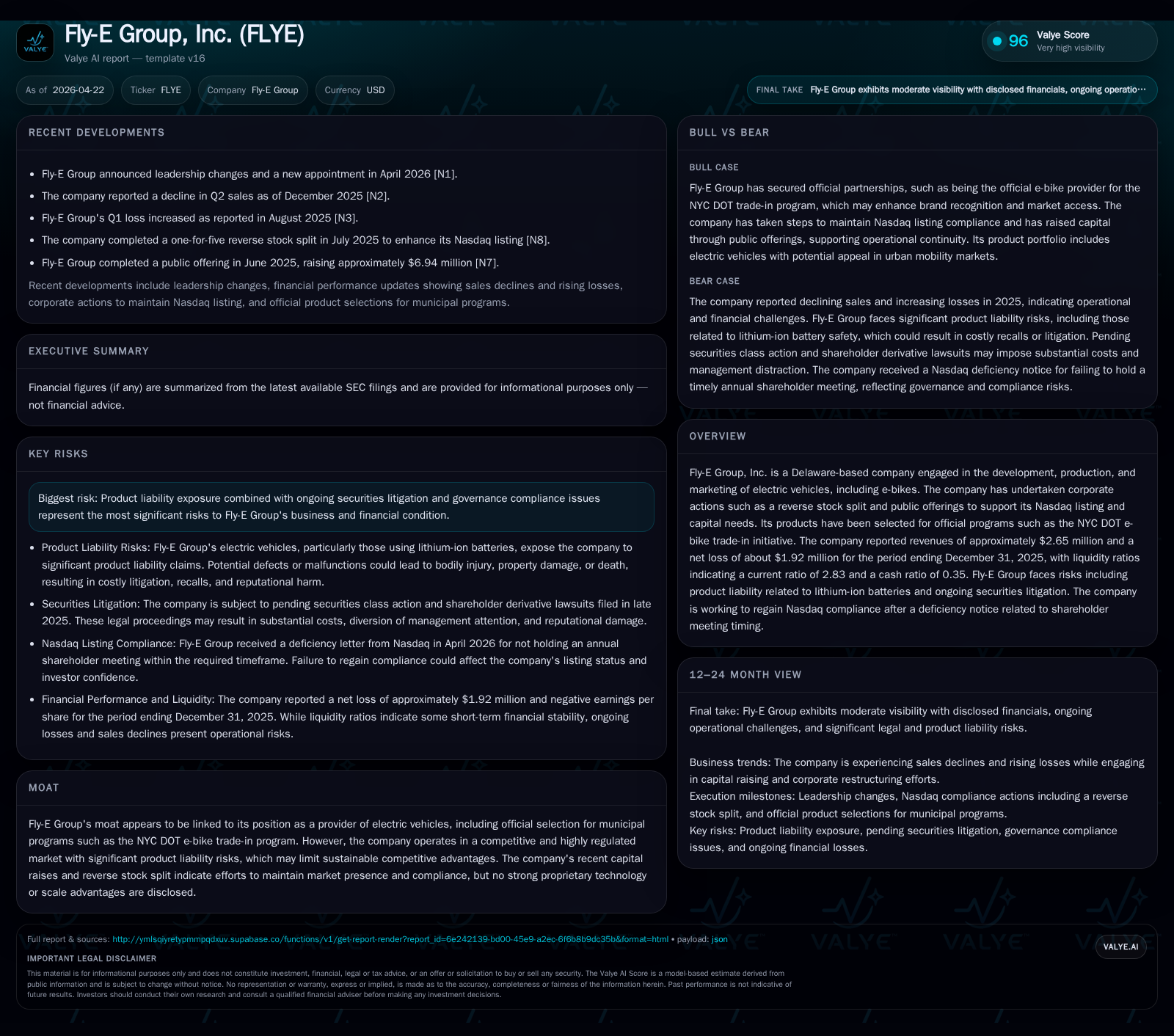
Fly-E Group's latest 10-Q reveals ongoing traction with municipal electric bike initiatives, notably the NYC DOT trade-in program, contrasting with significant governance hurdles marked by Nasdaq deficiency notices. The company's business model centers on electric vehicle production with exposure to product liability and regulatory risks, particularly linked to lithium-ion battery safety. Intense competition and substantial legal/litigation headwinds constrain Fly-E’s growth trajectory despite market partnerships. Financially, deteriorating revenue and escalating losses underscore capital pressures amid attempts to regain compliance and stabilize operations.
Latest Quarterly Operating Update and Regulatory Compliance Status
Fly-E Group’s April 2026 10-Q filing ([S2]) presents key operating metrics through December 31, 2025: predominantly a $2.65 million revenue run rate coupled with widened net losses around $1.92 million for the period. These figures indicate contraction relative to prior fiscal year results ([F1]). Simultaneously, the company faces active Nasdaq regulatory scrutiny as detailed in its contemporaneous 8-K ([S3]). The complaint centers on a failure to convene the annual shareholder meeting within the prescribed twelve-month window per Listing Rule 5620(a), resulting in a formal deficiency notification. Fly-E was afforded a deadline of June 1, 2026, to submit an actionable compliance plan with possible extensions contingent on Nasdaq approval running through late September 2026.
While this non-compliance is administrative rather than adversarial—with no board-shareholder conflict reported—the threat to continued listing stability is palpable given Nasdaq’s measured tolerance. Moreover, earlier Nasdaq notices for delayed SEC filings were only recently resolved ([S19], [S21]), illustrating an ongoing pattern of governance execution gaps risking market confidence and equity liquidity.
This dual dynamic—operational traction alongside structural compliance deficits—frames Fly-E’s current risk-reward profile.
Fly-E Group’s Business Model and Product Offering Dynamics
Fly-E Group principally generates revenue through the development, production, and sale of electric vehicles (EVs), specifically targeting consumer e-bikes tailored for urban mobility solutions (). Its niche includes partnerships with municipal entities, illustrated by official selection for New York City Department of Transportation’s e-bike trade-in program—a strategic endorsement enhancing Fly-E's market credibility.
The value proposition rests on offering cost-effective multimodal transportation alternatives aligning with increasing urban electrification trends. However, Fly-E operates within thin margins complicated by inherent product liability challenges linked to its adoption of lithium-ion battery technology—widespread in EVs but notorious for thermal runaway risks if improperly managed ([S4], [S6]). Such hazards expose Fly-E not only to potential recall scenarios but also elevated insurance premiums that strain financial flexibility.
While these partnerships provide vital sales channels and brand visibility crucial for early-stage market penetration, their scale remains limited relative to national or global competitors. Retention dynamics hinge on product reliability and safety reputation—a high bar set by incumbent OEMs with established after-sales support networks.
Competitive Landscape and Industry Regulatory Environment
Within the electric vehicle sector—particularly under the e-bike subcategory—Fly-E faces intense competition from larger original equipment manufacturers (OEMs) who command scale economies in manufacturing, supply chain integration, and distribution networks (). Unlike these incumbents, Fly-E does not disclose strong proprietary technological advantages or unique product differentiation beyond municipal program participation.
Regulatory environments impose strict safety standards focused on battery management systems given historical fire incidents across the industry. Compliance entails costly certification processes and ongoing risk management measures that disproportionately burden smaller players like Fly-E ([S4], [S5]).
Additionally, securities litigation against Fly-E compounds reputational risks and diverts management resources away from operational scaling ([S4], [S5]). Combined with Nasdaq listing challenges stemming from procedural delays on shareholder communications ([S3], [S13]), these factors limit access to equity capital essential for competitive positioning.
Growth Catalysts and Strategic Constraints
Key growth drivers include expansion of municipal partnerships leveraging governmental efforts toward sustainable urban mobility infrastructure. Increasing consumer acceptance of e-bikes as last-mile solutions supports structural demand formation beyond cyclical fluctuations (). Furthermore, public programs like NYC DOT’s trade-in initiative offer channel exclusivity opportunities enhancing unit economics if scaled effectively.
Conversely, substantial constraints persist. Litigation-related legal expenses threaten profitability while insurance coverage for product liabilities grows costlier due to lithium-ion battery risks ([S4], [S6]). Operational scale limitations hinder pricing power vis-à-vis large OEM competitors who command broad retail distribution chains.
Governance deficits evidenced by repeated Nasdaq compliance issues jeopardize ongoing listing eligibility necessary for accessing public markets to fund growth initiatives. Management turnover noted in early 2026 adds uncertainty over execution continuity ([N1]).
Overall growth prospects remain dependent on mitigating structural risk exposures while extracting additional value from targeted municipal channels amid industry consolidation pressures.
Upcoming Milestones and Operational Monitoring Points
Investors should monitor Fly-E’s timely submission and acceptance of a Nasdaq compliance plan by the June 1, 2026 deadline. Should Nasdaq grant extensions up to September 28, 2026 or deny relief requiring appeals will critically influence equity market status ([S3], [S13]).
Lawsuit developments tied to securities class action proceedings initially filed in late 2025 demand scrutiny given their material cost implications ([S4], [S5]). Positive resolutions would ease operational distractions; adverse outcomes might impair liquidity further.
Subsequent quarterly filings will clarify revenue trends—whether municipal program expansions yield significant top-line growth or whether broader macroeconomic pressures induce demand softness. Leadership changes announced in February/March 2026 present another factor affecting strategic coherence over medium term ([N1]).
Tracking incremental product quality improvements or new program endorsements could signal an inflection in competitive positioning or customer adoption patterns.
Financial Health Overview Supported by Recent Filing Data
A synthesized view of Fly-E’s financial profile from [F1] and corroborated by latest SEC disclosures highlights intensifying capital pressures:
Historical performance (annual)
| FY | Rev ($mm) | Net ($mm) | CFO ($mm) | OpInc ($mm) | Rev YoY | Net YoY |
|---|---|---|---|---|---|---|
| 2025 | 25 | -5 | -10 | -5 | -21.0% | -379.2% |
| 2024 | 32 | 2 | 4 | 3 |
Source: SEC companyfacts cache [F1].
Capital returns and efficiency (annual)
| FY | ROE% |
|---|---|
| 2025 | -53.8 |
| 2024 | 27.9 |
Source: SEC companyfacts cache [F1].
Revenue declined approximately 21% YoY while net losses deepened significantly (-379% YoY), reflecting both margin erosion and elevated operating expenses largely driven by legal costs and regulatory compliance activities ([F1], [S2]). Operating cash flows are negative at over $10 million annually underscoring ongoing cash burn necessitating further capital raises.
Current ratio above two suggests manageable near-term liquidity; however liquidity buffers remain modest given fixed asset light model emphasizing working capital financing needs amid constrained free cash flow generation ([F1]). Repeated filings delays have likely impacted market perception constraining alternative financing avenues.
Together these indicators depict a company balancing nascent commercial traction against fundamental financial fragility tied to external governance challenges and internal cost structure inefficiencies.
Disclaimer: This analysis is based exclusively on publicly available SEC filings dated April 2026 or earlier together with secondary reports referenced herein. It does not constitute investment advice or recommendations.
Disclaimer: This is research-only, informational analysis and not investment advice. It may include AI-generated interpretation and general industry context. Always verify important details using primary sources.

Comments