
Agree Realty Reports Strong Q1 Performance with Strategic Leasing Momentum
Agree Realty's Q1 2026 updates highlight robust leasing execution, tenant diversification, and capital management supporting growth in the retail REIT landscape.
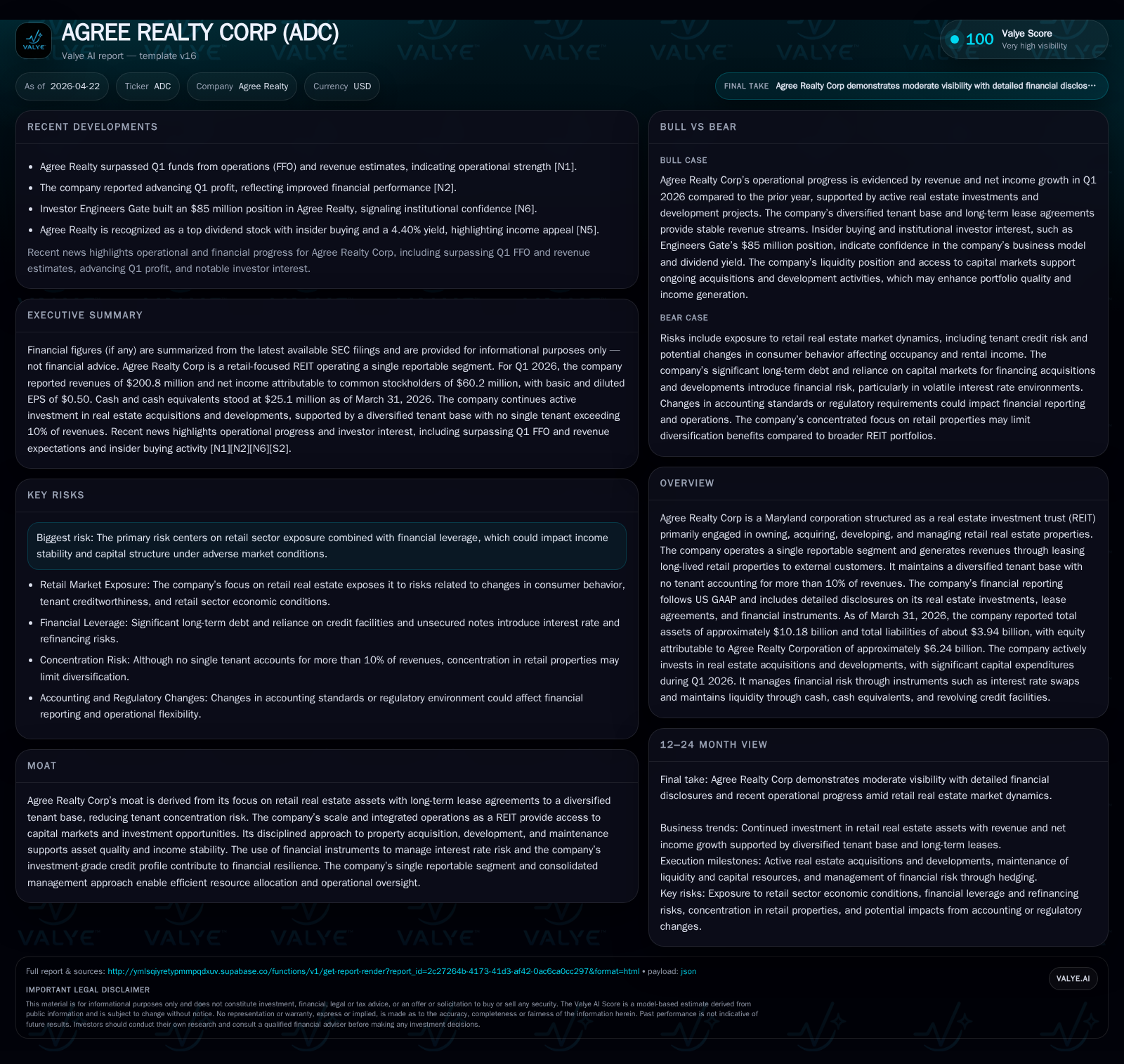
In its latest quarterly filing dated April 21, 2026, Agree Realty Corp demonstrated operational resilience and financial outperformance driven by strong leasing activity and tenant stability. The company’s single-segment retail REIT model, underpinned by diversified tenants and long-term net leases, facilitated a 16.4% revenue growth year-over-year in 2025. Capital structure improvements and cautious development spending position Agree Realty well within a competitive net-lease retail real estate sector faced with retail-specific risks and leverage considerations. Key milestones include monitoring lease renewals and capital deployment effectiveness amid evolving retail market dynamics.
Q1 2026 Operating Update: Outperformance and Portfolio Dynamics
Agree Realty's Q1 2026 earnings disclosure on April 21 detailed continued operational strength highlighted by revenue and funds from operations (FFO) beats relative to street estimates [S2][N1]. The company consolidated its Operating Partnership accounts per ASC Topic 810 guidance, thus enhancing transparency around its wholly owned subsidiaries' results [S2]. Notably, the periodic inclusion of restricted common shares related to forward equity offerings (820k shares) and larger share-based compensation awards impacted earnings per share computations via anti-dilution adjustments but underscored an active equity strategy aligning management incentives with shareholder returns [S2]. This underlying earnings power supports confidence in the firm’s capability to execute leasing renewals at accretive pricing levels.
Leasing momentum remains robust with continued tenant retention contributing to a steady contractual rental base. The reported increase in total lease payments versus prior periods evidences enhanced portfolio cash flow generation capacity bolstered by increased reimbursement streams for operating costs [S18]. Meanwhile, impairment provisions for select properties remained controlled at $1.4 million versus $4.3 million a year earlier, indicating relative asset quality stability even amid selective retail sector headwinds [S10].
Agree Realty’s Business Model: Single Segment Retail REIT with Diversified Tenants
Agree Realty operates as a fully integrated Maryland corporation structured as a real estate investment trust (REIT), focused exclusively on owning, acquiring, developing, and managing long-lived retail properties under primarily triple net leases [S1]. The company maintains just one reportable segment reflecting centralized portfolio performance evaluation by its Chief Executive Officer without geographic or tenant segmentation [S19]. This streamlined approach facilitates efficient allocation decisions across acquisitions, developments, renewals, or capital return initiatives.
A cornerstone of Agree’s business model lies in its broad tenant diversification—no individual tenant contributes more than 10% of revenues—mitigating concentrated exposure risk significantly relative to peers who face single-tenant dependencies that can jeopardize cash flow predictability [S1][N9]. Lease agreements typically span multiple years with contractual rent escalations built-in providing dependable income streams. Furthermore, the accounting policy employing straight-line recognition of rent including fixed increases accords predictability in revenue forecasting [S18].
The company's disciplined property acquisition process emphasizes valuing assets through cost appraisals adjusted for identifiable intangible components like below- or above-market leases to avoid overpayment or goodwill on purchase [S20]. This ensures alignment between purchase price and embedded earnings potential while maintaining asset quality early in the ownership cycle.
Competitive Positioning and Industry Structure in Retail Real Estate
Within the specialized net-lease retail REIT landscape—where firms such as Realty Income (O) actively compete—Agree Realty’s mid-to-large scale offers competitive advantages. Its integrated platform coupled with a strong balance sheet supports agile deal execution during market dislocations that create acquisition windows for high-quality retail locations.
Leasing leverage arises from covenant-strength tenant creditworthiness permitting renewal rent escalations sustaining pricing power despite increasing e-commerce competition. Additionally, regulatory constraints such as local zoning delays impede new ground-up developments broadly across key commercial corridors limiting supply growth; this scarcity benefits companies like Agree that control well-maintained existing assets with defensive market positioning .
Supply chain challenges relevant to construction materials have enforced discipline among developers limiting rash expansions hence curtailing risk of overbuilding—a distinct positive for Agree’s measured development pipeline that avoids aggressive speculative projects which are ill-suited in uncertain retail real estate demand environments.
Brokerage relationships remain pivotal for sourcing tenants and unlocking value-add leasing opportunities that enable achieving upward basis rent resets upon lease extensions or replacements enhancing effective yields.
Growth Catalysts: Leasing Execution, Market Penetration, and Capital Access
Several fundamental drivers underpin Agree Realty’s growth outlook:
Tenant Retention & Rent Escalations: High renewal rates of creditworthy tenants facilitate base rent increase capture supporting steady NOI growth aligned with inflationary trends [N1][S1]. Leasing velocity enhancements observed in Q1 affirm management’s successful mitigation of vacancy risk typically heightened in retail sectors.
Acquisition Pipeline Financing: Access to diverse capital sources—equity sales via forward contracts alongside term debt facilities at sub-5% all-in rates—enables accretive inorganic growth while keeping weighted average borrowing costs manageable [S12]. These funds support opportunistic property acquisitions consistent with yielding stable payout coverage.
Development Discipline: Ongoing investment in value-accretive ground-up developments or redevelopment requiring modest incremental outlays preserves capital flexibility during periods of economic uncertainty while enabling portfolio refreshment evident from relatively contained capex levels compared to historical peaks [F1][S21].
Management also highlights operational efficiencies gained through centralized asset oversight reducing overhead intensity relative to peers who report multi-segment complexity.
Risks and Constraints Rooted in Retail Exposure and Leverage
Primary vulnerabilities center on Agree’s focused exposure to the retail real estate sector where structural headwinds such as e-commerce adoption persistently pressure brick-and-mortar traffic affecting some tenant categories disproportionately [S1][N4]. Although tenant diversification blunts idiosyncratic shocks, macroeconomic cycles may still impact occupancy levels or rent collection timing during recessions.
Financial leverage—total gross indebtedness approximating $3.72 billion spread across unsecured loans, senior notes, revolving credits, and selective mortgages—subjects the entity to interest rate sensitivity particularly if refinancing conditions tighten amidst volatile rate environments or credit spreads widen unexpectedly limiting refinancing capacity without adverse cost implications [S10]. However, hedging strategies utilizing interest rate swaps mitigate some volatility risks inherent within floating components.
Tenant credit risk remains salient given variable solvency profiles among retailers; thus consistent underwriting rigor combined with geographically diversified property locations serves as a buffer against localized downturns or retailer bankruptcies impacting income stability.
Key Upcoming Milestones and Market Signals to Monitor
Investors should observe several key indicators signaling operational execution effectiveness or stress points:
- Lease expiration schedules hitting peak periods will test renewals achieved rent escalations against replacement leases establishing future cash flow trajectories.
- Changes in occupancy rates post-renewal cycles quantified via supplemental quarterly disclosures indicate leasing health especially if above industry averages.
- Capital expenditures measured relative to cash flow generate insights into pipeline conversion efficiency and capital cycle timing impacting free cash flow generation.
- Management guidance revisions after quarterly reporting events may provide directional cues regarding anticipated risks or opportunity expansions within shifting retail landscapes {N2}[N3][S2].
Additionally, macroeconomic variables including consumer spending indices or inflation trajectories potentially influence underwriting assumptions impacting portfolio valuation sensitivities.
Financial Performance & Capital Deployment Overview
Agree Realty delivered meaningful financial progress culminating in FY 2025 revenue of approximately $718 million representing a 16.4% year-over-year increase largely attributable to new acquisitions and organic rental escalations (Figures from annual filings) [F1], while operating income expanded by roughly 12.6% reaching $340 million backed by improved margin management. Net income rose around 8%, hitting $204 million maintaining positive earnings momentum despite incremental share dilution effects noted in Q1 arising from forward equity issuances structured for growth funding purposes [F1][S2].
Operating cash flow exhibited a healthy climb (~16.7% YoY) supported by robust rent collections offset partially by increased working capital demands linked to development activity resulting in negative free cash flow near -$370 million reflecting elevated capex spending scaled back from prior years but still significant due to ongoing buildouts of value-add projects (F1).
Capital structure remains prudently balanced with $600 million unsecured term loans roughly split between maturities in 2029 (4.37%) and 2031 (4.02%), augmented by senior unsecured notes exceeding $2.6 billion complemented by revolver utilization near $470 million providing liquidity buffers against episodic funding needs . Mortgage debt remains marginal at ~$42 million secured against specific properties amortizing mostly over short durations under non-recourse terms limiting overall balance sheet encumbrance to core property portfolios.
Dividend policy continues intact supported by steady payout ratios reflected in quarterly common dividends declared at $0.786 per share illustrating sustainable income distribution commitment balanced against retained earnings accumulation expanding shareholders’ equity base close to $6.24 billion end FY 2025 marking gradual balance sheet strengthening beneficial for longer-term rating agency considerations and maintaining cost-efficient capital access channels critical for sustained acquisition strategies [F1][S23].
Selected Financial Summary Table:
Historical performance (annual)
| FY | Rev ($mm) | Net ($mm) | CFO ($mm) | OpInc ($mm) | Rev YoY | Net YoY |
|---|---|---|---|---|---|---|
| 2025 | 718 | 204 | 504 | 340 | +16.4% | +8.0% |
| 2024 | 617 | 189 | 432 | 302 | +14.8% | +11.3% |
| 2023 | 537 | 170 | 392 | 254 | +25.1% | +11.5% |
| 2022 | 430 | 152 | 362 | 218 |
Source: SEC companyfacts cache [F1].
Capital returns and efficiency (annual)
| FY | Buybacks ($mm) | FCF ($mm) | ROE% |
|---|---|---|---|
| 2025 | 4 | 3.3 | |
| 2024 | 2 | -443 | 3.4 |
| 2023 | 3 | -808 | 3.3 |
| 2022 | 2 | -1238 | 3.3 |
Source: SEC companyfacts cache [F1].
Capital Structure Snapshot (Q1 2026):
| Debt Instrument | Principal ($MM) | Interest Rate | Maturity Year |
|---|---|---|---|
| Unsecured Term Loan | $350 | 4.37% | Jan 2029 |
| Unsecured Term Loan | $250 | 4.02% | May 2031 |
| Senior Unsecured Notes | ~$2,610 | Various | Various |
| Revolving Credit Facility | ~$470 | Variable | Revolving |
| Mortgage Notes Payable | ~$42 | ~3.65% | Various |
Overall, Agree Realty adapts consistently through measured portfolio management emphasizing leasing execution supported by diversified tenants within the challenging retail real estate domain while maintaining prudent financial stewardship backed by institutional-grade capital structures enabling both organic growth initiatives and tactical acquisitions.
Disclaimer: This analysis is based solely on disclosed information as of the latest filings dated April 21, 2026 ([S2], [S3], [S1]) combined with corroborative news releases ([N1], [N2], etc.). It does not constitute investment advice or endorsements of any securities.
Disclaimer: This is research-only, informational analysis and not investment advice. It may include AI-generated interpretation and general industry context. Always verify important details using primary sources.

Comments