
Beta Bionics Advances Commercial Scale While Facing Margin Pressure
The latest quarterly update highlights Beta Bionics’ ongoing commercialization efforts with rising operating expenses and sustained losses amid strategic reimbursement initiatives.
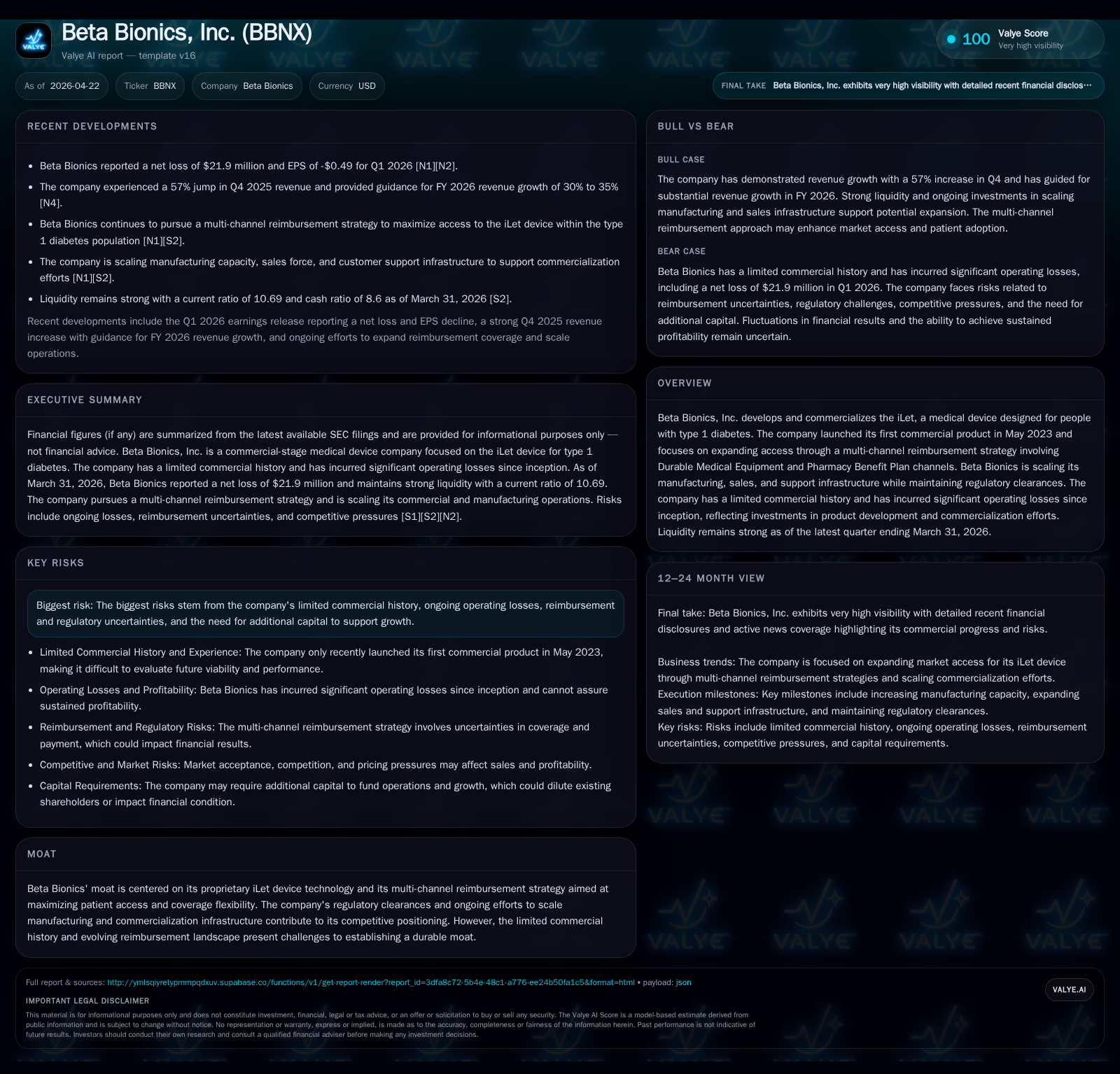
Beta Bionics reported Q1 2026 results showing positive revenue growth but below estimates, alongside increased operating losses driven by scaling commercial operations and manufacturing. The company’s iLet automated insulin delivery system leverages a multi-channel reimbursement approach through Durable Medical Equipment (DME) and Pharmacy Benefit Plan (PBP) pathways to broaden patient access. While the commercial footprint expands, challenges persist from reimbursement complexities, regulatory scrutiny, and profitability pressure. Monitoring upcoming regulatory clearances, payor contract expansions, and execution on manufacturing scale will be key to assessing growth trajectory.
Q1 2026 Operating Update Reflects Growing Pains of Commercial Scaling
Beta Bionics’ recently filed 10-Q for the quarter ended March 31, 2026 [S2] presents a snapshot of a company still navigating the early commercialization phase of its iLet automated insulin delivery system. Revenue was positive but missed analyst expectations per market commentary [N2], reflecting continued adoption challenges as the firm expands its salesforce and broadens patient reach. Operating losses intensified in Q1 as investments in manufacturing capacity buildup and commercial infrastructure scaled up. However, the balance sheet remains solid with approximately $30.2 million in cash and equivalents at quarter-end against current liabilities around $23.2 million, yielding a strong current ratio above 10x [F1], indicating financial flexibility for near-term execution.
Supplementary event disclosures filed the same day reinforce this picture of cautious optimism around revenue momentum tempered by margin pressures due to upfront investment costs [S3]. This operating update is crucial as it signals Beta Bionics' gradual transition from development to commercial-stage medical device player while underscoring inherent cost burdens.
Business Model: The iLet Device and Its Reimbursement Levers
Beta Bionics generates revenue by marketing the iLet system — a novel medical device designed specifically for people with type 1 diabetes (PWD)— that automates insulin delivery using proprietary algorithms integrated with continuous glucose monitoring sensors [S1]. The iLet distinguishes itself through technologically advanced closed-loop control capabilities aimed at reducing disease management burden compared to traditional pumps.
Central to Beta Bionics’ business model is its multi-channel coverage strategy that leverages both Durable Medical Equipment (DME) channels traditionally used for insulin pumps and emerging Pharmacy Benefit Plan (PBP) pathways primarily focused on medication dispensing [S10][S12]. This approach seeks to maximize patient access flexibility since each channel involves distinct payor relationships, reimbursement timings, out-of-pocket cost structures for patients, and varying impacts on company revenues.
By pursuing DME coverage, Beta Bionics taps into well-established insurance frameworks familiar to endocrinologists managing chronic diabetes care. Conversely, PBP facilitation aims at faster formulary inclusion for single-use components like infusion sets or sensors bundled with pharmacy benefits — potentially easing prescription workflows but often entailing different pricing negotiations. This dual-pathway reimbursement adds complexity but could represent an advantage if executed well.
Regulatory clearances underpin legitimacy; the FDA-approved status of iLet devices ensures market entry viability though ongoing compliance demands remain pertinent as evidenced in recent FDA observations [S11]. Pricing power appears moderated by payor negotiability and competitive alternatives in insulin delivery technology.
Competitive Environment and Industry Dynamics in Diabetes Care Devices
Beta Bionics operates within a competitive landscape populated by several established medical device companies offering automated insulin delivery systems leveraging various sensor-pump integration technologies [S1]. Industry incumbents benefit from longer commercial histories leading to entrenched payer contracts, broader provider familiarity, and refined manufacturing scale.
The sector faces notable barriers including protracted regulatory clearance cycles imposing timing risks on new product launches — illustrated by Beta Bionics’ ongoing Mint device development delays due to quality system warnings from the FDA [S11]. Reimbursement complexities continue evolving under health plans weighing cost-effectiveness versus novelty of advanced devices.
Manufacturing capacity constraints also represent hurdles: early-stage commercial-scale production requires ramped process controls to maintain quality without bottlenecks or recall risks. Clinical adoption trajectories depend heavily on endocrinologists’ comfort with transitioning patients from legacy devices—a factor tied tightly to education programs funded by Beta Bionics’ biomedical sales teams.
The limited operational history of Beta Bionics adds forecast uncertainty relative to competitors but the proprietary nature of their control algorithms potentially differentiates their offering if scaled effectively.
Drivers Accelerating Adoption: Access, Technology, and Infrastructure
Key levers supporting iLet adoption include Beta Bionics' expanding provider network marked by increased salesforce hiring and regional deployment reported in filings [N1], enabling greater direct engagement with diabetes clinics and healthcare providers. Increasing third-party payor coverage in both DME and PBP channels materially reduces patient access friction points amid complex insurance benefit design landscapes [S12].
Technological investments enhancing insulin delivery precision alongside continuous glucose monitoring integration foster clinical appeal amid an increasingly data-driven diabetes care environment. Additionally, manufacturing process improvements aimed at cost efficiencies while scaling output volume will be critical for meeting demand upticks without compromising supply reliability or escalating warranty costs [S8][S9].
These factors collectively indicate foundational infrastructure maturation elemental to long-term margin expansion despite current heavy upfront expense loads.
Challenges Restricting Profitability and Market Penetration
Despite top-line growth drivers, Beta Bionics continues grappling with widening operating losses stemming mainly from escalating selling, general & administrative expenses needed to support commercialization activities plus capital expenditure outlays on manufacturing capabilities [S4][N2]. This dynamic compresses margins with no immediate sign of reversal absent sizable revenue inflections or cost structure rationalization.
Reimbursement risk remains salient: slow or adverse payor decisions can materially delay revenue recognition or depress eventual pricing outcomes given negotiations over inclusion on formularies or DME supplier lists [S13]. Competition-induced pricing pressure further constrains potential gains on per-unit sales.
Moreover, the company's limited track record increases forecasting difficulty for future performance metrics—sales velocity, churn rates among end users with type 1 diabetes (PWD), warranty-related cost variability—compounding investor uncertainty around sustainable profitability timelines.
Recent FDA Warning Letter addressing deficiencies in quality management systems imposes reputational risk alongside possible regulatory follow-up actions potentially affecting product clearance pathways or necessitating corrective capital expenditures [S11].
Key Developments to Watch: Milestones, Guidance, and Capital Needs
Attention should focus on several forward-looking catalysts: the timeline for Mint product commercialization remains critical given past delays linked to FDA observations; successful resolution there would expand Beta Bionics’ portfolio breadth beyond its initial offering [S11][N1].
Expansion of payor contracts across both DME and PBP channels will serve as a barometer for broader market acceptance and revenue traction potential. Moreover, improvements in manufacturing throughput efficiency could unlock meaningful cost leverage supportive of margin progression amid rising volumes [N3].
Upcoming quarterly guidance updates should be scanned for adjustments reflecting operational realities around sales growth pacing or cost management trends.
Lastly, given persistent losses throughout recent years documented in filings alongside elevated R&D and SG&A spend levels indicating burn rate dynamics [F1], capital raise strategies will be pivotal—both size and timing—to provide runway continuity without dilutive overhangs.
Financial Review: Results Highlight Investment Burden Amid Growth Efforts
Historical performance (annual)
| FY | Net ($mm) | CFO ($mm) | OpInc ($mm) | Capex ($mm) | Net YoY |
|---|---|---|---|---|---|
| 2025 | -73 | -51 | -72 | 5 | -33.7% |
| 2024 | -55 | -48 | -45 | 3 |
Source: SEC companyfacts cache [F1].
Capital returns and efficiency (annual)
| FY | FCF ($mm) | ROE% |
|---|---|---|
| 2025 | -56 | -25.5 |
| 2024 | -52 | 22.3 |
Source: SEC companyfacts cache [F1].
A review of Beta Bionics’ annual financials up to FY2025 based on SEC XBRL data [F1] reveals widening net losses reaching approximately -$73.2 million in FY2025 from -$54.8 million in FY2024 representing a -33.7% year-over-year deterioration despite expanding revenues (revenue not explicitly stated). Operating income declined even more sharply by -58.4%, evidencing intensifying margin compression consistent with increasing SG&A investments supporting commercialization. Operating cash flow remained negative at -$50.9 million demonstrating ongoing cash burn balanced only partially by moderate capex rises (+56% YoY to $5.3 million).
Cash reserves stood robustly at ~$30.2 million as of March 31, 2026 enabling short-term liquidity adequacy while ongoing deficits underscore fundamental challenges achieving break-even status absent material revenue acceleration or expense containment.
| FY | Operating Income (USD) | Net Income (USD) | CFO (USD) | Capex (USD) | Cash & Equiv. (USD) at Q1 |
|---|---|---|---|---|---|
| 2025 | -71,681,000 | -73,200,000 | -50,925,000 | 5,297,000 | 30,206,000 |
| 2024 | -45,251,000 | -54,756,000 | -48,273,000 | 3,395,000 | N/A |
In sum, while Beta Bionics demonstrates promising strides toward building a novel automated insulin delivery business anchored by its differentiated iLet technology and multi-channel reimbursement approach targeting improved patient accessibility; substantial operational execution risks remain. Investors should weigh these factors carefully amidst scant historical commercial validation alongside ongoing regulatory quality concerns that may impact timing or scale ambitions.
Disclaimer: This is research-only, informational analysis and not investment advice. It may include AI-generated interpretation and general industry context. Always verify important details using primary sources.

Comments